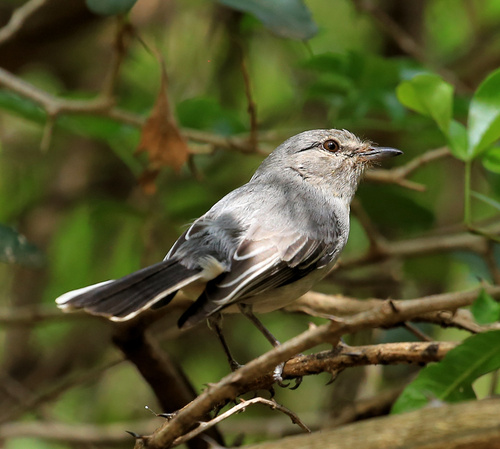
Isabelline Wheatear

Isabelline Wheatear

Oenanthe isabellina

Silhouette: PhyloPic

LCLeast ConcernNTVUENCR
Daily sighting probability <5% · Rare
at Queen Elizabeth National Park

In 3 days <5% in a week ~10%

10 Verified sightings at Queen Elizabeth National Park From 2019 to 2026
2,003 In all 21 parks
November Best month
☀️ Diurnal When it's spotted

About the Isabelline Wheatear

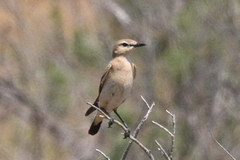
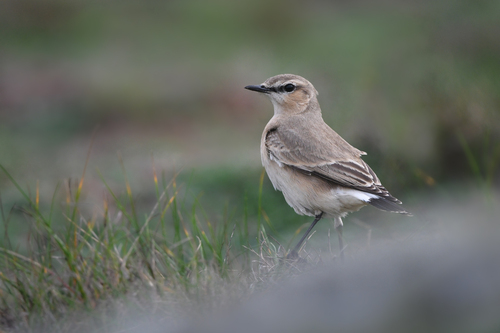
The isabelline wheatear (Oenanthe isabellina) is a small passerine bird that was formerly classed as a member of the thrush family Turdidae, but is now more generally considered to be an Old World flycatcher in the family Muscicapidae. It is a migratory insectivorous bird. Its habitat is steppe and open countryside and it breeds in southern Russia and Central Asia to northern Pakistan, wintering in Africa and northwestern India. It is a very rare vagrant to western Europe.

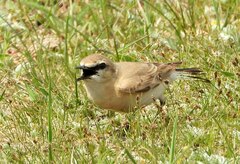
In colouring it resembles a female northern wheatear but it is larger at 15–16.5 centimetres (5.9–6.5 in) in length, more upright and more tawny in colour, and has more black on its tail. The term isabelline refers to the parchment-like colouration. The axillaries and underwing coverts are white, whereas in the commoner bird they are mottled with grey. The sexes are similar.

The name is from the specific isabellinus, Neo-Latin for "greyish-yellow", and is likely in reference to Isabella I of Castile, who is said to have promised not to change her undergarments until Spain was freed from the Moors. "Wheatear" is not derived from "wheat" or any sense of "ear", but is a 16th-century linguistic... Wikipedia →
Sounds

Song0:27

Kazakhstan · 2025

© Frank Lambert · XC1029691 · CC BY-NC-ND 4.0

Call1:18

Mongolia · 2025

© Richard E. Webster · XC1028210 · CC BY-NC-SA 4.0

Song and call0:34

Kazakhstan · 2023

© Peter Boesman · XC813540 · CC BY-NC-ND 4.0

Global Distribution

Parks Where Found

# Park Country Daily sighting probability
1 Gobi Gurvansaikhan National Park 🇲🇳 Mongolia
~70%
2 Awash National Park 🇪🇹 Ethiopia
~60%
3 Samburu National Reserve 🇰🇪 Kenya
~20%
4 Tsavo East National Park 🇰🇪 Kenya
~20%
5 Kidepo Valley National Park 🇺🇬 Uganda
~10%
6 Amboseli National Park 🇰🇪 Kenya
~10%
7 Nairobi National Park 🇰🇪 Kenya
~10%
8 Tsavo West National Park 🇰🇪 Kenya
~10%
9 Meru National Park 🇰🇪 Kenya
~10%
10 Masai Mara National Reserve 🇰🇪 Kenya
~10%
11 Ngorongoro Conservation Area 🇹🇿 Tanzania
~10%
12 Serengeti National Park 🇹🇿 Tanzania
~10%
13 Murchison Falls National Park 🇺🇬 Uganda
<5%
14 Lake Nakuru National Park 🇰🇪 Kenya
<5%
15 Aberdare National Park 🇰🇪 Kenya
<5%
16 Tarangire National Park 🇹🇿 Tanzania
<5%
17 Queen Elizabeth National Park 🇺🇬 Uganda
<5%
18 Ranthambore National Park 🇮🇳 India
<5%
19 Camargue 🇫🇷 France
<5%
20 Keoladeo National Park 🇮🇳 India
<5%
21 Wadden Sea National Park 🇩🇪 Germany
<5%

Cities Where Found

# City Country Daily sighting probability
1 Kuwait City 🇰🇼 Kuwait
~10%
2 Riyadh 🇸🇦 Saudi Arabia
~10%
3 Doha 🇶🇦 Qatar
~10%
4 Manama 🇧🇭 Bahrain
~10%
5 Ulaanbaatar 🇲🇳 Mongolia
~10%
6 Beirut 🇱🇧 Lebanon
~10%
7 Tel Aviv 🇮🇱 Israel
~10%
8 Abu Dhabi 🇦🇪 United Arab Emirates
<5%
9 Taipei 🇹🇼 Taiwan
<5%
10 Addis Ababa 🇪🇹 Ethiopia
<5%

Before you go

What are the chances of seeing an Isabelline Wheatear in Queen Elizabeth National Park?

Rare

Under 5% of wildlife watchers report an Isabelline Wheatear sighting in Queen Elizabeth National Park on a given day, based on 10 verified sightings from GBIF citizen-science data from 2019 to 2026. It is the 363rd most-seen of the 434 birds we can rate there. Over three days the chance rises to under 5%, and over a week to about 10%, if each day is a fresh chance.

When is the best time to see an Isabelline Wheatear in Queen Elizabeth National Park?

November

In that month about 10% of wildlife watchers report an Isabelline Wheatear in Queen Elizabeth National Park on a given day, against under 5% in December to October, the lowest months. That is one of Queen Elizabeth National Park's wettest months, with about 110 mm of rain against 15 mm in January.

What time of day is best to see an Isabelline Wheatear?

Between 11 am and 2 pm

Across all the parks we cover, that three-hour window holds the most Isabelline Wheatear sightings with a recorded time, and about 8 in 10 of them come between 6 am and 6 pm: it is a daytime animal.

Where does the Isabelline Wheatear sighting chance come from?

GBIF citizen-science records

It is estimated from how often the Isabelline Wheatear is recorded against all the birds logged in Queen Elizabeth National Park (10 verified sightings from 2019 to 2026), calibrated against known sighting rates. Figures are rounded to the nearest 10% because citizen-science data supports honest approximations, not decimals, and months with records from fewer than five people show "—". How it works.

← Back to Queen Elizabeth National Park