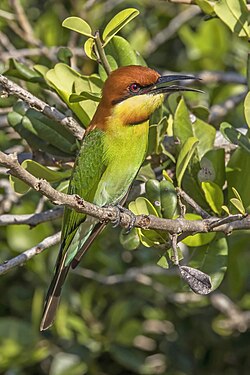
Chestnut-headed Bee-eater

Chestnut-headed Bee-eater

Merops leschenaulti

Silhouette: Sheatherius · PhyloPic

LCLeast ConcernNTVUENCR
Daily sighting probability ~50% · Likely
at Bali Barat National Park

In 3 days ~90% in a week >90%

586 Verified sightings at Bali Barat National Park From 2019 to 2026
7,897 In all 22 parks
July Best month
☀️ Diurnal When it's spotted

About the Chestnut-headed Bee-eater

The chestnut-headed bee-eater (Merops leschenaulti), or bay-headed bee-eater, is a bird in the bee-eater family Meropidae. It breeds on the Indian subcontinent and adjoining regions, ranging from India, Bangladesh and Sri Lanka across Southeast Asia to Indonesia.

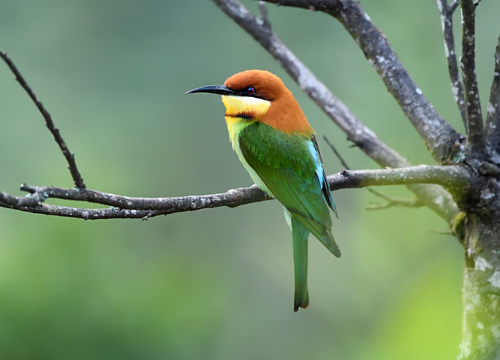
This species, like other bee-eaters, is a richly coloured, slender bird. It is predominantly green, with blue on the rump and lower belly. Its face and throat are yellow with a black eye stripe, and the crown and nape are rich chestnut. The thin curved bill is black. Sexes are alike, but young birds are duller. It is 18–20 cm long and lacks the two elongated central tail feathers possessed by most of its relatives.

The chestnut-headed bee-eater was formally described in 1817 by the French ornithologist Louis Pierre Vieillot under the current binomial name Merops leschenaulti. He specified the locality as Java. This was an error as this species does not occur there, and the locality has been designated as Sri Lanka. The specific epithet was chosen to honour the French naturalist and collector Jean-Baptiste Leschenault de La Tour who had brought Vieillot's specimen to France.

Three subspecies are recognised: M... Wikipedia →
Sounds

Call0:08

India · 2025

© Lim Ying Hien · XC987157 · CC BY-NC-ND 4.0

Song0:41

Thailand · 2024

© Greg Irving · XC943194 · CC BY-NC-SA 4.0

Flight call0:32

Thailand · 2023

© Alain Verneau · XC819736 · CC BY-NC-SA 4.0

Global Distribution

Parks Where Found

# Park Country Daily sighting probability
1 Bali Barat National Park 🇮🇩 Indonesia
~50%
2 Royal Bardia National Park 🇳🇵 Nepal
~40%
3 Khao Yai National Park 🇹🇭 Thailand
~40%
4 Kaziranga National Park 🇮🇳 India
~30%
5 Yala National Park 🇱🇰 Sri Lanka
~30%
6 Wilpattu National Park 🇱🇰 Sri Lanka
~30%
7 Periyar National Park 🇮🇳 India
~30%
8 Chitwan National Park 🇳🇵 Nepal
~30%
9 Kaeng Krachan National Park 🇹🇭 Thailand
~20%
10 Royal Manas National Park 🇧🇹 Bhutan
~20%
11 Manas National Park 🇮🇳 India
~20%
12 Udawalawe National Park 🇱🇰 Sri Lanka
~20%
13 Jim Corbett National Park 🇮🇳 India
~20%
14 Nagarhole National Park 🇮🇳 India
~20%
15 Cat Tien National Park 🇻🇳 Vietnam
~10%
16 Bandipur National Park 🇮🇳 India
~10%
17 Khao Sok National Park 🇹🇭 Thailand
~10%
18 Doi Inthanon National Park 🇹🇭 Thailand
~10%
19 Eravikulam National Park 🇮🇳 India
~10%
20 Minneriya National Park 🇱🇰 Sri Lanka
~10%
21 Mudumalai National Park 🇮🇳 India
<5%
22 Sinharaja Forest Reserve 🇱🇰 Sri Lanka
<5%

Cities Where Found

# City Country Daily sighting probability
1 Thrissur 🇮🇳 India
~10%
2 Dehradun 🇮🇳 India
<5%
3 Kozhikode 🇮🇳 India
<5%
4 Kathmandu 🇳🇵 Nepal
<5%
5 Guwahati 🇮🇳 India
<5%
6 Thiruvananthapuram 🇮🇳 India
<5%
7 Denpasar 🇮🇩 Indonesia
<5%
8 Dhaka 🇧🇩 Bangladesh
<5%
9 Ponnani 🇮🇳 India
<5%
10 Coimbatore 🇮🇳 India
<5%

Before you go

What are the chances of seeing a Chestnut-headed Bee-eater in Bali Barat National Park?

Likely

About 50% of wildlife watchers report a Chestnut-headed Bee-eater sighting in Bali Barat National Park on a given day, based on 586 verified sightings from GBIF citizen-science data from 2019 to 2026. It is the 12th most-seen of the 173 birds we can rate there. Over three days the chance rises to about 90%, and over a week to over 90%, if each day is a fresh chance.

When is the best time to see a Chestnut-headed Bee-eater in Bali Barat National Park?

July

In that month about 70% of wildlife watchers report a Chestnut-headed Bee-eater in Bali Barat National Park on a given day, against about 20% in December, the lowest month. That is one of Bali Barat National Park's driest months, with about 25 mm of rain against 280 mm in February.

What time of day is best to see a Chestnut-headed Bee-eater?

Between 6 and 9 am

Across all the parks we cover, that three-hour window holds the most Chestnut-headed Bee-eater sightings with a recorded time, and about 9 in 10 of them come between 6 am and 6 pm: it is a daytime animal.

Is Bali Barat National Park the best place to see a Chestnut-headed Bee-eater?

Yes

Of the 22 parks where we can rate Chestnut-headed Bee-eater sightings, Bali Barat National Park has the highest daily chance: about 50%. Next come Royal Bardia National Park (Nepal, about 40%) and Khao Yai National Park (Thailand, about 40%). All parks ranked.

Where does the Chestnut-headed Bee-eater sighting chance come from?

GBIF citizen-science records

It is estimated from how often the Chestnut-headed Bee-eater is recorded against all the birds logged in Bali Barat National Park (586 verified sightings from 2019 to 2026), calibrated against known sighting rates. Figures are rounded to the nearest 10% because citizen-science data supports honest approximations, not decimals, and months with records from fewer than five people show "—". How it works.

← Back to Bali Barat National Park