


Completed


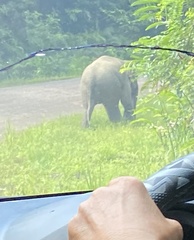

Asian Elephant
Elephas maximus
Silhouette: T. Michael Keesey · PhyloPic
- KingdomAnimalia (Animals)
- PhylumChordata (Chordates)
- ClassMammalia (Mammals)
- OrderProboscidea (Proboscideans)
- FamilyElephantidae (Elephants)
- GenusElephas (Asian Elephants)
- SpeciesElephas maximus (Asian Elephant)
In 3 days ~80% in a week >90%
13 Verified sightings at Bandhavgarh National Park From 2019 to 2026
2,996 In all 25 parks
February Best month
☀️ Diurnal When it's spotted


Completed
About the Asian Elephant
The Asian elephant (Elephas maximus), also known as the Asiatic elephant, is the only living species in the genus Elephas. It is the largest living land animal in Asia and the second largest living elephantid in the world. It is characterised by its long trunk with a single finger-like process; large tusks in males; laterally folded large ears and wrinkled grey skin that is partly depigmented on the trunk, ears or neck. Adult males average 4 t (4.4 short tons) in weight and females 2.7 t (3.0 short tons). It has a large and well developed neocortex of the brain, is highly intelligent and self-aware, being able to display behaviours associated with grief, learning and greeting.
The Asian elephant is distributed in the Indian subcontinent and Southeast Asia, from India in the west to Borneo in the east, and Nepal in the north to Sumatra in the south. It inhabits grasslands, tropical evergreen forests, semi-evergreen forests, moist deciduous forests, dry deciduous forests and dry thorn forests. It is herbivorous, eating about 150 kg (330 lb) of vegetation per day. Cows and calves form groups, while males remain solitary or form "bachelor groups" with other males. During the breeding season, males temporarily join female groups to mate. Wild Asian elephants live to be about 60 years old. While female captive elephants are recorded to have lived beyond 60 years when kept in semi-natural surroundings, Asian elephants die at a much younger age in captivity; captive populations are declining due to a low birth and high death rate.
Since 1986, the Asian elephant has been listed as Endangered on the IUCN Red List, as the population has declined by at least 50% over the last three elephant generations, which is about 60–75 years. It is primarily threatened by loss of habitat, habitat degradation, fragmentation and poaching. The earliest indications of captive use of Asian elephants are engravings on seals of the Indus Valley civilisation dated to the 3rd millennium BC. Wikipedia →
Sounds
Call0:08
Malaysia · 2015
© Marc Anderson · XC960777 · CC BY-NC-ND 4.0
Recording0:17
Malaysia · 2024
© Varun Mansinghka · iNaturalist · CC BY-NC 4.0
Recording0:33
Malaysia · 2026
© Michael Tervo · iNaturalist · CC BY-NC 4.0
Recent sightings of Asian Elephant in Bandhavgarh National Park
LIVEiNaturalistGlobal Distribution
Parks Where Found
Zoos & Centres Where Found
Closest Relatives at Bandhavgarh National Park
No species of the same family or order lives in Bandhavgarh National Park, so these are its closest relatives here: other mammals.






Before you go
What are the chances of seeing an Asian Elephant in Bandhavgarh National Park?
Likely
About 40% of wildlife watchers report an Asian Elephant sighting in Bandhavgarh National Park on a given day, based on 13 verified sightings from GBIF citizen-science data from 2019 to 2026. It is the 10th most-seen of the 14 mammals we can rate there. Over three days the chance rises to about 80%, and over a week to over 90%, if each day is a fresh chance.
When is the best time to see an Asian Elephant in Bandhavgarh National Park?
February
In that month about 60% of wildlife watchers report an Asian Elephant in Bandhavgarh National Park on a given day, against under 5% in January, the lowest month. That is one of Bandhavgarh National Park's driest months, with about 15 mm of rain against 400 mm in August. August and September have too few records to rate.
What time of day is best to see an Asian Elephant?
Between noon and 3 pm
Across all the parks we cover, that three-hour window holds the most Asian Elephant sightings with a recorded time, and about 7 in 10 of them come between 6 am and 6 pm: it is a daytime animal.
Is Bandhavgarh National Park the best place to see an Asian Elephant?
17th of 25
Of the 25 parks where we can rate Asian Elephant sightings, Bandhavgarh National Park ranks 17th at about 40%. The best odds are in Udawalawe National Park (Sri Lanka, about 90%), Yala National Park (Sri Lanka, about 90%) and Bandipur National Park (India, about 80%). All parks ranked.
Where does the Asian Elephant sighting chance come from?
GBIF citizen-science records
It is estimated from how often the Asian Elephant is recorded against all the mammals logged in Bandhavgarh National Park (13 verified sightings from 2019 to 2026), calibrated against known sighting rates. Figures are rounded to the nearest 10% because citizen-science data supports honest approximations, not decimals, and months with records from fewer than five people show "—". How it works.
