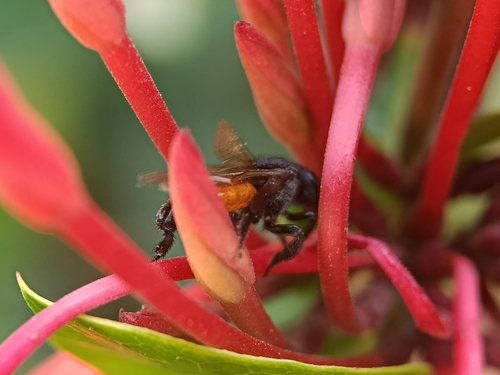
Red-Tailed Stingless Bee

Red-Tailed Stingless Bee

Trigona fulviventris

Daily sighting probability ~10% · With luck
at Bastimentos Island National Marine Park

In 3 days ~30% in a week ~60%

6 Verified sightings at Bastimentos Island National Marine Park From 2019 to 2026
367 In all 19 parks
August Best month
☀️ Diurnal When it's spotted

About the Red-Tailed Stingless Bee

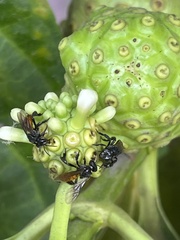
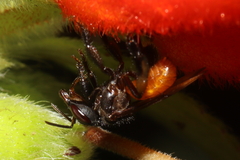
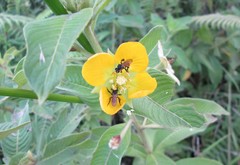
Trigona fulviventris, known by the common names culo-de-vaca, culo-de-señora, mu'ul-kab, culo-de-buey, and culo-de-vieja, is a species of stingless bee found in Mexico and neotropical regions of Central and South America. It is one of the largest and most widespread bees of its genus. They exhibit complex foraging behaviors by integrating spatio-temporal learning and flower scents. T. fulviventris has traditionally been observed to abstain from aggressive behavior with other species; however, more recent analyses have shown that T. fulviventris emit pheromones that act as attack signals particularly when related individuals are captured by predators.

Trigona fulviventris was first described by Félix Édouard Guérin-Méneville in 1845. It is a member of the order Hymenoptera, which includes ants, bees, wasps, and sawflies and part of the family Apidae, which includes other bees such as bumble bees, honey bees, and orchid bees. It is further categorized in the genus Trigona, a genus of stingless bees.

These subspecies are distinguished by coloration; morphological studies... Wikipedia →
Global Distribution

Parks Where Found

# Park Country Daily sighting probability
1 Monteverde Cloud Forest Reserve 🇨🇷 Costa Rica
~30%
2 Rincón de la Vieja National Park 🇨🇷 Costa Rica
~20%
3 Tikal National Park 🇬🇹 Guatemala
~20%
4 Tortuguero National Park 🇨🇷 Costa Rica
~20%
5 Biotopo Cerro Cahuí 🇬🇹 Guatemala
~20%
6 Corcovado National Park 🇨🇷 Costa Rica
~10%
7 Piedras Blancas National Park 🇨🇷 Costa Rica
~10%
8 Manuel Antonio National Park 🇨🇷 Costa Rica
~10%
9 Santa Rosa National Park 🇨🇷 Costa Rica
~10%
10 Soberanía National Park 🇵🇦 Panama
~10%
11 Bastimentos Island National Marine Park 🇵🇦 Panama
~10%
12 Tenorio Volcano National Park 🇨🇷 Costa Rica
~10%
13 Chirripó National Park 🇨🇷 Costa Rica
~10%
14 Carara National Park 🇨🇷 Costa Rica
~10%
15 Calakmul Biosphere Reserve 🇲🇽 Mexico
~10%
16 Braulio Carrillo National Park 🇨🇷 Costa Rica
~10%
17 Arenal Volcano National Park 🇨🇷 Costa Rica
~10%
18 La Amistad International Park (Panama) 🇵🇦 Panama
~10%
19 Parque Natural Metropolitano 🇵🇦 Panama
<5%

Cities Where Found

# City Country Daily sighting probability
1 Guatemala City 🇬🇹 Guatemala
~50%
2 San Pedro Sula 🇭🇳 Honduras
~20%
3 San José 🇨🇷 Costa Rica
~10%
4 San Salvador 🇸🇻 El Salvador
~10%
5 Panama City 🇵🇦 Panama
~10%

Before you go

What are the chances of seeing a Red-Tailed Stingless Bee in Bastimentos Island National Marine Park?

With luck

About 10% of wildlife watchers report a Red-Tailed Stingless Bee sighting in Bastimentos Island National Marine Park on a given day, based on 6 verified sightings from GBIF citizen-science data from 2019 to 2026. It is the 36th most-seen of the 52 insects we can rate there. Over three days the chance rises to about 30%, and over a week to about 60%, if each day is a fresh chance.

When is the best time to see a Red-Tailed Stingless Bee in Bastimentos Island National Marine Park?

January, June, August and October

In those months about 20% of wildlife watchers report a Red-Tailed Stingless Bee in Bastimentos Island National Marine Park on a given day, against under 5% in March–May, July, September and November–December, the lowest months.

What time of day is best to see a Red-Tailed Stingless Bee?

Between 9 am and noon

Across all the parks we cover, that three-hour window holds the most Red-Tailed Stingless Bee sightings with a recorded time, and about 9 in 10 of them come between 6 am and 6 pm: it is a daytime animal.

Is Bastimentos Island National Marine Park the best place to see a Red-Tailed Stingless Bee?

11th of 19

Of the 19 parks where we can rate Red-Tailed Stingless Bee sightings, Bastimentos Island National Marine Park ranks 11th at about 10%. The best odds are in Monteverde Cloud Forest Reserve (Costa Rica, about 30%), Rincón de la Vieja National Park (Costa Rica, about 20%) and Tikal National Park (Guatemala, about 20%).

Which relatives of the Red-Tailed Stingless Bee live in Bastimentos Island National Marine Park?

Same order: Hymenoptera

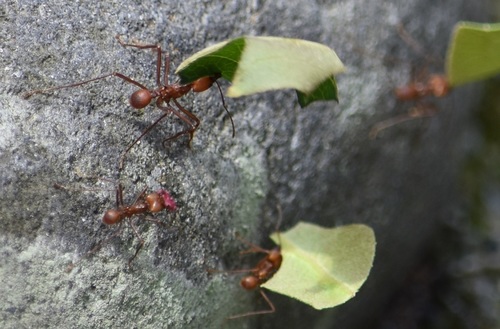
The closest relatives of the Red-Tailed Stingless Bee that you can see in Bastimentos Island National Marine Park (order Hymenoptera, Ants, Bees, Wasps, and Sawflies) are Hairy-Headed Leafcutter Ant (about 30%), Shimmering Golden Sugar Ant (about 20%) and Red-Headed Paper Wasp (about 20%), with each one's daily chance of a sighting.

Where does the Red-Tailed Stingless Bee sighting chance come from?

GBIF citizen-science records

It is estimated from how often the Red-Tailed Stingless Bee is recorded against all the insects logged in Bastimentos Island National Marine Park (6 verified sightings from 2019 to 2026), calibrated against known sighting rates. Figures are rounded to the nearest 10% because citizen-science data supports honest approximations, not decimals, and months with records from fewer than five people show "—". How it works.

← Back to Bastimentos Island National Marine Park