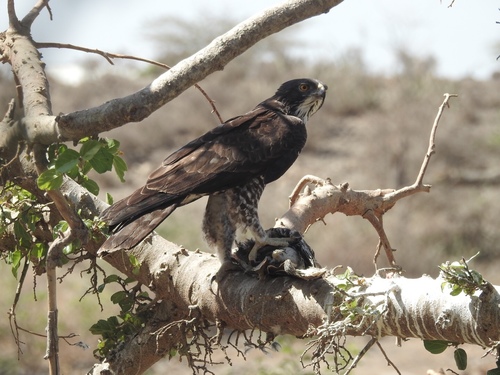
Gabar Goshawk

Gabar Goshawk

Micronisus gabar

Silhouette: Sheatherius · PhyloPic

LCLeast ConcernNTVUENCR
Daily sighting probability <5% · Rare
at Bwindi Impenetrable National Park

In 3 days <5%

8 Verified sightings at Bwindi Impenetrable National Park From 2019 to 2026
3,109 In all 43 parks
November Best month
☀️ Diurnal When it's spotted

About the Gabar Goshawk

The gabar goshawk (Micronisus gabar) is a small species of African and Arabian bird of prey in the family Accipitridae. The gabar goshawk is polymorphic and occurs in two distinct forms which fluctuate in relative abundance across the geographic range of the species. The more frequent, paler form has mostly grey upperparts with a conspicuous, white rump and white and grey barring on the chest, thighs and underwings, and a dark grey, barred tail. In contrast, the less frequent form, which accounts on average for approximately 25 percent of the overall population, is almost completely black. In both forms of adult the eyes are dark, and the legs are long and the cere is red. The cere and the legs are yellow in immatures and the plumage is generally browner, with the pale birds having untidier barring on the chest than the adult. The females are significantly larger than the males, the male's weigh 90 – 173g and the females 167 – 240g. The body length is 28–36 cm and the wingspan 63 cm.

The gabar goshawk is found in sub-Saharan Africa, extending to Arabian Peninsula. These subspecies are currently recognised: M. g. aequatorius: highlands... Wikipedia →

Sounds

Call0:09

South Africa · 2026

© Marna Buys · XC1100393 · CC BY-NC-SA 4.0

Call0:26

Burkina Faso · 2025

© Marc Languy · XC1009409 · CC BY-NC-SA 4.0

Call0:08

South Africa · 2023

© Marc Anderson · XC876164 · CC BY-NC-ND 4.0

Global Distribution

Parks Where Found

# Park Country Daily sighting probability
1 Kgalagadi Transfrontier Park 🇿🇦 South Africa
~30%
2 Etosha National Park 🇳🇦 Namibia
~20%
3 Samburu National Reserve 🇰🇪 Kenya
~20%
4 Nairobi National Park 🇰🇪 Kenya
~20%
5 Mkomazi National Park 🇹🇿 Tanzania
~10%
6 Tarangire National Park 🇹🇿 Tanzania
~10%
7 Tsavo East National Park 🇰🇪 Kenya
~10%
8 Tsavo West National Park 🇰🇪 Kenya
~10%
9 Hwange National Park 🇿🇼 Zimbabwe
~10%
10 Serengeti National Park 🇹🇿 Tanzania
~10%
11 Kidepo Valley National Park 🇺🇬 Uganda
~10%
12 Pilanesberg National Park 🇿🇦 South Africa
~10%
13 Chobe National Park 🇧🇼 Botswana
~10%
14 Moremi Game Reserve 🇧🇼 Botswana
~10%
15 Niokolo-Koba National Park 🇸🇳 Senegal
~10%
16 Mana Pools National Park 🇿🇼 Zimbabwe
~10%
17 Lake Nakuru National Park 🇰🇪 Kenya
~10%
18 Ngorongoro Conservation Area 🇹🇿 Tanzania
~10%
19 Gonarezhou National Park 🇿🇼 Zimbabwe
~10%
20 Ruaha National Park 🇹🇿 Tanzania
~10%
21 Lower Zambezi National Park 🇿🇲 Zambia
~10%
22 South Luangwa National Park 🇿🇲 Zambia
~10%
23 Akagera National Park 🇷🇼 Rwanda
~10%
24 Meru National Park 🇰🇪 Kenya
~10%
25 Masai Mara National Reserve 🇰🇪 Kenya
<5%
26 Waterberg Plateau Park 🇳🇦 Namibia
<5%
27 Awash National Park 🇪🇹 Ethiopia
<5%
28 Kruger National Park 🇿🇦 South Africa
<5%
29 Mikumi National Park 🇹🇿 Tanzania
<5%
30 Kafue National Park 🇿🇲 Zambia
<5%
31 Amboseli National Park 🇰🇪 Kenya
<5%
32 Lake Mburo National Park 🇺🇬 Uganda
<5%
33 Queen Elizabeth National Park 🇺🇬 Uganda
<5%
34 Gorongosa National Park 🇲🇿 Mozambique
<5%
35 uMkhuze Game Reserve 🇿🇦 South Africa
<5%
36 Liwonde National Park 🇲🇼 Malawi
<5%
37 Lake Manyara National Park 🇹🇿 Tanzania
<5%
38 Aberdare National Park 🇰🇪 Kenya
<5%
39 Murchison Falls National Park 🇺🇬 Uganda
<5%
40 Arusha National Park 🇹🇿 Tanzania
<5%
41 iSimangaliso Wetland Park 🇿🇦 South Africa
<5%
42 Kibale National Park 🇺🇬 Uganda
<5%
43 Bwindi Impenetrable National Park 🇺🇬 Uganda
<5%

Cities Where Found

# City Country Daily sighting probability
1 Maiduguri 🇳🇬 Nigeria
~60%
2 Ouagadougou 🇧🇫 Burkina Faso
~30%
3 N'Djamena 🇹🇩 Chad
~20%
4 Harare 🇿🇼 Zimbabwe
~20%
5 Lusaka 🇿🇲 Zambia
~10%
6 Kigali 🇷🇼 Rwanda
~10%
7 Abuja 🇳🇬 Nigeria
<5%
8 Kampala 🇺🇬 Uganda
<5%
9 Accra 🇬🇭 Ghana
<5%
10 Nairobi 🇰🇪 Kenya
<5%

Before you go

What are the chances of seeing a Gabar Goshawk in Bwindi Impenetrable National Park?

Rare

Under 5% of wildlife watchers report a Gabar Goshawk sighting in Bwindi Impenetrable National Park on a given day, based on 8 verified sightings from GBIF citizen-science data from 2019 to 2026. It is the 382nd most-seen of the 400 birds we can rate there. Over three days the chance rises to under 5%, if each day is a fresh chance.

When is the best time to see a Gabar Goshawk in Bwindi Impenetrable National Park?

Any time of year

In every month with enough records, under 5% of wildlife watchers report a Gabar Goshawk in Bwindi Impenetrable National Park on a given day, so our monthly data shows no clear season.

What time of day is best to see a Gabar Goshawk?

Between 7 and 10 am

Across all the parks we cover, that three-hour window holds the most Gabar Goshawk sightings with a recorded time, and about 9 in 10 of them come between 6 am and 6 pm: it is a daytime animal.

Is Bwindi Impenetrable National Park the best place to see a Gabar Goshawk?

43rd of 43

Of the 43 parks where we can rate Gabar Goshawk sightings, Bwindi Impenetrable National Park ranks 43rd at under 5%. The best odds are in Kgalagadi Transfrontier Park (South Africa, about 30%), Etosha National Park (Namibia, about 20%) and Samburu National Reserve (Kenya, about 20%).

Which relatives of the Gabar Goshawk live in Bwindi Impenetrable National Park?

Same family: Accipitridae

The closest relatives of the Gabar Goshawk that you can see in Bwindi Impenetrable National Park (family Accipitridae, Hawks, Eagles, and Kites) are Augur Buzzard (about 20%), African Harrier-Hawk (about 10%) and Mountain Buzzard (about 10%), with each one's daily chance of a sighting.

Where does the Gabar Goshawk sighting chance come from?

GBIF citizen-science records

It is estimated from how often the Gabar Goshawk is recorded against all the birds logged in Bwindi Impenetrable National Park (8 verified sightings from 2019 to 2026), calibrated against known sighting rates. Figures are rounded to the nearest 10% because citizen-science data supports honest approximations, not decimals, and months with records from fewer than five people show "—". How it works.

← Back to Bwindi Impenetrable National Park