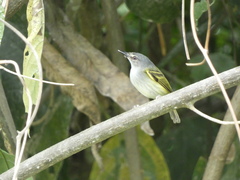
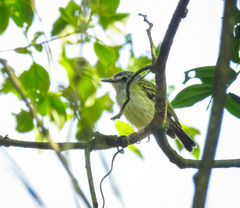
Slate-headed Tody-Flycatcher

Slate-headed Tody-Flycatcher

Poecilotriccus sylvia

Silhouette: Emily Willoughby · PhyloPic

LCLeast ConcernNTVUENCR
Daily sighting probability ~10% · With luck
at Cerro Azul Meámbar National Park

In 3 days ~20% in a week ~40%

62 Verified sightings at Cerro Azul Meámbar National Park From 2019 to 2026
1,398 In all 28 parks
June Best month
☀️ Diurnal When it's spotted

About the Slate-headed Tody-Flycatcher

The slaty-headed tody-flycatcher, or slate-headed tody-flycatcher, (Poecilotriccus sylvia) is a species of bird in the family Tyrannidae, the tyrant flycatchers. It is found in Belize, Brazil, Colombia, Costa Rica, Guatemala, Guyana, Honduras, Mexico, Nicaragua, Panama, Venezuela, and possibly French Guiana.

The slaty-headed tody-flycatcher was originally described in 1806 as Todus Sylvia. It was later moved to genus Todirostrum. Following a 1988 publication, taxonomic systems moved sylvia and several other species from Todirostrum to genus Poecilotriccus. By the early twenty-first century genus Poecilotriccus had species called both "tody-tyrant" and "tody-flycatcher" so taxonomic systems began renaming the "tyrants" to "flycatcher". The slaty-headed tody-flycatcher shares genus Poecilotriccus with 11 other species.

The slaty-headed tody-flycatcher has these five subspecies: Subspecies P. s. schistaceiceps was originally described as a full species and at least one twentieth century... Wikipedia →

Sounds

Song0:12

Colombia · 2024

© Esteban Ramos · XC1166475 · CC BY-NC-SA 4.0

Call0:37

Brazil · 2025

© JAYRSON ARAUJO DE OLIVEIRA · XC1035586 · CC BY-NC-SA 4.0

Song0:05

Venezuela · 2023

© Francisco contreras · XC838486 · CC BY-NC-SA 4.0

Global Distribution

Parks Where Found

# Park Country Daily sighting probability
1 Santa Rosa National Park 🇨🇷 Costa Rica
~10%
2 Cerro Azul Meámbar National Park 🇭🇳 Honduras
~10%
3 Montes Azules Biosphere Reserve 🇲🇽 Mexico
~10%
4 Tenorio Volcano National Park 🇨🇷 Costa Rica
~10%
5 Carara National Park 🇨🇷 Costa Rica
~10%
6 Cockscomb Basin Wildlife Sanctuary 🇧🇿 Belize
~10%
7 Cabo Blanco Absolute Nature Reserve 🇨🇷 Costa Rica
<5%
8 Sierra de la Macarena National Park 🇨🇴 Colombia
<5%
9 Piedras Blancas National Park 🇨🇷 Costa Rica
<5%
10 Biotopo Cerro Cahuí 🇬🇹 Guatemala
<5%
11 Calakmul Biosphere Reserve 🇲🇽 Mexico
<5%
12 Gandoca-Manzanillo Wildlife Refuge 🇨🇷 Costa Rica
<5%
13 Tikal National Park 🇬🇹 Guatemala
<5%
14 Henri Pittier National Park 🇻🇪 Venezuela
<5%
15 Corcovado National Park 🇨🇷 Costa Rica
<5%
16 Rincón de la Vieja National Park 🇨🇷 Costa Rica
<5%
17 Ostional Wildlife Refuge 🇨🇷 Costa Rica
<5%
18 Pico Bonito National Park 🇭🇳 Honduras
<5%
19 Las Baulas Marine National Park 🇨🇷 Costa Rica
<5%
20 Cahuita National Park 🇨🇷 Costa Rica
<5%
21 Arenal Volcano National Park 🇨🇷 Costa Rica
<5%
22 La Amistad International Park (Panama) 🇵🇦 Panama
<5%
23 Farallones de Cali National Natural Park 🇨🇴 Colombia
<5%
24 Chagres National Park 🇵🇦 Panama
<5%
25 Chirripó National Park 🇨🇷 Costa Rica
<5%
26 Braulio Carrillo National Park 🇨🇷 Costa Rica
<5%
27 Soberanía National Park 🇵🇦 Panama
<5%
28 Parque Natural Metropolitano 🇵🇦 Panama
<5%

Cities Where Found

# City Country Daily sighting probability
1 Cali 🇨🇴 Colombia
<5%
2 Belém 🇧🇷 Brazil
<5%
3 Panama City 🇵🇦 Panama
<5%

Before you go

What are the chances of seeing a Slate-headed Tody-Flycatcher in Cerro Azul Meámbar National Park?

With luck

About 10% of wildlife watchers report a Slate-headed Tody-Flycatcher sighting in Cerro Azul Meámbar National Park on a given day, based on 62 verified sightings from GBIF citizen-science data from 2019 to 2026. It is the 157th most-seen of the 293 birds we can rate there. Over three days the chance rises to about 20%, and over a week to about 40%, if each day is a fresh chance.

When is the best time to see a Slate-headed Tody-Flycatcher in Cerro Azul Meámbar National Park?

June

In that month about 20% of wildlife watchers report a Slate-headed Tody-Flycatcher in Cerro Azul Meámbar National Park on a given day, against under 5% in February, July and November–December, the lowest months. That is one of Cerro Azul Meámbar National Park's wettest months, with about 310 mm of rain against 80 mm in February.

What time of day is best to see a Slate-headed Tody-Flycatcher?

Between 7 and 10 am

Across all the parks we cover, that three-hour window holds the most Slate-headed Tody-Flycatcher sightings with a recorded time, and nearly all of them come between 6 am and 6 pm: it is a daytime animal.

Is Cerro Azul Meámbar National Park the best place to see a Slate-headed Tody-Flycatcher?

Among the best

Of the 28 parks where we can rate Slate-headed Tody-Flycatcher sightings, Cerro Azul Meámbar National Park ranks 2nd at about 10%, level with the leaders once rounded. The best odds are in Santa Rosa National Park (Costa Rica, about 10%).

Which relatives of the Slate-headed Tody-Flycatcher live in Cerro Azul Meámbar National Park?

Same family: Tyrannidae

The closest relatives of the Slate-headed Tody-Flycatcher that you can see in Cerro Azul Meámbar National Park (family Tyrannidae, Tyrant Flycatchers) are Social Flycatcher (about 60%), Great Kiskadee (about 60%) and Tropical Kingbird (about 50%), with each one's daily chance of a sighting.

Where does the Slate-headed Tody-Flycatcher sighting chance come from?

GBIF citizen-science records

It is estimated from how often the Slate-headed Tody-Flycatcher is recorded against all the birds logged in Cerro Azul Meámbar National Park (62 verified sightings from 2019 to 2026), calibrated against known sighting rates. Figures are rounded to the nearest 10% because citizen-science data supports honest approximations, not decimals, and months with records from fewer than five people show "—". How it works.

← Back to Cerro Azul Meámbar National Park