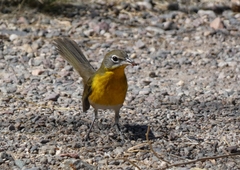
Yellow-breasted Chat

Yellow-breasted Chat

Icteria virens

Silhouette: Sheatherius · PhyloPic

LCLeast ConcernNTVUENCR
Daily sighting probability ~10% · With luck
at Biotopo Cerro Cahuí

In 3 days ~40% in a week ~70%

104 Verified sightings at Biotopo Cerro Cahuí From 2019 to 2026
3,250 In all 32 parks
October Best month
☀️ Diurnal When it's spotted

About the Yellow-breasted Chat

The yellow-breasted chat (Icteria virens) is a large songbird in its own family, Icteriidae, that is found in North and Central America. It was once placed in the New World warbler family Parulidae and is occasionally placed in the similarly named New World blackbird family, Icteridae.

The yellow-breasted chat was formally described in 1758 by Swedish naturalist Carl Linnaeus in the tenth edition of his Systema Naturae. He placed it with the thrushes in the genus Turdus, coined the binomial name Turdus virens, and specified the type locality as "America". The specific epithet is Latin meaning 'green'. The locality has been restricted to South Carolina. Linnaeus based his account on the "yellow brested chat" that had been described and illustrated by the English naturalist Mark Catesby in his book The Natural History of Carolina, Florida and the Bahama Islands. It is now the only species placed in the genus Icteria that was introduced in 1808 by the French ornithologist Louis Pierre Vieillot. It is also the only species placed in the family Icteriidae that was introduced (as Icterieae) in 1858 by the American naturalist Spencer Baird.

The yellow-breasted chat was formerly... Wikipedia →

Sounds

Call0:14

United States · 2026

© Chris Harrison · XC1103428 · CC BY-NC-SA 4.0

Song0:21

United States · 2013

© Tero Linjama · XC942709 · CC BY-NC-SA 4.0

Flight call1:28

United States · 2023

© David A. Brinkman · XC807580 · CC BY-NC-SA 4.0

Global Distribution

Parks Where Found

# Park Country Daily sighting probability
1 Big Bend National Park 🇺🇸 United States
~20%
2 Biotopo Cerro Cahuí 🇬🇹 Guatemala
~10%
3 Death Valley National Park 🇺🇸 United States
~10%
4 Cockscomb Basin Wildlife Sanctuary 🇧🇿 Belize
~10%
5 Cerro Azul Meámbar National Park 🇭🇳 Honduras
~10%
6 Lago de Yojoa 🇭🇳 Honduras
~10%
7 Channel Islands National Park 🇺🇸 United States
~10%
8 Great Smoky Mountains National Park 🇺🇸 United States
~10%
9 Zion National Park 🇺🇸 United States
<5%
10 Saguaro National Park 🇺🇸 United States
<5%
11 Calakmul Biosphere Reserve 🇲🇽 Mexico
<5%
12 Tikal National Park 🇬🇹 Guatemala
<5%
13 Bahía de Loreto National Park 🇲🇽 Mexico
<5%
14 Congaree National Park 🇺🇸 United States
<5%
15 Redwood National Park 🇺🇸 United States
<5%
16 Badlands National Park 🇺🇸 United States
<5%
17 Everglades National Park 🇺🇸 United States
<5%
18 Cañón del Sumidero National Park 🇲🇽 Mexico
<5%
19 Celestún Biosphere Reserve 🇲🇽 Mexico
<5%
20 Shenandoah National Park 🇺🇸 United States
<5%
21 Sian Ka'an Biosphere Reserve 🇲🇽 Mexico
<5%
22 Grand Canyon National Park 🇺🇸 United States
<5%
23 El Vizcaíno Biosphere Reserve 🇲🇽 Mexico
<5%
24 Guadalupe Mountains National Park 🇺🇸 United States
<5%
25 Cumbres de Monterrey National Park 🇲🇽 Mexico
<5%
26 Point Pelee National Park 🇨🇦 Canada
<5%
27 Joshua Tree National Park 🇺🇸 United States
<5%
28 Arenal Volcano National Park 🇨🇷 Costa Rica
<5%
29 Grand Teton National Park 🇺🇸 United States
<5%
30 Yosemite National Park 🇺🇸 United States
<5%
31 Acadia National Park 🇺🇸 United States
<5%
32 Rocky Mountain National Park 🇺🇸 United States
<5%

Cities Where Found

# City Country Daily sighting probability
1 León 🇲🇽 México
~10%
2 Houston 🇺🇸 United States
<5%
3 Los Angeles 🇺🇸 United States
<5%
4 San Antonio 🇺🇸 United States
<5%
5 Denver 🇺🇸 United States
<5%
6 Toronto 🇨🇦 Canada
<5%
7 Guadalajara 🇲🇽 México
<5%
8 San Pedro Sula 🇭🇳 Honduras
<5%
9 San Diego 🇺🇸 United States
<5%
10 Austin 🇺🇸 United States
<5%

Zoos & Centres Where Found

# Zoo / Centre Country
1 National Zoological Park 🇺🇸 United States In captivity

Before you go

What are the chances of seeing a Yellow-breasted Chat in Biotopo Cerro Cahuí?

With luck

About 10% of wildlife watchers report a Yellow-breasted Chat sighting in Biotopo Cerro Cahuí on a given day, based on 104 verified sightings from GBIF citizen-science data from 2019 to 2026. It is the 60th most-seen of the 191 birds we can rate there. Over three days the chance rises to about 40%, and over a week to about 70%, if each day is a fresh chance.

When is the best time to see a Yellow-breasted Chat in Biotopo Cerro Cahuí?

October

In that month about 50% of wildlife watchers report a Yellow-breasted Chat in Biotopo Cerro Cahuí on a given day, against under 5% in January, the lowest month. That is one of Biotopo Cerro Cahuí's wettest months, with about 210 mm of rain against 25 mm in March.

What time of day is best to see a Yellow-breasted Chat?

Between 7 and 10 am

Across all the parks we cover, that three-hour window holds the most Yellow-breasted Chat sightings with a recorded time, and about 9 in 10 of them come between 6 am and 6 pm: it is a daytime animal.

Is Biotopo Cerro Cahuí the best place to see a Yellow-breasted Chat?

2nd of 32

Of the 32 parks where we can rate Yellow-breasted Chat sightings, Biotopo Cerro Cahuí ranks 2nd at about 10%. The best odds are in Big Bend National Park (United States, about 20%).

Which relatives of the Yellow-breasted Chat live in Biotopo Cerro Cahuí?

Same family: Parulidae

The closest relatives of the Yellow-breasted Chat that you can see in Biotopo Cerro Cahuí (family Parulidae, New World Warblers) are Magnolia Warbler (about 40%), Black-and-white Warbler (about 40%) and American Redstart (about 30%), with each one's daily chance of a sighting.

Where does the Yellow-breasted Chat sighting chance come from?

GBIF citizen-science records

It is estimated from how often the Yellow-breasted Chat is recorded against all the birds logged in Biotopo Cerro Cahuí (104 verified sightings from 2019 to 2026), calibrated against known sighting rates. Figures are rounded to the nearest 10% because citizen-science data supports honest approximations, not decimals, and months with records from fewer than five people show "—". How it works.

← Back to Biotopo Cerro Cahuí