Rufous-bellied Thrush

Rufous-bellied Thrush

Turdus rufiventris

Silhouette: Abraão Leite · PhyloPic

LCLeast ConcernNTVUENCR
Daily sighting probability ~10% · With luck
at Belo Horizonte

In 3 days ~40% in a week ~70%

242 Verified sightings at Belo Horizonte
10,505 In all 14 parks From 2019 to 2026
August Best month
☀️ Diurnal When it's spotted

About the Rufous-bellied Thrush

The rufous-bellied thrush (Turdus rufiventris) is a songbird of the thrush family (Turdidae). Its distribution covers most of eastern and southeastern Brazil from the states of Maranhão south to Rio Grande do Sul, Bolivia, Paraguay, Uruguay, and central regions of Argentina.

It is one of the most common birds across much of southeastern Brazil, and is known there under the name sabiá-laranjeira (Portuguese pronunciation: [sabiˈa laɾɐ̃ˈʒejɾɐ]). It was famously referred to in the well-known first strophe of the Brazilian nationalist poem Canção do Exílio. The rufous-bellied thrush has been the state bird of São Paulo since 1966, and the national bird of Brazil since 2002. It is highly regarded in Brazil, where its song is often heard in the afternoons, but specially during the nights between August and November, where thousands of them sing until the sunrise, and is often seen as "the spirit of the Brazilian commoner".

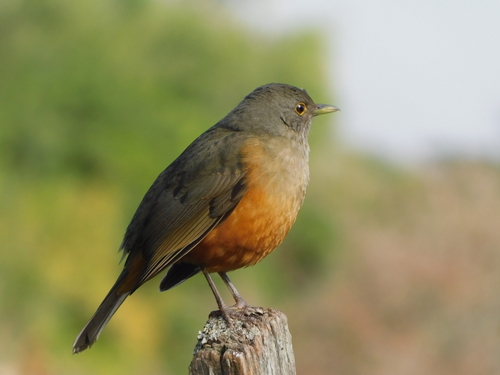
This species is named after its distinctive reddish-orange underparts. Rufous-bellied thrushes can reach a length of 25 cm and weigh up to 68 g (male) or 78 g (female), though weights of about 59 g for males and 64 g for females are more usual. Contrary... Wikipedia →
Sounds

Alarm call0:44

Brazil · 2026

© JAYRSON ARAUJO DE OLIVEIRA · XC1135373 · CC BY-NC-SA 4.0

Song0:26

Brazil · 2025

© Ricardo José Mitidieri · XC1058579 · CC BY-NC-SA 4.0

Distress call0:37

Brazil · 2025

© Pedro Menoncin · XC1051859 · CC BY-NC-SA 4.0

Global Distribution

Parks Where Found

# Park Country Daily sighting probability
1 Serra dos Órgãos National Park 🇧🇷 Brazil
~70%
2 Tijuca National Park 🇧🇷 Brazil
~70%
3 El Palmar National Park 🇦🇷 Argentina
~60%
4 Itatiaia National Park 🇧🇷 Brazil
~60%
5 Iberá National Park 🇦🇷 Argentina
~60%
6 El Impenetrable National Park 🇦🇷 Argentina
~50%
7 Amboró National Park 🇧🇴 Bolivia
~50%
8 Chapada Diamantina National Park 🇧🇷 Brazil
~50%
9 Chapada dos Guimarães National Park 🇧🇷 Brazil
~50%
10 Iguazú National Park 🇦🇷 Argentina
~40%
11 Iguaçu National Park 🇧🇷 Brazil
~30%
12 Serra da Canastra National Park 🇧🇷 Brazil
~20%
13 Parque Estadual Encontro das Águas 🇧🇷 Brazil
~10%
14 Emas National Park 🇧🇷 Brazil
<5%

Cities Where Found

# City Country Daily sighting probability
1 Mendoza 🇦🇷 Argentina
~90%
2 Porto Alegre 🇧🇷 Brazil
~90%
3 Curitiba 🇧🇷 Brazil
~90%
4 Buenos Aires 🇦🇷 Argentina
~90%
5 São Paulo 🇧🇷 Brazil
~80%
6 Campo Grande 🇧🇷 Brazil
~80%
7 Rosario 🇦🇷 Argentina
~70%
8 Rio de Janeiro 🇧🇷 Brazil
~70%
9 Montevideo 🇺🇾 Uruguay
~70%
10 Brasilia 🇧🇷 Brazil
~70%

Zoos & Centres Where Found

# Zoo / Centre Country
1 Pairi Daiza 🇧🇪 Belgium In captivity

Before you go

What are the chances of seeing a Rufous-bellied Thrush in Belo Horizonte?

With luck

About 10% of wildlife watchers report a Rufous-bellied Thrush sighting in Belo Horizonte on a given day, based on 242 verified sightings from GBIF citizen-science data. It is the 40th most-seen of the 220 birds we can rate there. Over three days the chance rises to about 40%, and over a week to about 70%, if each day is a fresh chance.

When is the best time to see a Rufous-bellied Thrush in Belo Horizonte?

August

In that month about 30% of wildlife watchers report a Rufous-bellied Thrush in Belo Horizonte on a given day, against under 5% in December to February, the lowest months. That is one of Belo Horizonte's driest months, with about 20 mm of rain against 270 mm in December.

What time of day is best to see a Rufous-bellied Thrush?

Between 10 am and 1 pm

Across all the parks we cover, that three-hour window holds the most Rufous-bellied Thrush sightings with a recorded time, and about 9 in 10 of them come between 6 am and 6 pm: it is a daytime animal.

Is Belo Horizonte the best place to see a Rufous-bellied Thrush?

19th of 24

Of the 24 cities where we can rate Rufous-bellied Thrush sightings, Belo Horizonte ranks 19th at about 10%. The best odds are in Mendoza (Argentina, about 90%), Porto Alegre (Brazil, about 90%) and Curitiba (Brazil, about 90%).

Which relatives of the Rufous-bellied Thrush live in Belo Horizonte?

Same genus: Turdus

The closest relatives of the Rufous-bellied Thrush that you can see in Belo Horizonte (genus Turdus, Typical Thrushes) are Pale-breasted Thrush (about 70%) and Creamy-bellied Thrush (about 30%), with each one's daily chance of a sighting.

Where does the Rufous-bellied Thrush sighting chance come from?

GBIF citizen-science records

It is estimated from how often the Rufous-bellied Thrush is recorded against all the birds logged in Belo Horizonte (242 verified sightings), calibrated against known sighting rates. Figures are rounded to the nearest 10% because citizen-science data supports honest approximations, not decimals, and months with records from fewer than five people show "—". How it works.

← Back to Belo Horizonte

