Bridled Tern

Bridled Tern

Onychoprion anaethetus

Silhouette: Sheatherius · PhyloPic

LCLeast ConcernNTVUENCR
Daily sighting probability <5% · Rare
at Dakar

In 3 days ~10%

5 Verified sightings at Dakar
521 In all 12 parks From 2019 to 2026
September Best month
☀️ Diurnal When it's spotted

About the Bridled Tern

The bridled tern (Onychoprion anaethetus) is a seabird of the family Laridae. It is a bird of the tropical oceans. The scientific name is from Ancient Greek. The genus comes from onux meaning "claw" or "nail", and prion, meaning "saw". The specific anaethetus means "senseless, stupid", in reference to its tameness around humans.

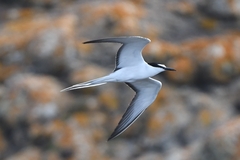
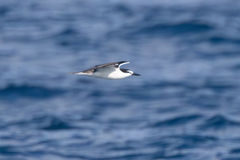
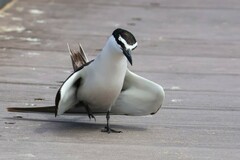
This is a medium-sized tern, at 30–32 cm in length and with a 77–81 cm wingspan similar to the common tern in size, but more heavily built. The wings and deeply forked tail are long, and it has dark grey upperparts and white underparts. The forehead and eyebrows are white, as is a striking collar on the hindneck. It has black legs and bill. Juvenile bridled terns are scaly grey above and pale below.

This species is unlikely to be confused with any tern apart from the similarly dark-backed sooty tern and the spectacled tern from the Tropical Pacific. It is paler-backed than that sooty, (but not as pale as the grey-backed) and has a narrower white forehead and a pale neck collar.

This bird is migratory and dispersive, wintering more widely through the tropical oceans. It has markedly marine habits compared to... Wikipedia →

Sounds

Call0:09

Australia · 2021

© Drew Davison · XC612657 · CC BY-NC-SA 4.0

Alarm call0:44

Australia · 2007

© Simon Elliott · XC589065 · CC BY-NC-ND 4.0

Begging call0:16

Australia · 2019

© AUDEVARD Aurélien · XC539164 · CC BY-NC-SA 4.0

Global Distribution

Parks Where Found

# Park Country Daily sighting probability
1 Rottnest Island 🇦🇺 Australia
~40%
2 Komodo National Park 🇮🇩 Indonesia
~10%
3 Raja Ampat 🇮🇩 Indonesia
~10%
4 Coiba National Park 🇵🇦 Panama
~10%
5 Ningaloo Marine Park 🇦🇺 Australia
<5%
6 Cape Range 🇦🇺 Australia
<5%
7 Yala National Park 🇱🇰 Sri Lanka
<5%
8 Manuel Antonio National Park 🇨🇷 Costa Rica
<5%
9 Cabo Blanco Absolute Nature Reserve 🇨🇷 Costa Rica
<5%
10 Corcovado National Park 🇨🇷 Costa Rica
<5%
11 Daintree National Park 🇦🇺 Australia
<5%
12 Bastimentos Island National Marine Park 🇵🇦 Panama
<5%

Cities Where Found

# City Country Daily sighting probability
1 Mumbai 🇮🇳 India
~10%
2 Wenzhou 🇨🇳 China
<5%
3 Dakar 🇸🇳 Senegal
<5%
4 Shanghai 🇨🇳 China
<5%
5 Kozhikode 🇮🇳 India
<5%
6 Colombo [Sri Jayawardenepura Kotte] 🇱🇰 Sri Lanka
<5%
7 Kollam 🇮🇳 India
<5%
8 Hong Kong 🇨🇳 China
<5%
9 Kochi 🇮🇳 India
<5%
10 Singapore 🇸🇬 Singapore
<5%

Zoos & Centres Where Found

# Zoo / Centre Country
1 Perth Zoo 🇦🇺 Australia In captivity
2 Caversham Wildlife Park 🇦🇺 Australia In captivity

Before you go

What are the chances of seeing a Bridled Tern in Dakar?

Rare

Under 5% of wildlife watchers report a Bridled Tern sighting in Dakar on a given day, based on 5 verified sightings from GBIF citizen-science data. It is the 141st most-seen of the 152 birds we can rate there. Over three days the chance rises to about 10%, if each day is a fresh chance.

When is the best time to see a Bridled Tern in Dakar?

September

In that month about 10% of wildlife watchers report a Bridled Tern in Dakar on a given day, against under 5% in October to August, the lowest months. That is one of Dakar's wettest months, with about 170 mm of rain against almost none in May.

What time of day is best to see a Bridled Tern?

Between 10 am and 1 pm

Across all the parks we cover, that three-hour window holds the most Bridled Tern sightings with a recorded time, and about 9 in 10 of them come between 6 am and 6 pm: it is a daytime animal.

Is Dakar the best place to see a Bridled Tern?

3rd of 10

Of the 10 cities where we can rate Bridled Tern sightings, Dakar ranks 3rd at under 5%. The best odds are in Mumbai (India, about 10%) and Wenzhou (China, under 5%).

Which relatives of the Bridled Tern live in Dakar?

Same family: Laridae

The closest relatives of the Bridled Tern that you can see in Dakar (family Laridae, Gulls, Terns, and Skimmers) are Sandwich Tern (about 50%), Caspian Tern (about 40%) and West African Crested Tern (about 40%), with each one's daily chance of a sighting.

Where does the Bridled Tern sighting chance come from?

GBIF citizen-science records

It is estimated from how often the Bridled Tern is recorded against all the birds logged in Dakar (5 verified sightings), calibrated against known sighting rates. Figures are rounded to the nearest 10% because citizen-science data supports honest approximations, not decimals, and months with records from fewer than five people show "—". How it works.

← Back to Dakar