Black-rumped Flameback

Black-rumped Flameback

Dinopium benghalense

Silhouette: Pepe Reigada · PhyloPic

LCLeast ConcernNTVUENCR
Daily sighting probability ~10% · With luck
at Gwalior

In 3 days ~30% in a week ~60%

18 Verified sightings at Gwalior
13,057 In all 21 parks From 2019 to 2026
August Best month
☀️ Diurnal When it's spotted

About the Black-rumped Flameback

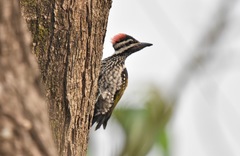
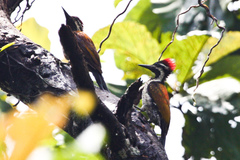
The black-rumped flameback (Dinopium benghalense), also known as the lesser golden-backed woodpecker or lesser goldenback, is a woodpecker found widely distributed in the Indian subcontinent. It is one of the few woodpeckers that are seen in urban areas. It has a characteristic rattling-whinnying call and an undulating flight. It is the only golden-backed woodpecker with a black throat and a black rump.

The black-rumped flameback was described and illustrated by two pre-Linnaean English naturalists from a dried specimen that had been brought to London. In 1738 Eleazar Albin included the bird as the "Bengall Woodpecker" in his A Natural History of Birds and in 1751 George Edwards included the "Spotted Indian Woodpecker" in his A Natural History of Uncommon Birds. The black-rumped flameback was formally described by the Swedish naturalist Carl Linnaeus in 1758 in the tenth edition of his Systema Naturae under the binomial name Picus benghalensis. He cited the earlier descriptions by Albin and Edwards. This woodpecker is now placed in the genus Dinopium that was introduced by the French polymath Constantine Samuel Rafinesque in 1814.

Five subspecies are recognised: The... Wikipedia →

Sounds

Call0:11

India · 2025

© Peter Boesman · XC1030551 · CC BY-NC-ND 4.0

Song0:10

India · 2024

© Jairam Vijayan · XC879008 · CC BY-SA 4.0

Flight call0:04

India · 2014

© Pronoy Baidya · XC196356 · CC BY-NC-ND 4.0

Global Distribution

Parks Where Found

# Park Country Daily sighting probability
1 Bandhavgarh National Park 🇮🇳 India
~50%
2 Kanha National Park 🇮🇳 India
~50%
3 Mudumalai National Park 🇮🇳 India
~50%
4 Periyar National Park 🇮🇳 India
~40%
5 Ranthambore National Park 🇮🇳 India
~40%
6 Satpura National Park 🇮🇳 India
~40%
7 Nagarhole National Park 🇮🇳 India
~40%
8 Royal Bardia National Park 🇳🇵 Nepal
~40%
9 Keoladeo National Park 🇮🇳 India
~30%
10 Bandipur National Park 🇮🇳 India
~30%
11 Sundarbans National Park 🇮🇳 India
~30%
12 Gir National Park 🇮🇳 India
~30%
13 Jim Corbett National Park 🇮🇳 India
~20%
14 Chitwan National Park 🇳🇵 Nepal
~20%
15 Wilpattu National Park 🇱🇰 Sri Lanka
~10%
16 Kaziranga National Park 🇮🇳 India
~10%
17 Manas National Park 🇮🇳 India
~10%
18 Eravikulam National Park 🇮🇳 India
<5%
19 Sinharaja Forest Reserve 🇱🇰 Sri Lanka
<5%
20 Yala National Park 🇱🇰 Sri Lanka
<5%
21 Royal Manas National Park 🇧🇹 Bhutan
<5%

Cities Where Found

# City Country Daily sighting probability
1 Savar 🇧🇩 Bangladesh
~70%
2 Tamluk 🇮🇳 India
~60%
3 Thiruvananthapuram 🇮🇳 India
~60%
4 Dhaka 🇧🇩 Bangladesh
~60%
5 Kollam 🇮🇳 India
~50%
6 Kolkata 🇮🇳 India
~50%
7 Kochi 🇮🇳 India
~40%
8 Asansol 🇮🇳 India
~40%
9 Thrissur 🇮🇳 India
~40%
10 Ponnani 🇮🇳 India
~40%

Before you go

What are the chances of seeing a Black-rumped Flameback in Gwalior?

With luck

About 10% of wildlife watchers report a Black-rumped Flameback sighting in Gwalior on a given day, based on 18 verified sightings from GBIF citizen-science data. It is the 43rd most-seen of the 86 birds we can rate there. Over three days the chance rises to about 30%, and over a week to about 60%, if each day is a fresh chance.

When is the best time to see a Black-rumped Flameback in Gwalior?

March and June–August

In those months about 20% of wildlife watchers report a Black-rumped Flameback in Gwalior on a given day, against about 10% in April–May and September–February, the lowest months. Those are among Gwalior's wettest months, with about 130 mm of rain a month against 5 mm in December.

What time of day is best to see a Black-rumped Flameback?

Between 7 and 10 am

Across all the parks we cover, that three-hour window holds the most Black-rumped Flameback sightings with a recorded time, and about 9 in 10 of them come between 6 am and 6 pm: it is a daytime animal.

Is Gwalior the best place to see a Black-rumped Flameback?

34th of 57

Of the 57 cities where we can rate Black-rumped Flameback sightings, Gwalior ranks 34th at about 10%. The best odds are in Savar (Bangladesh, about 70%), Tamluk (India, about 60%) and Thiruvananthapuram (India, about 60%).

Which relatives of the Black-rumped Flameback live in Gwalior?

Same order: Piciformes

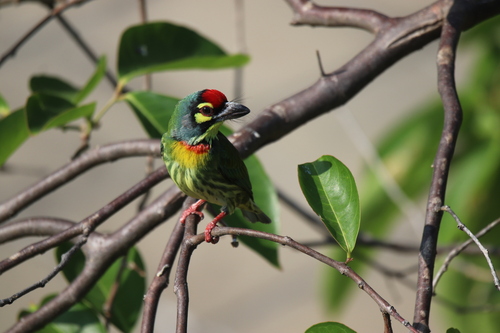
The closest relatives of the Black-rumped Flameback that you can see in Gwalior (order Piciformes, Woodpeckers and Allies) are Brown-headed Barbet (about 40%) and Coppersmith Barbet (about 40%), with each one's daily chance of a sighting.

Where does the Black-rumped Flameback sighting chance come from?

GBIF citizen-science records

It is estimated from how often the Black-rumped Flameback is recorded against all the birds logged in Gwalior (18 verified sightings), calibrated against known sighting rates. Figures are rounded to the nearest 10% because citizen-science data supports honest approximations, not decimals, and months with records from fewer than five people show "—". How it works.

← Back to Gwalior