Taiga Flycatcher

Taiga Flycatcher

Ficedula albicilla

Silhouette: Rachael Joakim · PhyloPic

LCLeast ConcernNTVUENCR
Daily sighting probability ~20% · Possible
at Hanoi

In 3 days ~50% in a week ~80%

44 Verified sightings at Hanoi
7,995 In all 25 parks From 2019 to 2026
April Best month
🌅 Crepuscular When it's spotted

About the Taiga Flycatcher

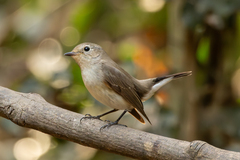
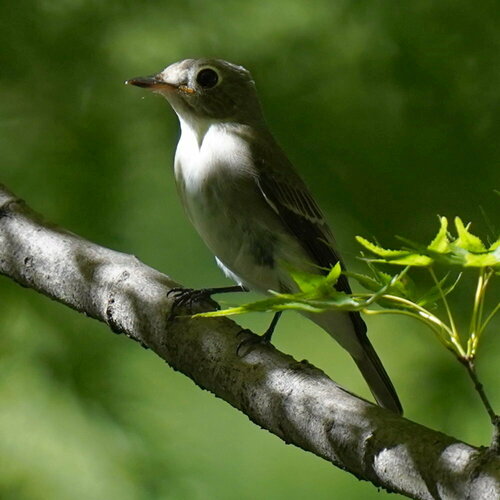
The taiga flycatcher or red-throated flycatcher (Ficedula albicilla) is a migratory bird in the family Muscicapidae. The species was first described by Peter Simon Pallas in 1811. The female has brown upper parts with a blackish tail flanked by white. The breast is buffish with underparts mostly white. The male has ear coverts and sides of the neck blue-tinged grey with breeding males having orange-red coloration on the throats. Unlike the taiga flycatcher, the female of the similar red-breasted flycatcher has a brown tail while the red colour in breeding males extends to the breast in the red-breasted flycatcher. It breeds in northern Eurasia from eastern Russia to Siberia and Mongolia. It is a winter visitor to South and South-east Asia in Bangladesh, Bhutan, India, Cambodia, Laos, Myanmar, Nepal, Malaysia, Thailand, China, Vietnam, and Japan. Its natural habitat is taiga forest. It is a rare vagrant to western Europe.

It was formerly considered a subspecies of the red-breasted flycatcher. The genus name is from Latin and refers to a small fig-eating bird (ficus, fig) supposed to change into the blackcap in winter. The specific name albicilla is from Latin albus, white, and Neo-Latin cilla tail; this meaning of cilla arose from a misunderstanding of motacilla, the name for the wagtail. Wikipedia →

Sounds

Song0:47

China · 2026

© Peter Boesman · XC1147506 · CC BY-NC-ND 4.0

Call0:35

China · 2025

© Penghui Lou · XC1045297 · CC BY-NC-SA 4.0

Subsong0:14

Mongolia · 2025

© Ding Li Yong · XC1011851 · CC BY-NC-ND 4.0

Global Distribution

Parks Where Found

# Park Country Daily sighting probability
1 Kaeng Krachan National Park 🇹🇭 Thailand
~40%
2 Khao Yai National Park 🇹🇭 Thailand
~40%
3 Doi Inthanon National Park 🇹🇭 Thailand
~30%
4 Chitwan National Park 🇳🇵 Nepal
~30%
5 Kaziranga National Park 🇮🇳 India
~30%
6 Manas National Park 🇮🇳 India
~20%
7 Bandhavgarh National Park 🇮🇳 India
~10%
8 Royal Bardia National Park 🇳🇵 Nepal
~10%
9 Gobi Gurvansaikhan National Park 🇲🇳 Mongolia
~10%
10 Keoladeo National Park 🇮🇳 India
~10%
11 Kanha National Park 🇮🇳 India
~10%
12 Sundarbans National Park 🇮🇳 India
~10%
13 Satpura National Park 🇮🇳 India
~10%
14 Cuc Phuong National Park 🇻🇳 Vietnam
~10%
15 Jim Corbett National Park 🇮🇳 India
~10%
16 Cat Tien National Park 🇻🇳 Vietnam
~10%
17 Royal Manas National Park 🇧🇹 Bhutan
~10%
18 Khao Luang National Park 🇹🇭 Thailand
~10%
19 Ranthambore National Park 🇮🇳 India
<5%
20 Gir National Park 🇮🇳 India
<5%
21 Namdapha National Park 🇮🇳 India
<5%
22 Mudumalai National Park 🇮🇳 India
<5%
23 Nagarhole National Park 🇮🇳 India
<5%
24 Khao Sok National Park 🇹🇭 Thailand
<5%
25 Bandipur National Park 🇮🇳 India
<5%

Cities Where Found

# City Country Daily sighting probability
1 Asansol 🇮🇳 India
~50%
2 Savar 🇧🇩 Bangladesh
~40%
3 Xiuying District 🇨🇳 China
~20%
4 Yangon 🇲🇲 Myanmar
~20%
5 Bangkok 🇹🇭 Thailand
~20%
6 Hanoi 🇻🇳 Vietnam
~20%
7 Tamluk 🇮🇳 India
~20%
8 Guwahati 🇮🇳 India
~20%
9 Jabalpur 🇮🇳 India
~20%
10 Lucknow 🇮🇳 India
~20%

Before you go

What are the chances of seeing a Taiga Flycatcher in Hanoi?

Possible

About 20% of wildlife watchers report a Taiga Flycatcher sighting in Hanoi on a given day, based on 44 verified sightings from GBIF citizen-science data. It is the 31st most-seen of the 97 birds we can rate there. Over three days the chance rises to about 50%, and over a week to about 80%, if each day is a fresh chance.

When is the best time to see a Taiga Flycatcher in Hanoi?

April

In that month about 40% of wildlife watchers report a Taiga Flycatcher in Hanoi on a given day, against about 10% in May–August, October and December, the lowest months. That is one of Hanoi's driest months, with about 80 mm of rain against 320 mm in August.

What time of day is best to see a Taiga Flycatcher?

Between 4 and 7 am

Across all the parks we cover, that three-hour window holds the most Taiga Flycatcher sightings with a recorded time, and about half of them come between 6 am and 6 pm: it is most active around dawn and dusk.

Is Hanoi the best place to see a Taiga Flycatcher?

6th of 76

Of the 76 cities where we can rate Taiga Flycatcher sightings, Hanoi ranks 6th at about 20%. The best odds are in Asansol (India, about 50%), Savar (Bangladesh, about 40%) and Xiuying District (China, about 20%).

Where does the Taiga Flycatcher sighting chance come from?

GBIF citizen-science records

It is estimated from how often the Taiga Flycatcher is recorded against all the birds logged in Hanoi (44 verified sightings), calibrated against known sighting rates. Figures are rounded to the nearest 10% because citizen-science data supports honest approximations, not decimals, and months with records from fewer than five people show "—". How it works.

← Back to Hanoi