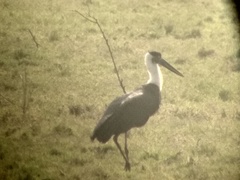
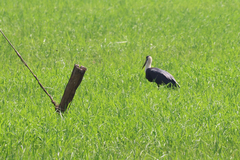
Asian Woolly-necked Stork

Asian Woolly-necked Stork

Ciconia episcopus

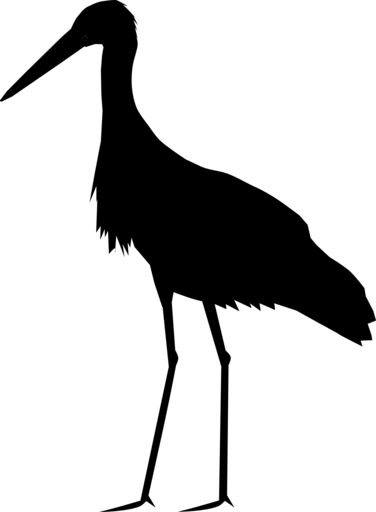
Silhouette: L. Shyamal · PhyloPic

LCNTNear ThreatenedVUENCR
Daily sighting probability ~10% · With luck
at Kalyan-Dombivli

In 3 days ~20% in a week ~40%

76 Verified sightings at Kalyan-Dombivli
6,843 In all 22 parks From 2019 to 2026
February Best month
☀️ Diurnal When it's spotted

About the Asian Woolly-necked Stork

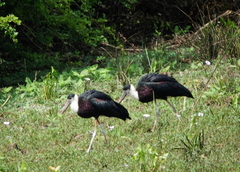
The Asian woolly-necked stork or Asian woollyneck (Ciconia episcopus) is a species of large wading bird in the stork family Ciconiidae. It breeds singly, or in small loose colonies. It is distributed in a wide variety of habitats including marshes in forests, agricultural areas, and freshwater wetlands across Asia.

The woolly-necked stork was described by the French polymath Georges-Louis Leclerc, Comte de Buffon in 1780 in his Histoire Naturelle des Oiseaux from a specimen collected from the Coromandel Coast of India. The bird was also illustrated in a hand-coloured plate engraved by François-Nicolas Martinet in the Planches Enluminées D'Histoire Naturelle which was produced under the supervision of Edme-Louis Daubenton to accompany Buffon's text. Neither the plate caption nor Buffon's description included a scientific name but in 1783 the Dutch naturalist Pieter Boddaert coined the binomial name Ardea episcopus in his catalogue of the Planches Enluminées. The woolly-necked stork is now placed in the genus Ciconia that was erected by the French zoologist Mathurin Jacques Brisson in 1760. The genus name Ciconia is the Latin word for a "stork"; the specific epithet episcopus... Wikipedia →

Sounds

Aberrant0:22

India · 2025

© Sreekumar Chirukandoth · XC1068686 · CC BY-NC-SA 4.0

Global Distribution

Parks Where Found

# Park Country Daily sighting probability
1 Kaziranga National Park 🇮🇳 India
~60%
2 Wilpattu National Park 🇱🇰 Sri Lanka
~60%
3 Royal Bardia National Park 🇳🇵 Nepal
~40%
4 Ranthambore National Park 🇮🇳 India
~40%
5 Keoladeo National Park 🇮🇳 India
~30%
6 Minneriya National Park 🇱🇰 Sri Lanka
~30%
7 Satpura National Park 🇮🇳 India
~30%
8 Udawalawe National Park 🇱🇰 Sri Lanka
~30%
9 Chitwan National Park 🇳🇵 Nepal
~30%
10 Yala National Park 🇱🇰 Sri Lanka
~30%
11 Mudumalai National Park 🇮🇳 India
~20%
12 Bandhavgarh National Park 🇮🇳 India
~20%
13 Nagarhole National Park 🇮🇳 India
~20%
14 Periyar National Park 🇮🇳 India
~20%
15 Gir National Park 🇮🇳 India
~20%
16 Bandipur National Park 🇮🇳 India
~10%
17 Cat Tien National Park 🇻🇳 Vietnam
~10%
18 Jim Corbett National Park 🇮🇳 India
~10%
19 Bali Barat National Park 🇮🇩 Indonesia
<5%
20 Sinharaja Forest Reserve 🇱🇰 Sri Lanka
<5%
21 Kanha National Park 🇮🇳 India
<5%
22 Manas National Park 🇮🇳 India
<5%

Cities Where Found

# City Country Daily sighting probability
1 Ponnani 🇮🇳 India
~30%
2 Agra 🇮🇳 India
~20%
3 Thrissur 🇮🇳 India
~20%
4 Bhopal 🇮🇳 India
~10%
5 Kota 🇮🇳 India
~10%
6 Chhatrapati Sambhajinagar 🇮🇳 India
~10%
7 Kalyan-Dombivli 🇮🇳 India
~10%
8 Vasai-Virar 🇮🇳 India
~10%
9 Solapur 🇮🇳 India
<5%
10 Kozhikode 🇮🇳 India
<5%

Zoos & Centres Where Found

# Zoo / Centre Country
1 Planckendael Zoo 🇧🇪 Belgium In captivity
2 Saigon Zoo and Botanical Gardens 🇻🇳 Vietnam In captivity
3 Bandung Zoo 🇮🇩 Indonesia In captivity
4 Tier- und Freizeitpark Thüle 🇩🇪 Germany In captivity
5 Thrissur Zoo 🇮🇳 India In captivity
6 Rákosův pavilon 🇨🇿 Czechia In captivity
7 Mořský svět 🇨🇿 Czechia In captivity
8 Wolfgang-Köhler-Primaten-Forschungszentrum 🇩🇪 Germany In captivity

Before you go

What are the chances of seeing an Asian Woolly-necked Stork in Kalyan-Dombivli?

With luck

About 10% of wildlife watchers report an Asian Woolly-necked Stork sighting in Kalyan-Dombivli on a given day, based on 76 verified sightings from GBIF citizen-science data. It is the 80th most-seen of the 179 birds we can rate there. Over three days the chance rises to about 20%, and over a week to about 40%, if each day is a fresh chance.

When is the best time to see an Asian Woolly-necked Stork in Kalyan-Dombivli?

February

In that month about 20% of wildlife watchers report an Asian Woolly-necked Stork in Kalyan-Dombivli on a given day, against under 5% in March and May–December, the lowest months. That is one of Kalyan-Dombivli's driest months, with almost no rain against 830 mm in July.

What time of day is best to see an Asian Woolly-necked Stork?

Between 9 am and noon

Across all the parks we cover, that three-hour window holds the most Asian Woolly-necked Stork sightings with a recorded time, and about 9 in 10 of them come between 6 am and 6 pm: it is a daytime animal.

Is Kalyan-Dombivli the best place to see an Asian Woolly-necked Stork?

7th of 28

Of the 28 cities where we can rate Asian Woolly-necked Stork sightings, Kalyan-Dombivli ranks 7th at about 10%. The best odds are in Ponnani (India, about 30%), Agra (India, about 20%) and Thrissur (India, about 20%).

Which relatives of the Asian Woolly-necked Stork live in Kalyan-Dombivli?

Same family: Ciconiidae

The closest relatives of the Asian Woolly-necked Stork that you can see in Kalyan-Dombivli (family Ciconiidae, Storks) are Painted Stork (about 20%) and Asian Openbill Stork (about 20%), with each one's daily chance of a sighting.

Where does the Asian Woolly-necked Stork sighting chance come from?

GBIF citizen-science records

It is estimated from how often the Asian Woolly-necked Stork is recorded against all the birds logged in Kalyan-Dombivli (76 verified sightings), calibrated against known sighting rates. Figures are rounded to the nearest 10% because citizen-science data supports honest approximations, not decimals, and months with records from fewer than five people show "—". How it works.

← Back to Kalyan-Dombivli