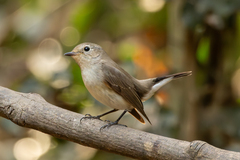
Taiga Flycatcher

Taiga Flycatcher

Ficedula albicilla

Silhouette: Rachael Joakim · PhyloPic

LCLeast ConcernNTVUENCR
Daily sighting probability <5% · Rare
at Kalyan-Dombivli

In 3 days <5%

8 Verified sightings at Kalyan-Dombivli
7,995 In all 25 parks From 2019 to 2026
November Best month
🌅 Crepuscular When it's spotted

About the Taiga Flycatcher

The taiga flycatcher or red-throated flycatcher (Ficedula albicilla) is a migratory bird in the family Muscicapidae. The species was first described by Peter Simon Pallas in 1811. The female has brown upper parts with a blackish tail flanked by white. The breast is buffish with underparts mostly white. The male has ear coverts and sides of the neck blue-tinged grey with breeding males having orange-red coloration on the throats. Unlike the taiga flycatcher, the female of the similar red-breasted flycatcher has a brown tail while the red colour in breeding males extends to the breast in the red-breasted flycatcher. It breeds in northern Eurasia from eastern Russia to Siberia and Mongolia. It is a winter visitor to South and South-east Asia in Bangladesh, Bhutan, India, Cambodia, Laos, Myanmar, Nepal, Malaysia, Thailand, China, Vietnam, and Japan. Its natural habitat is taiga forest. It is a rare vagrant to western Europe.

It was formerly considered a subspecies of the red-breasted flycatcher. The genus name is from Latin and refers to a small fig-eating bird (ficus, fig) supposed to change into the blackcap in winter. The specific name albicilla is from Latin albus, white, and Neo-Latin cilla tail; this meaning of cilla arose from a misunderstanding of motacilla, the name for the wagtail. Wikipedia →

Sounds

Song0:47

China · 2026

© Peter Boesman · XC1147506 · CC BY-NC-ND 4.0

Call0:35

China · 2025

© Penghui Lou · XC1045297 · CC BY-NC-SA 4.0

Subsong0:14

Mongolia · 2025

© Ding Li Yong · XC1011851 · CC BY-NC-ND 4.0

Global Distribution

Parks Where Found

# Park Country Daily sighting probability
1 Kaeng Krachan National Park 🇹🇭 Thailand
~40%
2 Khao Yai National Park 🇹🇭 Thailand
~40%
3 Doi Inthanon National Park 🇹🇭 Thailand
~30%
4 Chitwan National Park 🇳🇵 Nepal
~30%
5 Kaziranga National Park 🇮🇳 India
~30%
6 Manas National Park 🇮🇳 India
~20%
7 Bandhavgarh National Park 🇮🇳 India
~10%
8 Royal Bardia National Park 🇳🇵 Nepal
~10%
9 Gobi Gurvansaikhan National Park 🇲🇳 Mongolia
~10%
10 Keoladeo National Park 🇮🇳 India
~10%
11 Kanha National Park 🇮🇳 India
~10%
12 Sundarbans National Park 🇮🇳 India
~10%
13 Satpura National Park 🇮🇳 India
~10%
14 Cuc Phuong National Park 🇻🇳 Vietnam
~10%
15 Jim Corbett National Park 🇮🇳 India
~10%
16 Cat Tien National Park 🇻🇳 Vietnam
~10%
17 Royal Manas National Park 🇧🇹 Bhutan
~10%
18 Khao Luang National Park 🇹🇭 Thailand
~10%
19 Ranthambore National Park 🇮🇳 India
<5%
20 Gir National Park 🇮🇳 India
<5%
21 Namdapha National Park 🇮🇳 India
<5%
22 Mudumalai National Park 🇮🇳 India
<5%
23 Nagarhole National Park 🇮🇳 India
<5%
24 Khao Sok National Park 🇹🇭 Thailand
<5%
25 Bandipur National Park 🇮🇳 India
<5%

Cities Where Found

# City Country Daily sighting probability
1 Asansol 🇮🇳 India
~50%
2 Savar 🇧🇩 Bangladesh
~40%
3 Xiuying District 🇨🇳 China
~20%
4 Yangon 🇲🇲 Myanmar
~20%
5 Bangkok 🇹🇭 Thailand
~20%
6 Hanoi 🇻🇳 Vietnam
~20%
7 Tamluk 🇮🇳 India
~20%
8 Guwahati 🇮🇳 India
~20%
9 Jabalpur 🇮🇳 India
~20%
10 Lucknow 🇮🇳 India
~20%

Before you go

What are the chances of seeing a Taiga Flycatcher in Kalyan-Dombivli?

Rare

Under 5% of wildlife watchers report a Taiga Flycatcher sighting in Kalyan-Dombivli on a given day, based on 8 verified sightings from GBIF citizen-science data. It is the 161st most-seen of the 179 birds we can rate there. Over three days the chance rises to under 5%, if each day is a fresh chance.

When is the best time to see a Taiga Flycatcher in Kalyan-Dombivli?

Any time of year

In every month with enough records, under 5% of wildlife watchers report a Taiga Flycatcher in Kalyan-Dombivli on a given day, so our monthly data shows no clear season.

What time of day is best to see a Taiga Flycatcher?

Between 4 and 7 am

Across all the parks we cover, that three-hour window holds the most Taiga Flycatcher sightings with a recorded time, and about half of them come between 6 am and 6 pm: it is most active around dawn and dusk.

Is Kalyan-Dombivli the best place to see a Taiga Flycatcher?

68th of 76

Of the 76 cities where we can rate Taiga Flycatcher sightings, Kalyan-Dombivli ranks 68th at under 5%. The best odds are in Asansol (India, about 50%), Savar (Bangladesh, about 40%) and Xiuying District (China, about 20%).

Where does the Taiga Flycatcher sighting chance come from?

GBIF citizen-science records

It is estimated from how often the Taiga Flycatcher is recorded against all the birds logged in Kalyan-Dombivli (8 verified sightings), calibrated against known sighting rates. Figures are rounded to the nearest 10% because citizen-science data supports honest approximations, not decimals, and months with records from fewer than five people show "—". How it works.

← Back to Kalyan-Dombivli