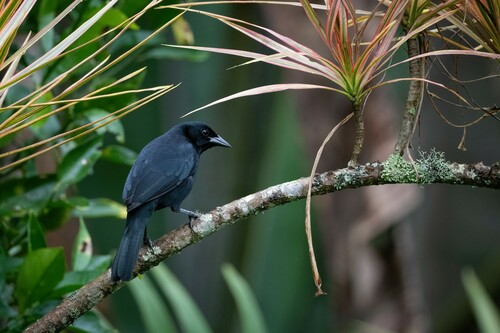
Hooded Siskin

Hooded Siskin

Spinus magellanicus

Silhouette: Andy Wilson · PhyloPic

LCLeast ConcernNTVUENCR
Daily sighting probability ~10% · With luck
at Lima

In 3 days ~10% in a week ~30%

404 Verified sightings at Lima
1,732 In all 14 parks From 2019 to 2026
June Best month
☀️ Diurnal When it's spotted

About the Hooded Siskin

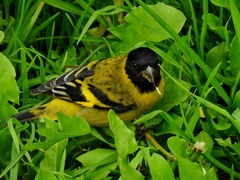
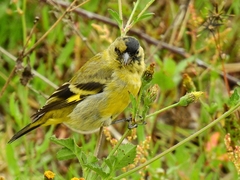
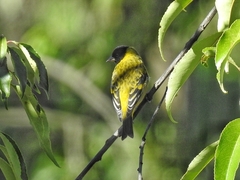
The hooded siskin (Spinus magellanicus) is a small passerine bird in the family Fringillidae, the finches and euphonias. It is found in every mainland South American country except French Guiana and Suriname. The hooded siskin has a complicated taxonomic history and as of early 2026 its taxonomy has not been fully resolved. It was originally described in 1805 with the binomial Fringilla magellanica. It was later moved to what was then the subgenus Spinus within genus Carduelis and also spent time in genus Sporagra. Beginning in about 2009 the subgenus was elevated to full genus level and the hooded siskin, the rest of the New World siskins, and the New World goldfinches were therefore elevated to now-genus Spinus.

The IOC, AviList, and BirdLife International's Handbook of the Birds of the World assign it these 12 subspecies. The status of some subspecies is not resolved. Wikipedia →

Sounds

Call0:55

Ecuador · 2026

© Manuel Sánchez-Nivicela · XC1140208 · CC BY-NC-ND 4.0

Song0:30

Argentina · 2022

© Marcos E. Sosa · XC1019024 · CC BY-NC-SA 4.0

Begging call0:47

Chile · 2019

© Cristian Pinto · XC498659 · CC BY-NC-SA 4.0

Global Distribution

Parks Where Found

# Park Country Daily sighting probability
1 Lauca National Park 🇨🇱 Chile
~40%
2 Serra da Canastra National Park 🇧🇷 Brazil
~30%
3 El Palmar National Park 🇦🇷 Argentina
~30%
4 Itatiaia National Park 🇧🇷 Brazil
~20%
5 Iberá National Park 🇦🇷 Argentina
~20%
6 Amboró National Park 🇧🇴 Bolivia
~10%
7 El Impenetrable National Park 🇦🇷 Argentina
~10%
8 Chapada Diamantina National Park 🇧🇷 Brazil
~10%
9 Manu National Park 🇵🇪 Peru
<5%
10 Los Nevados National Natural Park 🇨🇴 Colombia
<5%
11 Iguazú National Park 🇦🇷 Argentina
<5%
12 Serra dos Órgãos National Park 🇧🇷 Brazil
<5%
13 Iguaçu National Park 🇧🇷 Brazil
<5%
14 Podocarpus National Park 🇪🇨 Ecuador
<5%

Cities Where Found

# City Country Daily sighting probability
1 Buenos Aires 🇦🇷 Argentina
~50%
2 Cochabamba 🇧🇴 Bolivia
~40%
3 Rosario 🇦🇷 Argentina
~40%
4 Quito 🇪🇨 Ecuador
~40%
5 Mendoza 🇦🇷 Argentina
~40%
6 Arequipa 🇵🇪 Peru
~30%
7 Cordoba 🇦🇷 Argentina
~20%
8 Asuncion 🇵🇾 Paraguay
~20%
9 Montevideo 🇺🇾 Uruguay
~20%
10 Curitiba 🇧🇷 Brazil
~20%

Zoos & Centres Where Found

# Zoo / Centre Country
1 Kolmården Wildlife Park 🇸🇪 Sweden In captivity

Before you go

What are the chances of seeing a Hooded Siskin in Lima?

With luck

About 10% of wildlife watchers report a Hooded Siskin sighting in Lima on a given day, based on 404 verified sightings from GBIF citizen-science data. It is the 89th most-seen of the 171 birds we can rate there. Over three days the chance rises to about 10%, and over a week to about 30%, if each day is a fresh chance.

When is the best time to see a Hooded Siskin in Lima?

February, May–June, September and November

In those months about 10% of wildlife watchers report a Hooded Siskin in Lima on a given day, against under 5% in March–April, July–August, October and December–January, the lowest months.

What time of day is best to see a Hooded Siskin?

Between 10 am and 1 pm

Across all the parks we cover, that three-hour window holds the most Hooded Siskin sightings with a recorded time, and nearly all of them come between 6 am and 6 pm: it is a daytime animal.

Is Lima the best place to see a Hooded Siskin?

14th of 15

Of the 15 cities where we can rate Hooded Siskin sightings, Lima ranks 14th at about 10%. The best odds are in Buenos Aires (Argentina, about 50%), Cochabamba (Bolivia, about 40%) and Rosario (Argentina, about 40%).

Where does the Hooded Siskin sighting chance come from?

GBIF citizen-science records

It is estimated from how often the Hooded Siskin is recorded against all the birds logged in Lima (404 verified sightings), calibrated against known sighting rates. Figures are rounded to the nearest 10% because citizen-science data supports honest approximations, not decimals, and months with records from fewer than five people show "—". How it works.

← Back to Lima