Daily sighting probability ~10% · With luck
at Miami

In 3 days ~30% in a week ~50%

309 Verified sightings at Miami
1,600 In all 24 parks From 2019 to 2026
July Best month
☀️ Diurnal When it's spotted

About the Queen

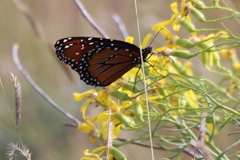
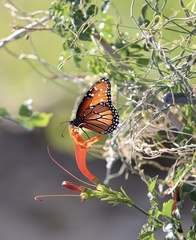
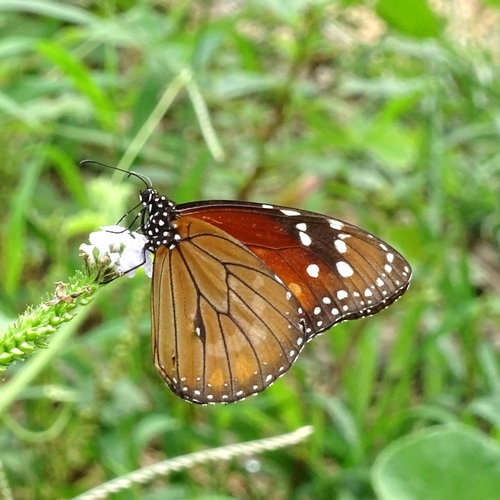
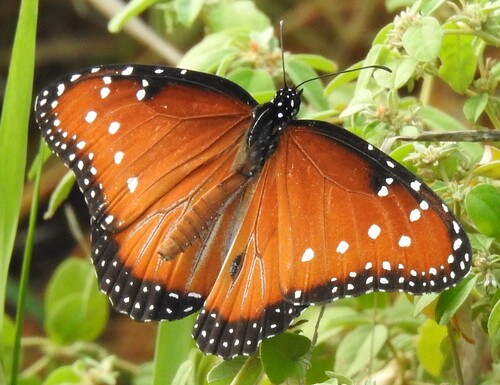
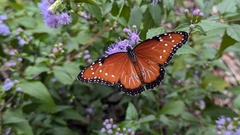
The queen butterfly (Danaus gilippus) is a North and South American butterfly in the family Nymphalidae with a wingspan of 80–85 mm (3+1⁄8–3+3⁄8 in). It is orange or brown with black wing borders and small white forewing spots on its dorsal wing surface, and reddish ventral wing surface fairly similar to the dorsal surface. The ventral hindwings have black veins and small white spots in a black border. The male has a black androconial scent patch on its dorsal hindwings. It can be found in meadows, fields, marshes, deserts, and at the edges of forests.

This species is possibly a close relative to the similarly colored soldier butterfly (or tropical queen, D. eresimus), in any case, it is not close to the plain tiger (D. chrysippus, African queen) as was long believed. There are seven subspecies.

Females lay one egg at a time on larval host plants. Larvae use these plants as a food source, whereas adult butterflies feed mainly on nectar from flowers. Unpalatability to avian predators is a feature of the butterfly; however, its level is highly variable. Unpalatability is correlated with the level of cardenolides obtained via the larval diet, but other compounds like alkaloids also play a part in promoting distastefulness.

Males patrol to search for females, who may mate up to 15 times a day. Male organs called hair-pencils play an important role in courtship, with males with lower hair-pencil counts being selected against. These hair-pencils may be involved in releasing pheromones during courtship that could attract female mates. Wikipedia →
Global Distribution

Parks Where Found

# Park Country Daily sighting probability
1 Saguaro National Park 🇺🇸 United States
~40%
2 Big Cypress National Preserve 🇺🇸 United States
~30%
3 Big Bend National Park 🇺🇸 United States
~30%
4 Iberá National Park 🇦🇷 Argentina
~30%
5 El Vizcaíno Biosphere Reserve 🇲🇽 Mexico
~30%
6 Bahía de Loreto National Park 🇲🇽 Mexico
~20%
7 Everglades National Park 🇺🇸 United States
~20%
8 Joshua Tree National Park 🇺🇸 United States
~20%
9 Cabo Pulmo National Park 🇲🇽 Mexico
~20%
10 Cumbres de Monterrey National Park 🇲🇽 Mexico
~20%
11 Guadalupe Mountains National Park 🇺🇸 United States
~20%
12 Padre Island National Seashore 🇺🇸 United States
~20%
13 Biotopo Cerro Cahuí 🇬🇹 Guatemala
~20%
14 Grand Canyon National Park 🇺🇸 United States
~10%
15 Galápagos Islands 🇪🇨 Ecuador
~10%
16 Calakmul Biosphere Reserve 🇲🇽 Mexico
~10%
17 Merritt Island National Wildlife Refuge 🇺🇸 United States
~10%
18 Death Valley National Park 🇺🇸 United States
~10%
19 Arrecifes de Cozumel National Park 🇲🇽 Mexico
~10%
20 Lago de Yojoa 🇭🇳 Honduras
~10%
21 Ría Lagartos Biosphere Reserve 🇲🇽 Mexico
~10%
22 Zion National Park 🇺🇸 United States
~10%
23 Monteverde Cloud Forest Reserve 🇨🇷 Costa Rica
~10%
24 La Amistad International Park (Panama) 🇵🇦 Panama
<5%

Cities Where Found

# City Country Daily sighting probability
1 Phoenix 🇺🇸 United States
~40%
2 San Antonio 🇺🇸 United States
~30%
3 Austin 🇺🇸 United States
~30%
4 Mesa 🇺🇸 United States
~30%
5 Ciudad Juárez 🇲🇽 México
~20%
6 Monterrey 🇲🇽 México
~10%
7 Dallas 🇺🇸 United States
~10%
8 Torreón 🇲🇽 México
~10%
9 León 🇲🇽 México
~10%
10 San Luis Potosí 🇲🇽 México
~10%

Before you go

What are the chances of seeing a Queen in Miami?

With luck

About 10% of wildlife watchers report a Queen sighting in Miami on a given day, based on 309 verified sightings from GBIF citizen-science data. It is the 42nd most-seen of the 826 insects we can rate there. Over three days the chance rises to about 30%, and over a week to about 50%, if each day is a fresh chance.

When is the best time to see a Queen in Miami?

July and August

In those months about 20% of wildlife watchers report a Queen in Miami on a given day, against about 10% in September to June, the lowest months. Those are among Miami's wettest months, with about 170 mm of rain a month against 45 mm in January.

What time of day is best to see a Queen?

Between 10 am and 1 pm

Across all the parks we cover, that three-hour window holds the most Queen sightings with a recorded time, and about 9 in 10 of them come between 6 am and 6 pm: it is a daytime animal.

Is Miami the best place to see a Queen?

14th of 26

Of the 26 cities where we can rate Queen sightings, Miami ranks 14th at about 10%. The best odds are in Phoenix (United States, about 40%), San Antonio (United States, about 30%) and Austin (United States, about 30%).

Where does the Queen sighting chance come from?

GBIF citizen-science records

It is estimated from how often the Queen is recorded against all the insects logged in Miami (309 verified sightings), calibrated against known sighting rates. Figures are rounded to the nearest 10% because citizen-science data supports honest approximations, not decimals, and months with records from fewer than five people show "—". How it works.

← Back to Miami