Western Sandpiper

Western Sandpiper

Calidris mauri

Silhouette: Edwin Price · PhyloPic

LCLeast ConcernNTVUENCR
Daily sighting probability <5% · Rare
at New York City

In 3 days <5%

180 Verified sightings at New York City
5,614 In all 34 parks From 2019 to 2026
August Best month
☀️ Diurnal When it's spotted

About the Western Sandpiper

The western sandpiper (Calidris mauri) is a small migratory shorebird. The genus name is from Ancient Greek kalidris or skalidris, a term used by Aristotle for some grey-coloured waterside birds. The specific mauri commemorates Italian botanist Ernesto Mauri (1791–1836).

This is one of the most abundant shorebird species in North America, with a population in the millions. Within the genus Calidris the western sandpiper is most closely related to the semipalmated sandpiper (Calidris pusilla).

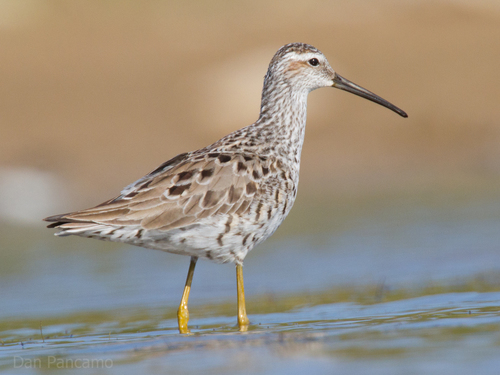
Adults have dark legs and a short, thin, dark bill, thinner at the tip. The body is brown on top and white underneath. They are reddish-brown on the crown. This bird can be difficult to distinguish from other similar tiny shorebirds, especially the semipalmated sandpiper. This is particularly the case in winter plumage, when both species are plain grey. The western sandpiper acquires winter plumage much earlier in the autumn than the semipalmated sandpiper.

Measurements: Length: 14–17 cm (5.5–6.7 in) Wingspan: 35–37 cm (14–15 in) Weight: 22–35 g (0.78–1.23 oz) Their breeding habitat is tundra in eastern Siberia and Alaska. They nest on the ground usually under... Wikipedia →

Sounds

Call0:11

Mexico · 2021

© Manuel Grosselet · XC623972 · CC BY-NC-SA 4.0

Alarm call0:34

United States · 2017

© Patrik Åberg · XC406210 · CC BY-NC-SA 4.0

Song0:26

United States · 2013

© Andrew Spencer · XC149244 · CC BY-NC-SA 3.0

Global Distribution

Parks Where Found

# Park Country Daily sighting probability
1 Pacific Rim National Park Reserve 🇨🇦 Canada
~30%
2 El Vizcaíno Biosphere Reserve 🇲🇽 Mexico
~30%
3 Isla del Coco National Park 🇨🇷 Costa Rica
~20%
4 Ría Lagartos Biosphere Reserve 🇲🇽 Mexico
~20%
5 Celestún Biosphere Reserve 🇲🇽 Mexico
~10%
6 Channel Islands National Park 🇺🇸 United States
~10%
7 Padre Island National Seashore 🇺🇸 United States
~10%
8 Carara National Park 🇨🇷 Costa Rica
~10%
9 Great Bear Rainforest 🇨🇦 Canada
~10%
10 Bahía de Loreto National Park 🇲🇽 Mexico
~10%
11 Olympic National Park 🇺🇸 United States
~10%
12 Caroni Swamp 🇹🇹 Trinidad and Tobago
<5%
13 Merritt Island National Wildlife Refuge 🇺🇸 United States
<5%
14 Arrecifes de Cozumel National Park 🇲🇽 Mexico
<5%
15 Katmai National Park 🇺🇸 United States
<5%
16 Bastimentos Island National Marine Park 🇵🇦 Panama
<5%
17 Palo Verde National Park 🇨🇷 Costa Rica
<5%
18 Redwood National Park 🇺🇸 United States
<5%
19 Everglades National Park 🇺🇸 United States
<5%
20 Ciénaga de Zapata 🇨🇺 Cuba
<5%
21 Las Baulas Marine National Park 🇨🇷 Costa Rica
<5%
22 Death Valley National Park 🇺🇸 United States
<5%
23 Piedras Blancas National Park 🇨🇷 Costa Rica
<5%
24 La Amistad International Park (Panama) 🇵🇦 Panama
<5%
25 Marino Ballena National Park 🇨🇷 Costa Rica
<5%
26 Sian Ka'an Biosphere Reserve 🇲🇽 Mexico
<5%
27 Galápagos Islands 🇪🇨 Ecuador
<5%
28 Cabo Blanco Absolute Nature Reserve 🇨🇷 Costa Rica
<5%
29 Gandoca-Manzanillo Wildlife Refuge 🇨🇷 Costa Rica
<5%
30 Big Cypress National Preserve 🇺🇸 United States
<5%
31 Tortuguero National Park 🇨🇷 Costa Rica
<5%
32 Parque Natural Metropolitano 🇵🇦 Panama
<5%
33 Yellowstone National Park 🇺🇸 United States
<5%
34 Wadden Sea National Park 🇩🇪 Germany
<5%

Cities Where Found

# City Country Daily sighting probability
1 Panama City 🇵🇦 Panama
~20%
2 San Diego 🇺🇸 United States
~10%
3 San Francisco 🇺🇸 United States
~10%
4 Los Angeles 🇺🇸 United States
~10%
5 Havana 🇨🇺 Cuba
~10%
6 León 🇲🇽 México
~10%
7 Maracaibo 🇻🇪 Venezuela
<5%
8 Mesa 🇺🇸 United States
<5%
9 Portland 🇺🇸 United States
<5%
10 Seattle 🇺🇸 United States
<5%

Zoos & Centres Where Found

# Zoo / Centre Country
1 Monterey Bay Aquarium 🇺🇸 United States In captivity

Before you go

What are the chances of seeing a Western Sandpiper in New York City?

Rare

Under 5% of wildlife watchers report a Western Sandpiper sighting in New York City on a given day, based on 180 verified sightings from GBIF citizen-science data. It is the 282nd most-seen of the 359 birds we can rate there. Over three days the chance rises to under 5%, if each day is a fresh chance.

When is the best time to see a Western Sandpiper in New York City?

Any time of year

In every month with enough records, under 5% of wildlife watchers report a Western Sandpiper in New York City on a given day, so our monthly data shows no clear season.

What time of day is best to see a Western Sandpiper?

Between 9 am and noon

Across all the parks we cover, that three-hour window holds the most Western Sandpiper sightings with a recorded time, and about 9 in 10 of them come between 6 am and 6 pm: it is a daytime animal.

Is New York City the best place to see a Western Sandpiper?

19th of 27

Of the 27 cities where we can rate Western Sandpiper sightings, New York City ranks 19th at under 5%. The best odds are in Panama City (Panama, about 20%), San Diego (United States, about 10%) and San Francisco (United States, about 10%).

Where does the Western Sandpiper sighting chance come from?

GBIF citizen-science records

It is estimated from how often the Western Sandpiper is recorded against all the birds logged in New York City (180 verified sightings), calibrated against known sighting rates. Figures are rounded to the nearest 10% because citizen-science data supports honest approximations, not decimals, and months with records from fewer than five people show "—". How it works.

← Back to New York City