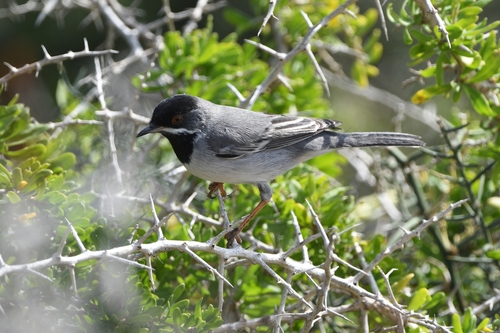
Garden Warbler

Garden Warbler

Sylvia borin

Silhouette: Martin Bulla, based on John Cox's illustration · PhyloPic

LCLeast ConcernNTVUENCR
Daily sighting probability <5% · Rare
at Ramallah

In 3 days ~10% in a week ~20%

15 Verified sightings at Ramallah
1,741 In all 33 parks From 2019 to 2026
May Best month
☀️ Diurnal When it's spotted

About the Garden Warbler

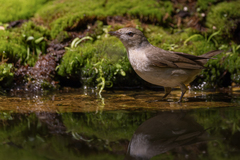
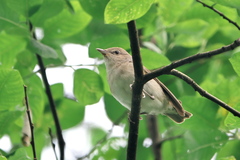
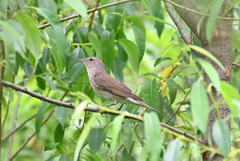
The garden warbler (Sylvia borin) is a common and widespread small bird that breeds in most of Europe and in the Palearctic to western Siberia. It is a plain, long-winged and long-tailed warbler with brown upperparts and dull white underparts; the sexes are similar and juveniles resemble the adults. Its two subspecies differ only slightly and interbreed where their ranges overlap. Due to its lack of distinguishing features, this species can be confused with a number of other unstreaked warblers. The garden warbler's rich melodic song is similar to that of the blackcap, its closest relative, which competes with it for territory when nesting in the same woodland.

The preferred breeding habitat in Eurasia is open woodland with dense low cover for nesting; despite its name, gardens are rarely occupied by this small passerine bird. The clutch of four or five blotched cream or white eggs is laid in a robust cup-shaped nest built near the ground and concealed by dense vegetation. The eggs are incubated for 11–12 days. The chicks are altricial, hatching naked and with closed eyes, and are fed by both parents. They fledge about 10 days after hatching. Only about a quarter of young birds survive their first year. The garden warbler is strongly migratory, wintering in sub-Saharan Africa. A wide range of habitats are used in Africa, but closed forest and treeless Sahel are both shunned. Insects are the main food in the breeding season, although fruit predominates when birds are fattening prior to migration, figs being a particular favourite where available. These warblers have a mixed diet of insects and fruit in their African wintering grounds.

The garden warbler is hunted by Eurasian sparrowhawks and domestic cats, and its eggs and nestlings are taken by a variety of mammalian and avian predators. It may be host to various fleas, mites and internal parasites, and it is a host of the common cuckoo, a brood parasite. The large and fairly stable numbers and huge range of the garden warbler mean that it is classed as least concern by the International Union for Conservation of Nature. Despite a small population decline in much of its European range, the bird's breeding distribution is expanding northwards in Scandinavia. Wikipedia →

Sounds

Call0:08

Sweden · 2024

© Zsombor Károlyi · XC1163365 · CC BY-NC-SA 4.0

Song1:19

Poland · 2026

© Romuald Mikusek · XC1151593 · CC BY-NC-SA 4.0

Imitation0:52

Netherlands · 2024

© Jorge Leitão · XC911362 · CC BY-NC-SA 4.0

Global Distribution

Parks Where Found

# Park Country Daily sighting probability
1 Białowieża National Park 🇵🇱 Poland
~20%
2 Biebrza National Park 🇵🇱 Poland
~10%
3 Ecrins National Park 🇫🇷 France
~10%
4 Bavarian Forest National Park 🇩🇪 Germany
~10%
5 Picos de Europa National Park 🇪🇸 Spain
~10%
6 Ordesa y Monte Perdido National Park 🇪🇸 Spain
~10%
7 Tsavo West National Park 🇰🇪 Kenya
~10%
8 Gauja National Park 🇱🇻 Latvia
~10%
9 Mercantour National Park 🇫🇷 France
<5%
10 Snowdonia National Park 🇬🇧 United Kingdom
<5%
11 Pyrénées National Park 🇫🇷 France
<5%
12 Sierra de Guadarrama National Park 🇪🇸 Spain
<5%
13 Wadden Sea National Park 🇩🇪 Germany
<5%
14 Hortobágy National Park 🇭🇺 Hungary
<5%
15 Fertő-Hanság National Park 🇭🇺 Hungary
<5%
16 Arusha National Park 🇹🇿 Tanzania
<5%
17 Nairobi National Park 🇰🇪 Kenya
<5%
18 Tatra National Park 🇸🇰 Slovakia
<5%
19 Cévennes National Park 🇫🇷 France
<5%
20 Aigüestortes National Park 🇪🇸 Spain
<5%
21 Sierra Nevada National Park 🇪🇸 Spain
<5%
22 Doñana National Park 🇪🇸 Spain
<5%
23 Cairngorms National Park 🇬🇧 United Kingdom
<5%
24 Camargue 🇫🇷 France
<5%
25 Lake Mburo National Park 🇺🇬 Uganda
<5%
26 Triglav National Park 🇸🇮 Slovenia
<5%
27 Monfragüe National Park 🇪🇸 Spain
<5%
28 Lake Nakuru National Park 🇰🇪 Kenya
<5%
29 Etosha National Park 🇳🇦 Namibia
<5%
30 Kibale National Park 🇺🇬 Uganda
<5%
31 Ngorongoro Conservation Area 🇹🇿 Tanzania
<5%
32 Masai Mara National Reserve 🇰🇪 Kenya
<5%
33 Kruger National Park 🇿🇦 South Africa
<5%

Cities Where Found

# City Country Daily sighting probability
1 Jerusalem 🇮🇱 Israel
~20%
2 Yekaterinburg 🇷🇺 Russia
~10%
3 Novosibirsk 🇷🇺 Russia
~10%
4 Helsinki 🇫🇮 Finland
~10%
5 Kazan 🇷🇺 Russia
~10%
6 Cologne 🇩🇪 Germany
~10%
7 Minsk 🇧🇾 Belarus
~10%
8 Saint Petersburg 🇷🇺 Russia
<5%
9 Stockholm 🇸🇪 Sweden
<5%
10 Yerevan 🇦🇲 Armenia
<5%

Before you go

What are the chances of seeing a Garden Warbler in Ramallah?

Rare

Under 5% of wildlife watchers report a Garden Warbler sighting in Ramallah on a given day, based on 15 verified sightings from GBIF citizen-science data. It is the 87th most-seen of the 118 birds we can rate there. Over three days the chance rises to about 10%, and over a week to about 20%, if each day is a fresh chance.

When is the best time to see a Garden Warbler in Ramallah?

May

In that month about 20% of wildlife watchers report a Garden Warbler in Ramallah on a given day, against under 5% in June–August and October–April, the lowest months. That is one of Ramallah's driest months, with about 5 mm of rain against 90 mm in January.

What time of day is best to see a Garden Warbler?

Between 7 and 10 am

Across all the parks we cover, that three-hour window holds the most Garden Warbler sightings with a recorded time, and about 9 in 10 of them come between 6 am and 6 pm: it is a daytime animal.

Is Ramallah the best place to see a Garden Warbler?

15th of 48

Of the 48 cities where we can rate Garden Warbler sightings, Ramallah ranks 15th at under 5%. The best odds are in Jerusalem (Israel, about 20%), Yekaterinburg (Russia, about 10%) and Novosibirsk (Russia, about 10%).

Which relatives of the Garden Warbler live in Ramallah?

Same genus: Sylvia

The closest relatives of the Garden Warbler that you can see in Ramallah (genus Sylvia, Sylvia Warblers) are Blackcap (about 50%), Lesser Whitethroat (about 40%) and Whitethroat (about 10%), with each one's daily chance of a sighting.

Where does the Garden Warbler sighting chance come from?

GBIF citizen-science records

It is estimated from how often the Garden Warbler is recorded against all the birds logged in Ramallah (15 verified sightings), calibrated against known sighting rates. Figures are rounded to the nearest 10% because citizen-science data supports honest approximations, not decimals, and months with records from fewer than five people show "—". How it works.

← Back to Ramallah