Eurasian Spoonbill

Eurasian Spoonbill

Platalea leucorodia

Silhouette: Jamie Whitehouse · PhyloPic

LCLeast ConcernNTVUENCR
Daily sighting probability <5% · Rare
at Surat

In 3 days ~10% in a week ~30%

7 Verified sightings at Surat
9,983 In all 19 parks From 2019 to 2026
January Best month
☀️ Diurnal When it's spotted

About the Eurasian Spoonbill

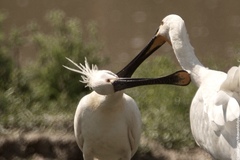
The Eurasian spoonbill (Platalea leucorodia), or common spoonbill, is a wading bird of the ibis and spoonbill family Threskiornithidae, native to Europe, Africa and Asia. The species is partially migratory with the more northerly breeding populations mostly migrating south for the winter.

The Eurasian spoonbill was formally described in 1758 by the Swedish naturalist Carl Linnaeus in the tenth edition of his Systema Naturae under the current binomial name Platalea leucorodia. Linnaeus cited works by earlier authors including the description and illustration by the English naturalist Eleazar Albin that was published in 1734. Linnaeus specified the type locality as Europe but restricted it to Sweden in 1761. The genus name Platalea is Latin and means "broad", referring to the distinctive shape of the bill; the specific epithet leucorodia is from Ancient Greek leukerodios meaning "spoonbill", itself derived from leukos, "white" and erodios "heron". A molecular phylogenetic study of the spoonbills based on mitochondrial DNA found that the Eurasian spoonbill is sister taxon to a clade containing the royal and black-faced spoonbills. In England it was traditionally known as... Wikipedia →

Sounds

Begging call0:12

United Kingdom · 2023

© Frank Lambert · XC816205 · CC BY-NC-ND 4.0

Nocturnal flight call0:16

Mongolia · 2022

© Stanislas Wroza · XC768152 · CC BY-NC-SA 4.0

Call0:12

Portugal · 2022

© Jorge Leitão · XC750733 · CC BY-NC-SA 4.0

Global Distribution

Parks Where Found

# Park Country Daily sighting probability
1 Doñana National Park 🇪🇸 Spain
~60%
2 Hortobágy National Park 🇭🇺 Hungary
~50%
3 Keoladeo National Park 🇮🇳 India
~50%
4 Yala National Park 🇱🇰 Sri Lanka
~50%
5 Kiskunság National Park 🇭🇺 Hungary
~40%
6 Camargue 🇫🇷 France
~30%
7 Wadden Sea National Park 🇩🇪 Germany
~30%
8 Fertő-Hanság National Park 🇭🇺 Hungary
~20%
9 Udawalawe National Park 🇱🇰 Sri Lanka
~20%
10 Monfragüe National Park 🇪🇸 Spain
~10%
11 Wilpattu National Park 🇱🇰 Sri Lanka
~10%
12 Ranthambore National Park 🇮🇳 India
<5%
13 Minneriya National Park 🇱🇰 Sri Lanka
<5%
14 Satpura National Park 🇮🇳 India
<5%
15 Sierra de Guadarrama National Park 🇪🇸 Spain
<5%
16 Bavarian Forest National Park 🇩🇪 Germany
<5%
17 Nagarhole National Park 🇮🇳 India
<5%
18 Bandipur National Park 🇮🇳 India
<5%
19 Kanha National Park 🇮🇳 India
<5%

Cities Where Found

# City Country Daily sighting probability
1 Naha 🇯🇵 Japan
~20%
2 Agra 🇮🇳 India
~20%
3 Quanzhou 🇨🇳 China
~20%
4 Rabat 🇲🇦 Morocco
~20%
5 Vasai-Virar 🇮🇳 India
~20%
6 Chennai 🇮🇳 India
~10%
7 Dakar 🇸🇳 Senegal
~10%
8 Rajkot 🇮🇳 India
~10%
9 Mumbai 🇮🇳 India
~10%
10 Kalyan-Dombivli 🇮🇳 India
~10%

Zoos & Centres Where Found

# Zoo / Centre Country
1 Pairi Daiza 🇧🇪 Belgium In captivity
2 Prague Zoo 🇨🇿 Czechia In captivity
3 Natura Artis Magistra 🇳🇱 Netherlands In captivity
4 Dublin Zoo 🇮🇪 Ireland In captivity
5 Barcelona Zoo 🇪🇸 Spain In captivity
6 Dvůr Králové Zoo 🇨🇿 Czechia In captivity
7 Paris Zoological Park 🇫🇷 France In captivity
8 Parc des oiseaux 🇫🇷 France In captivity
9 Aquarium du palais de la Porte Dorée 🇫🇷 France In captivity
10 Zoobotánico Jerez 🇪🇸 Spain In captivity
11 Safaripark Beekse Bergen 🇳🇱 Netherlands In captivity
12 Parc animalier de Sainte-Croix 🇫🇷 France In captivity
13 Beijing Zoo 🇨🇳 China In captivity
14 Parc ornithologique de Pont-de-Gau 🇫🇷 France In captivity
15 Cotswold Wildlife Park 🇬🇧 United Kingdom In captivity
16 Nuremberg Zoo 🇩🇪 Germany In captivity
17 Tiergarten Am Tiergarten 28 in Nürnberg 🇩🇪 Germany In captivity
18 Slimbridge Wetland Centre 🇬🇧 United Kingdom In captivity
19 Sanjay Gandhi Biological Park 🇮🇳 India In captivity
20 Toyama Municipal Family Park Zoo 🇯🇵 Japan In captivity
21 Mysore Zoo 🇮🇳 India In captivity
22 Kyiv Zoo 🇺🇦 Ukraine In captivity
23 Bannerghatta Zoo 🇮🇳 India In captivity
24 Berlin Zoological Garden 🇩🇪 Germany In captivity
25 Dierenpark Hoenderdaell 🇳🇱 Netherlands In captivity
26 Zhengzhou Zoo 🇨🇳 China In captivity
27 Alipore Zoological Gardens 🇮🇳 India In captivity
28 Attica Zoological Park 🇬🇷 Greece In captivity
29 Augsburg Zoo 🇩🇪 Germany In captivity
30 Krakow Zoo 🇵🇱 Poland In captivity
31 Aquarama Barcelona 🇪🇸 Spain In captivity
32 Le Cornelle 🇮🇹 Italy In captivity
33 National Zoological Gardens of Sri Lanka 🇱🇰 Sri Lanka In captivity
34 Oasi Naturalistica di Sant'Alessio 🇮🇹 Italy In captivity
35 Ueno Zoological Gardens (West Garden) 🇯🇵 Japan In captivity
36 L'Oceanogràfic 🇪🇸 Spain In captivity
37 Leningrad Zoo 🇷🇺 Russia In captivity
38 Pyrénées Animal Park 🇫🇷 France In captivity
39 Zoopark Limpopo 🇷🇺 Russia In captivity
40 Las Águilas Jungle Park 🇪🇸 Spain In captivity
41 Zoo de Córdoba 🇪🇸 Spain In captivity
42 Belgrade Zoo 🇷🇸 Serbia In captivity
43 Bird Park Steinen 🇩🇪 Germany In captivity
44 Parco Zoo 🇮🇹 Italy In captivity
45 Santillana Zoo 🇪🇸 Spain In captivity
46 Beijing Aquarium 🇨🇳 China In captivity
47 Zoo de Lourosa 🇵🇹 Portugal In captivity
48 Aquarium Berlin 🇩🇪 Germany In captivity
49 Rákosův pavilon 🇨🇿 Czechia In captivity
50 Tiergarten Am Tiergarten 12 in Nürnberg 🇩🇪 Germany In captivity

Before you go

What are the chances of seeing a Eurasian Spoonbill in Surat?

Rare

Under 5% of wildlife watchers report a Eurasian Spoonbill sighting in Surat on a given day, based on 7 verified sightings from GBIF citizen-science data. It is the 95th most-seen of the 114 birds we can rate there. Over three days the chance rises to about 10%, and over a week to about 30%, if each day is a fresh chance.

When is the best time to see a Eurasian Spoonbill in Surat?

September–October and December–January

In those months about 10% of wildlife watchers report a Eurasian Spoonbill in Surat on a given day, against under 5% in February–August and November, the lowest months. Those are among Surat's driest months, with about 65 mm of rain a month against 450 mm in July.

What time of day is best to see a Eurasian Spoonbill?

Between 11 am and 2 pm

Across all the parks we cover, that three-hour window holds the most Eurasian Spoonbill sightings with a recorded time, and about 7 in 10 of them come between 6 am and 6 pm: it is a daytime animal.

Is Surat the best place to see a Eurasian Spoonbill?

16th of 53

Of the 53 cities where we can rate Eurasian Spoonbill sightings, Surat ranks 16th at under 5%. The best odds are in Naha (Japan, about 20%), Agra (India, about 20%) and Quanzhou (China, about 20%).

Which relatives of the Eurasian Spoonbill live in Surat?

Same family: Threskiornithidae

The closest relatives of the Eurasian Spoonbill that you can see in Surat (family Threskiornithidae, Ibises and Spoonbills) are Black-headed Ibis (about 20%) and Glossy Ibis (about 10%), with each one's daily chance of a sighting.

Where does the Eurasian Spoonbill sighting chance come from?

GBIF citizen-science records

It is estimated from how often the Eurasian Spoonbill is recorded against all the birds logged in Surat (7 verified sightings), calibrated against known sighting rates. Figures are rounded to the nearest 10% because citizen-science data supports honest approximations, not decimals, and months with records from fewer than five people show "—". How it works.

← Back to Surat