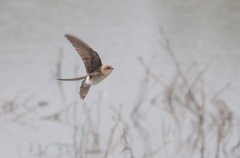
Fairy Martin

Fairy Martin

Petrochelidon ariel

Silhouette: Andy Wilson · PhyloPic

LCLeast ConcernNTVUENCR
Daily sighting probability ~10% · With luck
at Sydney

In 3 days ~20% in a week ~40%

1,223 Verified sightings at Sydney
375 In all 14 parks From 2019 to 2026
October Best month
☀️ Diurnal When it's spotted

About the Fairy Martin

The fairy martin (Petrochelidon ariel) is a member of the swallow family of passerine birds which breeds in Australia. It is migratory wintering through most of Australia, with some birds reaching New Guinea and Indonesia. It is increasingly a wanderer to New Zealand, where it may have bred. This species is frequently placed in the genus Hirundo as Hirundo ariel.

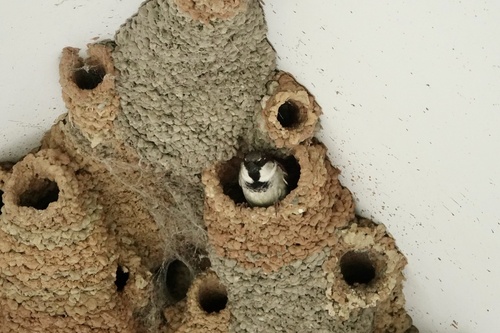
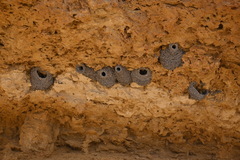
This is a bird of open country near water, and is usually seen near its nest sites in cliffs, culverts or bridges. The fairy martin is dumpy and square tailed. It averages 12 centimetres (4.7 in) long and weighs 11 grams (0.39 oz). The adult has an iridescent blue back, brown wings and tail, a rufous crown and nape, and a whitish rump. The underparts are dull white. The sexes are similar, but young birds are duller and browner, with a paler forehead and pale fringes to the back and wing feathers.

This species can be distinguished from other Australian swallows by its pale rump. The most similar species, the tree martin, has a shallowly forked tail and blue-black head and nape. The call of this vocal swallow is a chrrrr and the song is a high-pitched twitter. The vocalizations are higher pitched than those... Wikipedia →
Sounds

Call0:27

Australia · 2022

© Marc Anderson · XC816326 · CC BY-NC-ND 4.0

Call0:10

Australia · 2009

© Mark Harper · XC40563 · CC BY-NC-ND 2.5

Recording0:21

Australia · 2018

© deborod · iNaturalist · CC BY-NC 4.0

Global Distribution

Parks Where Found

# Park Country Daily sighting probability
1 Uluru-Kata Tjuta National Park 🇦🇺 Australia
~40%
2 Nitmiluk National Park 🇦🇺 Australia
~10%
3 Daintree National Park 🇦🇺 Australia
<5%
4 Kosciuszko National Park 🇦🇺 Australia
<5%
5 Flinders Ranges National Park 🇦🇺 Australia
<5%
6 Ningaloo Marine Park 🇦🇺 Australia
<5%
7 Litchfield National Park 🇦🇺 Australia
<5%
8 Great Otway National Park 🇦🇺 Australia
<5%
9 Booderee National Park 🇦🇺 Australia
<5%
10 Wilsons Promontory National Park 🇦🇺 Australia
<5%
11 Royal National Park 🇦🇺 Australia
<5%
12 Hattah-Kulkyne National Park 🇦🇺 Australia
<5%
13 Blue Mountains National Park 🇦🇺 Australia
<5%
14 Lamington National Park 🇦🇺 Australia
<5%

Cities Where Found

# City Country Daily sighting probability
1 Brisbane 🇦🇺 Australia
~10%
2 Sydney 🇦🇺 Australia
~10%
3 Melbourne 🇦🇺 Australia
<5%

Before you go

What are the chances of seeing a Fairy Martin in Sydney?

With luck

About 10% of wildlife watchers report a Fairy Martin sighting in Sydney on a given day, based on 1,223 verified sightings from GBIF citizen-science data. It is the 72nd most-seen of the 243 birds we can rate there. Over three days the chance rises to about 20%, and over a week to about 40%, if each day is a fresh chance.

When is the best time to see a Fairy Martin in Sydney?

September to February

In those months about 10% of wildlife watchers report a Fairy Martin in Sydney on a given day, against under 5% in March to August, the lowest months.

What time of day is best to see a Fairy Martin?

Between 9 am and noon

Across all the parks we cover, that three-hour window holds the most Fairy Martin sightings with a recorded time, and about 9 in 10 of them come between 6 am and 6 pm: it is a daytime animal.

Is Sydney the best place to see a Fairy Martin?

Among the best

Of the 3 cities where we can rate Fairy Martin sightings, Sydney ranks 2nd at about 10%, level with the leaders once rounded. The best odds are in Brisbane (Australia, about 10%).

Where does the Fairy Martin sighting chance come from?

GBIF citizen-science records

It is estimated from how often the Fairy Martin is recorded against all the birds logged in Sydney (1,223 verified sightings), calibrated against known sighting rates. Figures are rounded to the nearest 10% because citizen-science data supports honest approximations, not decimals, and months with records from fewer than five people show "—". How it works.

← Back to Sydney