Tree Martin

Tree Martin

Petrochelidon nigricans

Silhouette: Andy Wilson · PhyloPic

LCLeast ConcernNTVUENCR
Daily sighting probability <5% · Rare
at Sydney

In 3 days ~10% in a week ~20%

586 Verified sightings at Sydney
2,160 In all 22 parks From 2019 to 2026
December Best month
☀️ Diurnal When it's spotted

About the Tree Martin

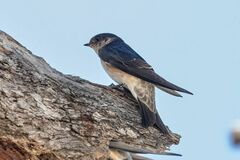
The tree martin (Petrochelidon nigricans) is a member of the swallow family of passerine birds. It breeds in Australia, mostly south of latitude 20°S, and on Timor island. It is migratory, wintering through most of Australia, New Guinea, Indonesia east of the Wallace Line, and the Solomon Islands. It is a vagrant to New Zealand, where it has bred, and New Caledonia. This species is frequently placed in the genus Hirundo as Hirundo nigricans.

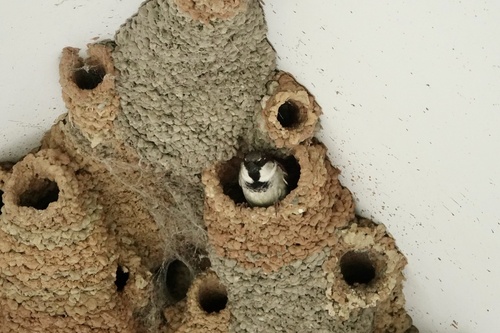
This is a bird of open woodland, preferably with large trees to provide nest holes. It is increasingly common in urban and suburban areas. The tree martin was formally described in 1817 by the French ornithologist Louis Vieillot under the binomial name Hirundo nigricans. The specific epithet is Latin meaning "blackish". Vieillot gave the type locality as "Nouvelle-Hollande" (New South Wales) but this has been corrected to Hobart, Tasmania. The tree martin is now one of ten swallows placed in the genus Petrochelidon that was introduced in 1851 by the German ornithologist Jean Cabanis.

Three subspecies are recognised: Wikipedia →

Sounds

Flight call0:45

Australia · 2021

© Eddy Smith · XC743570 · CC BY-NC-SA 4.0

Call0:46

Australia · 2020

© Marc Anderson · XC673841 · CC BY-NC-ND 4.0

Song1:13

Australia · 2015

© Frank Lambert · XC407788 · CC BY-NC-ND 4.0

Global Distribution

Parks Where Found

# Park Country Daily sighting probability
1 Maria Island National Park 🇦🇺 Australia
~60%
2 Rottnest Island 🇦🇺 Australia
~50%
3 Flinders Ranges National Park 🇦🇺 Australia
~40%
4 Flinders Chase 🇦🇺 Australia
~30%
5 Daintree National Park 🇦🇺 Australia
~30%
6 Uluru-Kata Tjuta National Park 🇦🇺 Australia
~20%
7 Cape Range 🇦🇺 Australia
~20%
8 Ningaloo Marine Park 🇦🇺 Australia
~20%
9 Freycinet National Park 🇦🇺 Australia
~10%
10 Hattah-Kulkyne National Park 🇦🇺 Australia
~10%
11 Litchfield National Park 🇦🇺 Australia
~10%
12 Grampians National Park 🇦🇺 Australia
~10%
13 Kosciuszko National Park 🇦🇺 Australia
~10%
14 Great Otway National Park 🇦🇺 Australia
~10%
15 Noosa National Park 🇦🇺 Australia
<5%
16 Blue Mountains National Park 🇦🇺 Australia
<5%
17 Springbrook National Park 🇦🇺 Australia
<5%
18 Cradle Mountain-Lake St Clair National Park 🇦🇺 Australia
<5%
19 Lamington National Park 🇦🇺 Australia
<5%
20 Wilsons Promontory National Park 🇦🇺 Australia
<5%
21 Kakadu National Park 🇦🇺 Australia
<5%
22 Royal National Park 🇦🇺 Australia
<5%

Cities Where Found

# City Country Daily sighting probability
1 Perth 🇦🇺 Australia
~30%
2 Brisbane 🇦🇺 Australia
~20%
3 Hobart 🇦🇺 Australia
~10%
4 Sydney 🇦🇺 Australia
<5%
5 Melbourne 🇦🇺 Australia
<5%

Before you go

What are the chances of seeing a Tree Martin in Sydney?

Rare

Under 5% of wildlife watchers report a Tree Martin sighting in Sydney on a given day, based on 586 verified sightings from GBIF citizen-science data. It is the 98th most-seen of the 243 birds we can rate there. Over three days the chance rises to about 10%, and over a week to about 20%, if each day is a fresh chance.

When is the best time to see a Tree Martin in Sydney?

December

In that month about 10% of wildlife watchers report a Tree Martin in Sydney on a given day, against under 5% in January to November, the lowest months.

What time of day is best to see a Tree Martin?

Between 8 and 11 am

Across all the parks we cover, that three-hour window holds the most Tree Martin sightings with a recorded time, and about 9 in 10 of them come between 6 am and 6 pm: it is a daytime animal.

Is Sydney the best place to see a Tree Martin?

4th of 5

Of the 5 cities where we can rate Tree Martin sightings, Sydney ranks 4th at under 5%. The best odds are in Perth (Australia, about 30%), Brisbane (Australia, about 20%) and Hobart (Australia, about 10%).

Where does the Tree Martin sighting chance come from?

GBIF citizen-science records

It is estimated from how often the Tree Martin is recorded against all the birds logged in Sydney (586 verified sightings), calibrated against known sighting rates. Figures are rounded to the nearest 10% because citizen-science data supports honest approximations, not decimals, and months with records from fewer than five people show "—". How it works.

← Back to Sydney