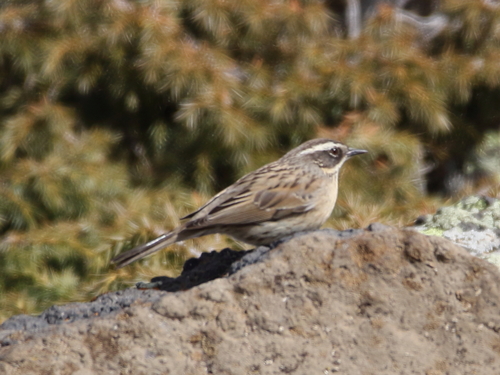
Dunnock

Dunnock

Prunella modularis

Silhouette: Matt Wilkins · PhyloPic

LCLeast ConcernNTVUENCR
Daily sighting probability ~10% · With luck
at Tehran

In 3 days ~20% in a week ~50%

72 Verified sightings at Tehran
8,534 In all 31 parks From 2019 to 2026
February Best month
☀️ Diurnal When it's spotted

About the Dunnock

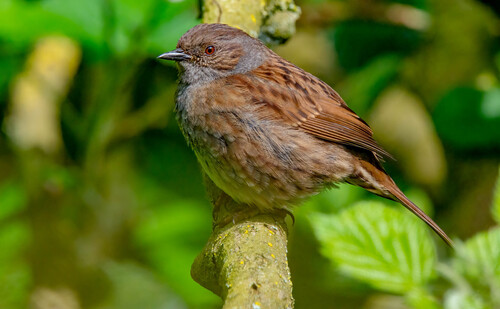
The dunnock (Prunella modularis) is a small passerine, or perching bird, found throughout temperate Europe and into Asian Russia. Dunnocks have also been introduced and become common in New Zealand. It is the most widespread member of the accentor family; most other accentors are limited to mountain habitats. Other, largely archaic, English names for the dunnock include hedge accentor, hedge sparrow, hedge warbler, and titling.

The dunnock was described by the Swedish naturalist Carl Linnaeus in 1758 in the tenth edition of his Systema Naturae. He coined the binomial name of Motacilla modularis. The specific epithet is from the Latin modularis "modulating" or "singing". This species is now placed in the genus Prunella that was introduced by the French ornithologist Louis Pierre Vieillot in 1816.

The name "dunnock" comes from the English dun (dingy brown, dark-coloured) and the diminutive form of bird ock (thus, the original "little brown bird"), while "accentor" is from post-classical Latin and means a person who sings with another. The genus name Prunella is from the German Braunelle, "dunnock", a diminutive of braun, "brown".

Seven subspecies are accepted by the IOC... Wikipedia →
Sounds

Song0:47

France · 2026

© Gautier Laurent · XC1185211 · CC BY-NC-SA 4.0

Begging call0:12

United Kingdom · 2026

© Anthony McGeehan · XC1143252 · CC BY-NC-SA 4.0

Song0:46

France · 2026

© Grégoire Chauvot · XC1157855 · CC BY-NC-SA 4.0

Global Distribution

Parks Where Found

# Park Country Daily sighting probability
1 Aoraki Mount Cook National Park 🇳🇿 New Zealand
~70%
2 Arthur's Pass National Park 🇳🇿 New Zealand
~50%
3 Snowdonia National Park 🇬🇧 United Kingdom
~50%
4 Aigüestortes National Park 🇪🇸 Spain
~40%
5 Rakiura National Park 🇳🇿 New Zealand
~30%
6 Tatra National Park 🇸🇰 Slovakia
~30%
7 Picos de Europa National Park 🇪🇸 Spain
~30%
8 Fiordland National Park 🇳🇿 New Zealand
~30%
9 Cairngorms National Park 🇬🇧 United Kingdom
~30%
10 Pyrénées National Park 🇫🇷 France
~20%
11 Ordesa y Monte Perdido National Park 🇪🇸 Spain
~20%
12 Sierra de Guadarrama National Park 🇪🇸 Spain
~20%
13 Ecrins National Park 🇫🇷 France
~20%
14 Hohe Tauern National Park 🇦🇹 Austria
~20%
15 Egmont National Park 🇳🇿 New Zealand
~20%
16 Wadden Sea National Park 🇩🇪 Germany
~10%
17 Bavarian Forest National Park 🇩🇪 Germany
~10%
18 Białowieża National Park 🇵🇱 Poland
~10%
19 Mercantour National Park 🇫🇷 France
~10%
20 Triglav National Park 🇸🇮 Slovenia
~10%
21 Abel Tasman National Park 🇳🇿 New Zealand
~10%
22 Vanoise National Park 🇫🇷 France
~10%
23 Biebrza National Park 🇵🇱 Poland
~10%
24 Cévennes National Park 🇫🇷 France
~10%
25 Gauja National Park 🇱🇻 Latvia
~10%
26 Kiskunság National Park 🇭🇺 Hungary
<5%
27 Hortobágy National Park 🇭🇺 Hungary
<5%
28 Sierra Nevada National Park 🇪🇸 Spain
<5%
29 Monfragüe National Park 🇪🇸 Spain
<5%
30 Fertő-Hanság National Park 🇭🇺 Hungary
<5%
31 Camargue 🇫🇷 France
<5%

Cities Where Found

# City Country Daily sighting probability
1 Liverpool 🇬🇧 United Kingdom
~70%
2 Manchester 🇬🇧 United Kingdom
~60%
3 Birmingham 🇬🇧 United Kingdom
~50%
4 London 🇬🇧 United Kingdom
~40%
5 Leeds 🇬🇧 United Kingdom
~40%
6 Cologne 🇩🇪 Germany
~40%
7 Dublin 🇮🇪 Ireland
~40%
8 Essen 🇩🇪 Germany
~40%
9 Brussels 🇧🇪 Belgium
~30%
10 Paris 🇫🇷 France
~20%

Before you go

What are the chances of seeing a Dunnock in Tehran?

With luck

About 10% of wildlife watchers report a Dunnock sighting in Tehran on a given day, based on 72 verified sightings from GBIF citizen-science data. It is the 43rd most-seen of the 113 birds we can rate there. Over three days the chance rises to about 20%, and over a week to about 50%, if each day is a fresh chance.

When is the best time to see a Dunnock in Tehran?

December to February

In those months about 20% of wildlife watchers report a Dunnock in Tehran on a given day, against under 5% in April to October, the lowest months.

What time of day is best to see a Dunnock?

Between 9 am and noon

Across all the parks we cover, that three-hour window holds the most Dunnock sightings with a recorded time, and about 9 in 10 of them come between 6 am and 6 pm: it is a daytime animal.

Is Tehran the best place to see a Dunnock?

16th of 46

Of the 46 cities where we can rate Dunnock sightings, Tehran ranks 16th at about 10%. The best odds are in Liverpool (United Kingdom, about 70%), Manchester (United Kingdom, about 60%) and Birmingham (United Kingdom, about 50%).

Where does the Dunnock sighting chance come from?

GBIF citizen-science records

It is estimated from how often the Dunnock is recorded against all the birds logged in Tehran (72 verified sightings), calibrated against known sighting rates. Figures are rounded to the nearest 10% because citizen-science data supports honest approximations, not decimals, and months with records from fewer than five people show "—". How it works.

← Back to Tehran