



Completed

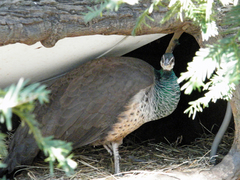


Common Peafowl
Pavo cristatus
Silhouette: PhyloPic
- KingdomAnimalia (Animals)
- PhylumChordata (Chordates)
- ClassAves (Birds)
- OrderGalliformes (Landfowl)
- FamilyPhasianidae (Pheasants, Grouse, and Allies)
- GenusPavo (Peafowl)
- SpeciesPavo cristatus (Common Peafowl)
In 3 days ~70% in a week >90%
496 Verified sightings at Vadodara
26,919 In all 27 parks From 2019 to 2026
June Best month
☀️ Diurnal When it's spotted
About the Common Peafowl
The Indian peafowl (Pavo cristatus), also known as the common peafowl, or blue peafowl, is a species of peafowl native to the Indian subcontinent. While it originated in the Indian subcontinent, it has since been introduced to many other parts of the world. Male peafowl are referred to as peacocks, and female peafowl are referred to as peahens, although both sexes are often referred to colloquially as a "peacock".
The Indian peafowl displays a marked form of sexual dimorphism. The brightly coloured male has a blue coloured head with a fan-shaped crest and is best known for his long train. The train is made up of elongated upper-tail covert feathers with colourful eyespots. These stiff feathers are raised into a fan and quivered in a display during courtship. The peahen is predominantly brown in colour, with a white face and iridescent green lower neck, and lacks the elaborate train. There are several colour mutations of the Indian peafowl including the leucistic white peafowl.
Despite the length and size of the covert feathers, the peacock is still capable of flight. The peafowl lives mainly on the ground in open forests or on cultivable lands where it forages for berries and grains, and also preys on snakes, lizards and small rodents. It makes loud calls, which makes it easier to detect, and are often used to indicate the presence of a predator in the forest areas. It forages on the ground in small groups and usually escapes on foot through undergrowth and avoids flying, though it flies into tall trees to roost.
The function of the Indian peacock's elaborate train has been debated for more than a century. In the 19th century, Charles Darwin found it a puzzle, hard to explain through ordinary natural selection. His later explanation, sexual selection, is widely but not universally accepted. In the 20th century, Amotz Zahavi argued that the train was a handicap, and that males were honestly signalling their fitness in proportion to the splendour of their trains. Despite extensive study, opinions remain divided on the mechanisms involved.
The Indian peafowl is listed as Least Concern on the IUCN Red List. It is the national bird of India and venerated in Hindu and Greek mythology. Wikipedia →
Recent sightings of Common Peafowl in Vadodara
LIVEiNaturalistGlobal Distribution
Parks Where Found
Cities Where Found
| # | City | Country | Daily sighting probability |
|---|---|---|---|
| 1 | Tiruppur | 🇮🇳 India | |
| 2 | Ahmedabad | 🇮🇳 India | |
| 3 | Coimbatore | 🇮🇳 India | |
| 4 | Aligarh | 🇮🇳 India | |
| 5 | Tiruchirappalli | 🇮🇳 India | |
| 6 | Jaipur | 🇮🇳 India | |
| 7 | Gwalior | 🇮🇳 India | |
| 8 | Indore | 🇮🇳 India | |
| 9 | Bhopal | 🇮🇳 India | |
| 10 | Chandigarh | 🇮🇳 India |
Zoos & Centres Where Found
Closest Relatives at Vadodara










Before you go
What are the chances of seeing a Common Peafowl in Vadodara?
Likely
About 40% of wildlife watchers report a Common Peafowl sighting in Vadodara on a given day, based on 496 verified sightings from GBIF citizen-science data. It is the 19th most-seen of the 168 birds we can rate there. Over three days the chance rises to about 70%, and over a week to over 90%, if each day is a fresh chance.
When is the best time to see a Common Peafowl in Vadodara?
June
In that month about 60% of wildlife watchers report a Common Peafowl in Vadodara on a given day, against about 20% in January and March, the lowest months. That is one of Vadodara's wettest months, with about 140 mm of rain against almost none in January.
What time of day is best to see a Common Peafowl?
Between 3 and 6 pm
Across all the parks we cover, that three-hour window holds the most Common Peafowl sightings with a recorded time, and about 9 in 10 of them come between 6 am and 6 pm: it is a daytime animal.
Is Vadodara the best place to see a Common Peafowl?
19th of 87
Of the 87 cities where we can rate Common Peafowl sightings, Vadodara ranks 19th at about 40%. The best odds are in Tiruppur (India, about 90%), Ahmedabad (India, about 70%) and Coimbatore (India, about 70%).
Where does the Common Peafowl sighting chance come from?
GBIF citizen-science records
It is estimated from how often the Common Peafowl is recorded against all the birds logged in Vadodara (496 verified sightings), calibrated against known sighting rates. Figures are rounded to the nearest 10% because citizen-science data supports honest approximations, not decimals, and months with records from fewer than five people show "—". How it works.
