Great Potoo

Great Potoo

Nyctibius grandis

Silhouette: Dominic Sherony (photo) and Albertonykus (silhouette) · PhyloPic

LCLeast ConcernNTVUENCR
Daily sighting probability <5% · Rare
at Valencia, Venezuela

In 3 days ~10%

28 Verified sightings at Valencia, Venezuela
3,916 In all 23 parks From 2019 to 2026
April Best month
🌅 Crepuscular When it's spotted

About the Great Potoo

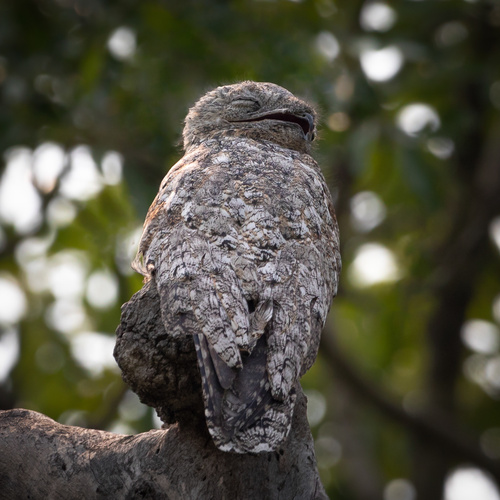
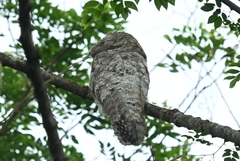
The great potoo or grand potoo (Nyctibius grandis) is the largest potoo species and is widely distributed in Central and South America. Much like owls, this species is nocturnal. It preys on large insects and small vertebrates, which it captures in sallies from high perches.

The great potoo is best known for its distinctive moaning growl, which echoes through the Neotropical night. The great potoo was formally described in 1789 by the German naturalist Johann Friedrich Gmelin in his revised and expanded edition of Carl Lineus's Systema Naturae. He placed it with all the nightjar like species in the genus Caprimulgus and coined the binomial name Caprimulgus grandis. The great potoo is now one of the seven potoos placed in the genus Nyctibius that was introduced in 1816 by the French ornithologist Louis Pierre Vieillot. The genus name is from Ancient Greek nuktibios meaning "night-living", from nux "night" and bios "life". The species is monotypic: no subspecies are recognised.

The great potoo has a large head in relation to its body, large, dark brown eyes, and a short but broad beak. Their wings are elliptical in shape, their tail is elongated,... Wikipedia →
Sounds

Flight call0:07

Brazil · 2025

© Joost van Bruggen · XC1050488 · CC BY-NC-ND 4.0

Song0:29

Ecuador · 2025

© Marc Anderson · XC986569 · CC BY-NC-ND 4.0

Canto0:39

Brazil · 2018

© Caio Brito · XC556452 · CC BY-NC-SA 4.0

Global Distribution

Parks Where Found

# Park Country Daily sighting probability
1 Cuyabeno Wildlife Reserve 🇪🇨 Ecuador
~20%
2 Yasuní National Park 🇪🇨 Ecuador
~10%
3 Manu National Park 🇵🇪 Peru
~10%
4 Tayrona National Natural Park 🇨🇴 Colombia
~10%
5 Parque Estadual Encontro das Águas 🇧🇷 Brazil
~10%
6 Amacayacu National Natural Park 🇨🇴 Colombia
~10%
7 Pico Bonito National Park 🇭🇳 Honduras
~10%
8 Gandoca-Manzanillo Wildlife Refuge 🇨🇷 Costa Rica
~10%
9 Tambopata National Reserve 🇵🇪 Peru
~10%
10 Tortuguero National Park 🇨🇷 Costa Rica
~10%
11 Soberanía National Park 🇵🇦 Panama
~10%
12 Bastimentos Island National Marine Park 🇵🇦 Panama
~10%
13 Cahuita National Park 🇨🇷 Costa Rica
~10%
14 Darién National Park 🇵🇦 Panama
<5%
15 Anavilhanas National Park 🇧🇷 Brazil
<5%
16 Sierra de la Macarena National Park 🇨🇴 Colombia
<5%
17 Parque Natural Metropolitano 🇵🇦 Panama
<5%
18 La Amistad International Park (Panama) 🇵🇦 Panama
<5%
19 Braulio Carrillo National Park 🇨🇷 Costa Rica
<5%
20 Cockscomb Basin Wildlife Sanctuary 🇧🇿 Belize
<5%
21 Tenorio Volcano National Park 🇨🇷 Costa Rica
<5%
22 Chapada dos Guimarães National Park 🇧🇷 Brazil
<5%
23 Arenal Volcano National Park 🇨🇷 Costa Rica
<5%

Cities Where Found

# City Country Daily sighting probability
1 Valencia 🇻🇪 Venezuela
<5%

Zoos & Centres Where Found

# Zoo / Centre Country
1 Complejo Turistico de Quistococha 🇵🇪 Peru In captivity

Before you go

What are the chances of seeing a Great Potoo in Valencia, Venezuela?

Rare

Under 5% of wildlife watchers report a Great Potoo sighting in Valencia, Venezuela on a given day, based on 28 verified sightings from GBIF citizen-science data. It is the 110th most-seen of the 186 birds we can rate there. Over three days the chance rises to about 10%, if each day is a fresh chance.

When is the best time to see a Great Potoo in Valencia, Venezuela?

March and April

In those months about 10% of wildlife watchers report a Great Potoo in Valencia, Venezuela on a given day, against under 5% in May to February, the lowest months. Those are among Valencia, Venezuela's driest months, with about 30 mm of rain a month against 110 mm in August.

What time of day is best to see a Great Potoo?

Between 6 and 9 pm

Across all the parks we cover, that three-hour window holds the most Great Potoo sightings with a recorded time, and about 6 in 10 of them come between 6 am and 6 pm: it is most active around dawn and dusk.

Where else can you see a Great Potoo?

Only Valencia, Venezuela, in our data

Valencia, Venezuela is the only city on Wallace's Line with enough records to rate Great Potoo sightings: under 5% of wildlife watchers there report one on a given day.

Where does the Great Potoo sighting chance come from?

GBIF citizen-science records

It is estimated from how often the Great Potoo is recorded against all the birds logged in Valencia, Venezuela (28 verified sightings), calibrated against known sighting rates. Figures are rounded to the nearest 10% because citizen-science data supports honest approximations, not decimals, and months with records from fewer than five people show "—". How it works.

← Back to Valencia, Venezuela