Ring-necked Duck

Ring-necked Duck

Aythya collaris

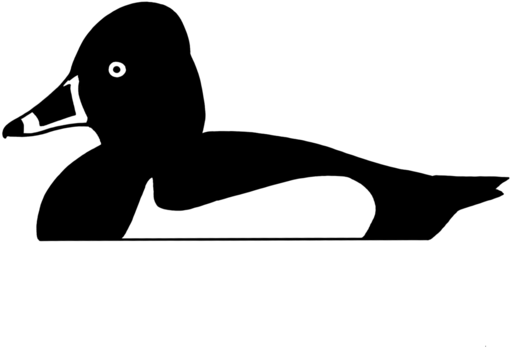
Silhouette: Andy Wilson · PhyloPic

LCLeast ConcernNTVUENCR
Daily sighting probability <5% · Rare
at Congaree National Park

In 3 days <5% in a week ~10%

21 Verified sightings at Congaree National Park From 2019 to 2026
8,321 In all 48 parks
December Best month
☀️ Diurnal When it's spotted

About the Ring-necked Duck

The ring-necked duck (Aythya collaris) is a diving duck from North America commonly found in freshwater ponds and lakes. The scientific name is derived from Greek aithuia, an unidentified seabird mentioned by authors including Hesychius and Aristotle, and Latin collaris, "of the neck" from collum, "neck".

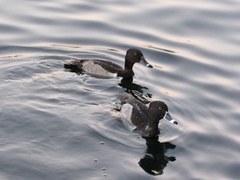
Ring-necked ducks are small to medium-sized diving ducks with the following length, weight, and wingspan measurements: Length: 15.3–18.1 in (39–46 cm) Weight: 17.3–32.1 oz (490–910 g) Wingspan: 24.4–24.8 in (62–63 cm) The adult male is similar in color pattern to the Eurasian tufted duck, its relative. Males are a little bit bigger than the female. It has two white rings surrounding its gray bill, a shiny black angular head, black back, white line on the wings, a white breast and yellow eyes. The adult female has a grayish brown angular head and body with a dark brown back, a dark bill with a more subtle light band than the male, grayish-blue feet and brown eyes with white rings surrounding them. Females also make a noise like trrr. The cinnamon neck ring is usually difficult to observe, which is why the bird is sometimes referred to as a "ringbill". Wikipedia →

Sounds

Call0:59

United States · 2023

© Richard E. Webster · XC941129 · CC BY-NC-SA 4.0

Call0:34

Canada · 2016

© James Bradley · XC333894 · CC BY-NC-SA 4.0

Call0:12

United States · 2012

© Andrew Spencer · XC100902 · CC BY-NC-ND 2.5

Global Distribution

Parks Where Found

# Park Country Daily sighting probability
1 Elk Island National Park 🇨🇦 Canada
~30%
2 Riding Mountain National Park 🇨🇦 Canada
~30%
3 Wrangell-St. Elias National Park 🇺🇸 United States
~20%
4 Death Valley National Park 🇺🇸 United States
~20%
5 Banff National Park 🇨🇦 Canada
~20%
6 Yellowstone National Park 🇺🇸 United States
~20%
7 Merritt Island National Wildlife Refuge 🇺🇸 United States
~20%
8 Jasper National Park 🇨🇦 Canada
~10%
9 Voyageurs National Park 🇺🇸 United States
~10%
10 Kluane National Park 🇨🇦 Canada
~10%
11 Rocky Mountain National Park 🇺🇸 United States
~10%
12 Wood Buffalo National Park 🇨🇦 Canada
~10%
13 Channel Islands National Park 🇺🇸 United States
~10%
14 El Vizcaíno Biosphere Reserve 🇲🇽 Mexico
~10%
15 Redwood National Park 🇺🇸 United States
~10%
16 Lago de Yojoa 🇭🇳 Honduras
~10%
17 Cape Breton Highlands National Park 🇨🇦 Canada
~10%
18 Glacier National Park 🇺🇸 United States
~10%
19 Grand Teton National Park 🇺🇸 United States
<5%
20 Isle Royale National Park 🇺🇸 United States
<5%
21 Everglades National Park 🇺🇸 United States
<5%
22 Katmai National Park 🇺🇸 United States
<5%
23 Gros Morne National Park 🇨🇦 Canada
<5%
24 Grand Canyon National Park 🇺🇸 United States
<5%
25 Cerro Azul Meámbar National Park 🇭🇳 Honduras
<5%
26 Denali National Park 🇺🇸 United States
<5%
27 Zion National Park 🇺🇸 United States
<5%
28 Olympic National Park 🇺🇸 United States
<5%
29 Big Bend National Park 🇺🇸 United States
<5%
30 Pacific Rim National Park Reserve 🇨🇦 Canada
<5%
31 Shenandoah National Park 🇺🇸 United States
<5%
32 Great Bear Rainforest 🇨🇦 Canada
<5%
33 Celestún Biosphere Reserve 🇲🇽 Mexico
<5%
34 Point Pelee National Park 🇨🇦 Canada
<5%
35 Bahía de Loreto National Park 🇲🇽 Mexico
<5%
36 Big Cypress National Preserve 🇺🇸 United States
<5%
37 Congaree National Park 🇺🇸 United States
<5%
38 Acadia National Park 🇺🇸 United States
<5%
39 Padre Island National Seashore 🇺🇸 United States
<5%
40 Saguaro National Park 🇺🇸 United States
<5%
41 Arrecifes de Cozumel National Park 🇲🇽 Mexico
<5%
42 Cairngorms National Park 🇬🇧 United Kingdom
<5%
43 Great Smoky Mountains National Park 🇺🇸 United States
<5%
44 Bastimentos Island National Marine Park 🇵🇦 Panama
<5%
45 Sian Ka'an Biosphere Reserve 🇲🇽 Mexico
<5%
46 La Amistad International Park (Panama) 🇵🇦 Panama
<5%
47 Wadden Sea National Park 🇩🇪 Germany
<5%
48 Yosemite National Park 🇺🇸 United States
<5%

Cities Where Found

# City Country Daily sighting probability
1 Ciudad Juárez 🇲🇽 México
~60%
2 Mesa 🇺🇸 United States
~40%
3 Las Vegas 🇺🇸 United States
~20%
4 Seattle 🇺🇸 United States
~20%
5 Portland 🇺🇸 United States
~20%
6 Denver 🇺🇸 United States
~10%
7 Phoenix 🇺🇸 United States
~10%
8 Calgary 🇨🇦 Canada
~10%
9 San Luis Potosí 🇲🇽 México
~10%
10 Austin 🇺🇸 United States
~10%

Zoos & Centres Where Found

# Zoo / Centre Country
1 San Diego Zoo 🇺🇸 United States In captivity
2 National Zoological Park 🇺🇸 United States In captivity
3 Zoo Pilsen 🇨🇿 Czechia In captivity
4 Ecomuseum Zoo 🇨🇦 Canada In captivity
5 Slimbridge Wetland Centre 🇬🇧 United Kingdom In captivity
6 Woodland Park Zoo 🇺🇸 United States In captivity
7 Oregon Zoo 🇺🇸 United States In captivity
8 Cologne Zoological Garden 🇩🇪 Germany In captivity
9 Queens Zoo 🇺🇸 United States In captivity
10 L'Oceanogràfic 🇪🇸 Spain In captivity
11 Salisbury Zoo 🇺🇸 United States In captivity
12 Alameda Park Zoo 🇺🇸 United States In captivity
13 Tracy Aviary 🇺🇸 United States In captivity
14 Visitors Center and Aquarium 🇺🇸 United States In captivity
15 Cologne Zoo Aquarium 🇩🇪 Germany In captivity

Before you go

What are the chances of seeing a Ring-necked Duck in Congaree National Park?

Rare

Under 5% of wildlife watchers report a Ring-necked Duck sighting in Congaree National Park on a given day, based on 21 verified sightings from GBIF citizen-science data from 2019 to 2026. It is the 124th most-seen of the 148 birds we can rate there. Over three days the chance rises to under 5%, and over a week to about 10%, if each day is a fresh chance.

When is the best time to see a Ring-necked Duck in Congaree National Park?

December

In that month about 10% of wildlife watchers report a Ring-necked Duck in Congaree National Park on a given day, against under 5% in January to November, the lowest months.

What time of day is best to see a Ring-necked Duck?

Between 8 and 11 am

Across all the parks we cover, that three-hour window holds the most Ring-necked Duck sightings with a recorded time, and about 9 in 10 of them come between 6 am and 6 pm: it is a daytime animal.

Where does the Ring-necked Duck sighting chance come from?

GBIF citizen-science records

It is estimated from how often the Ring-necked Duck is recorded against all the birds logged in Congaree National Park (21 verified sightings from 2019 to 2026), calibrated against known sighting rates. Figures are rounded to the nearest 10% because citizen-science data supports honest approximations, not decimals, and months with records from fewer than five people show "—". How it works.

← Back to Congaree National Park