
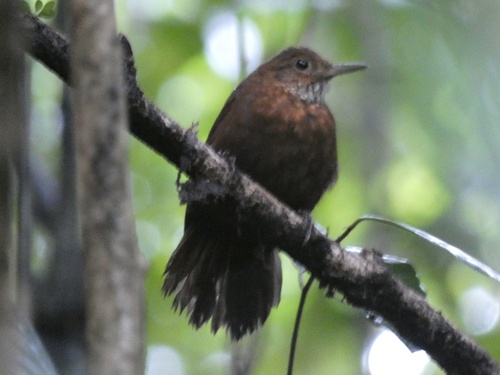
Ruddy Woodcreeper

Ruddy Woodcreeper

Dendrocincla homochroa

Silhouette: Sheatherius · PhyloPic

LCLeast ConcernNTVUENCR
Daily sighting probability <5% · Rare
at Corcovado National Park

In 3 days <5% in a week ~10%

33 Verified sightings at Corcovado National Park From 2019 to 2026
2,707 In all 25 parks
April Best month
☀️ Diurnal When it's spotted

About the Ruddy Woodcreeper

The ruddy woodcreeper (Dendrocincla homochroa) is a passerine bird in subfamily Dendrocolaptinae of the ovenbird family Furnariidae. It is found from southern Mexico to northern Colombia and extreme northern Venezuela. The ruddy woodcreeper has these four subspecies:

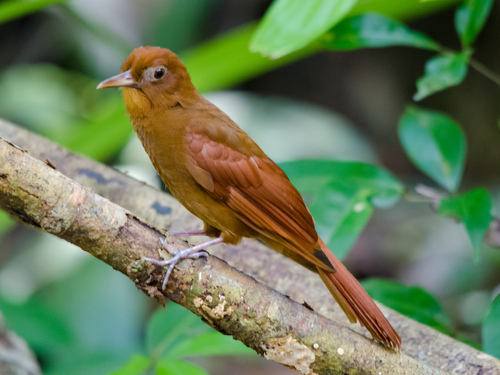
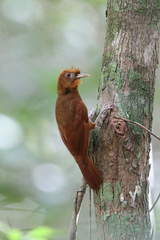
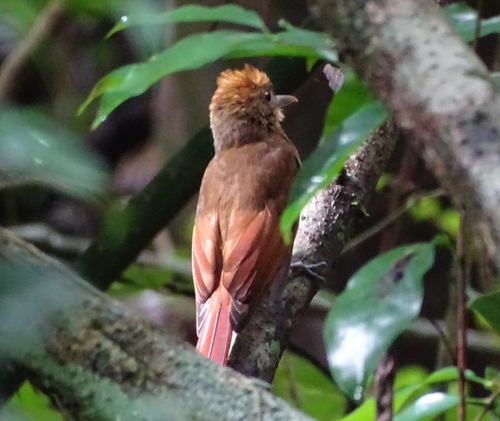
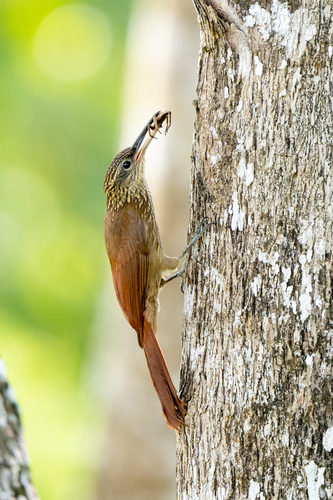
The ruddy woodcreeper is 17.5 to 20.5 cm (6.9 to 8.1 in) long. Males weigh 34 to 45 g (1.2 to 1.6 oz) and females 27 to 39 g (0.95 to 1.4 oz). The species is a medium-sized member of its genus, with a straight bill, a short tail, and a large head with a ruffled nape. The sexes have the same plumage. The nominate subspecies has dark rufous to chestnut-brown upperparts with a brighter reddish crown. Its wings, uppertail coverts, and tail are rufous chestnut. The tips of its primaries are dusky. It has grayish lores and eyering and a cinnamon-buff to tawny-ochraceous throat. Its underparts are rufous brown with a paler belly and... Wikipedia →

Sounds

Song0:16

Colombia · 2019

© Francisco Troncoso · XC488296 · CC BY-NC-SA 4.0

Call0:26

Colombia · 2007

© Niels Krabbe · XC235685 · CC BY-NC-SA 4.0

Uncertain0:28

Mexico · 2022

© Andrea Martinez · XC764181 · CC BY 4.0

Global Distribution

Parks Where Found

# Park Country Daily sighting probability
1 Calakmul Biosphere Reserve 🇲🇽 Mexico
~30%
2 Rincón de la Vieja National Park 🇨🇷 Costa Rica
~20%
3 Tikal National Park 🇬🇹 Guatemala
~20%
4 Sian Ka'an Biosphere Reserve 🇲🇽 Mexico
~10%
5 Cockscomb Basin Wildlife Sanctuary 🇧🇿 Belize
~10%
6 Cabo Blanco Absolute Nature Reserve 🇨🇷 Costa Rica
~10%
7 Santa Rosa National Park 🇨🇷 Costa Rica
~10%
8 Monteverde Cloud Forest Reserve 🇨🇷 Costa Rica
~10%
9 Montes Azules Biosphere Reserve 🇲🇽 Mexico
<5%
10 Pico Bonito National Park 🇭🇳 Honduras
<5%
11 Biotopo Cerro Cahuí 🇬🇹 Guatemala
<5%
12 Soberanía National Park 🇵🇦 Panama
<5%
13 Chagres National Park 🇵🇦 Panama
<5%
14 Corcovado National Park 🇨🇷 Costa Rica
<5%
15 Ostional Wildlife Refuge 🇨🇷 Costa Rica
<5%
16 La Amistad International Park (Panama) 🇵🇦 Panama
<5%
17 Tenorio Volcano National Park 🇨🇷 Costa Rica
<5%
18 Cerro Azul Meámbar National Park 🇭🇳 Honduras
<5%
19 Marino Ballena National Park 🇨🇷 Costa Rica
<5%
20 Carara National Park 🇨🇷 Costa Rica
<5%
21 Volcán Barú National Park 🇵🇦 Panama
<5%
22 Tapantí-Macizo de la Muerte National Park 🇨🇷 Costa Rica
<5%
23 Piedras Blancas National Park 🇨🇷 Costa Rica
<5%
24 Braulio Carrillo National Park 🇨🇷 Costa Rica
<5%
25 Arenal Volcano National Park 🇨🇷 Costa Rica
<5%

Before you go

What are the chances of seeing a Ruddy Woodcreeper in Corcovado National Park?

Rare

Under 5% of wildlife watchers report a Ruddy Woodcreeper sighting in Corcovado National Park on a given day, based on 33 verified sightings from GBIF citizen-science data from 2019 to 2026. It is the 252nd most-seen of the 332 birds we can rate there. Over three days the chance rises to under 5%, and over a week to about 10%, if each day is a fresh chance.

When is the best time to see a Ruddy Woodcreeper in Corcovado National Park?

Any time of year

In every month with enough records, under 5% of wildlife watchers report a Ruddy Woodcreeper in Corcovado National Park on a given day, so our monthly data shows no clear season.

What time of day is best to see a Ruddy Woodcreeper?

Between 9 am and noon

Across all the parks we cover, that three-hour window holds the most Ruddy Woodcreeper sightings with a recorded time, and nearly all of them come between 6 am and 6 pm: it is a daytime animal.

Where does the Ruddy Woodcreeper sighting chance come from?

GBIF citizen-science records

It is estimated from how often the Ruddy Woodcreeper is recorded against all the birds logged in Corcovado National Park (33 verified sightings from 2019 to 2026), calibrated against known sighting rates. Figures are rounded to the nearest 10% because citizen-science data supports honest approximations, not decimals, and months with records from fewer than five people show "—". How it works.

← Back to Corcovado National Park