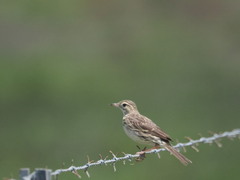

Australian Pipit

Australian Pipit

Anthus australis

Silhouette: Susan Murphy (original photograph), T. Michael Keesey (vectorization) · PhyloPic

Daily sighting probability <5% · Rare
at Daintree National Park

In 3 days <5% in a week ~10%

19 Verified sightings at Daintree National Park From 2019 to 2026
835 In all 16 parks
February Best month
☀️ Diurnal When it's spotted

About the Australian Pipit

The Australian pipit (Anthus australis) is a fairly small passerine bird of open country in Australia and New Guinea. It belongs to the pipit genus Anthus in the family Motacillidae. It is a slender bird, 16 to 19 cm long, and weighs about 40 grams. The plumage is pale brown above with dark streaks. The underparts are pale with streaks on the breast. There is a pale stripe over the eye and dark malar and moustachial stripes. The long tail has white outer-feathers and is often wagged up and down. The legs are long and pinkish-brown while the bill is slender and brownish.

It has a sparrow-like chirruping call and a drawn-out tswee call. The Australian pipit was formerly grouped with other pipits as Richard's pipit Anthus novaeseelandiae. This species was split into Richard's, African, Mountain, Paddyfield and Australasian pipits. Many authors further split the Australasian pipit into two species: Australian pipit (Anthus australis) in Australia and New Guinea and New Zealand pipit (Anthus novaeseelandiae) in New Zealand.

A number of subspecies are recognised: Wikipedia →

Sounds

Call0:11

Australia · 2020

© Marc Anderson · XC611266 · CC BY-NC-ND 4.0

Song0:18

Australia · 2025

© Étienne Leroy · XC1069908 · CC BY-NC-SA 4.0

Uncertain0:06

Australia · 2020

© Liam Manderson · XC605814 · CC BY-NC-SA 4.0

Global Distribution

Parks Where Found

# Park Country Daily sighting probability
1 Maria Island National Park 🇦🇺 Australia
~30%
2 Flinders Ranges National Park 🇦🇺 Australia
~20%
3 Ningaloo Marine Park 🇦🇺 Australia
~20%
4 Kosciuszko National Park 🇦🇺 Australia
~20%
5 Flinders Chase 🇦🇺 Australia
~20%
6 Uluru-Kata Tjuta National Park 🇦🇺 Australia
~10%
7 Cape Range 🇦🇺 Australia
~10%
8 Cradle Mountain-Lake St Clair National Park 🇦🇺 Australia
~10%
9 Freycinet National Park 🇦🇺 Australia
<5%
10 Wilsons Promontory National Park 🇦🇺 Australia
<5%
11 Great Otway National Park 🇦🇺 Australia
<5%
12 Daintree National Park 🇦🇺 Australia
<5%
13 Grampians National Park 🇦🇺 Australia
<5%
14 Blue Mountains National Park 🇦🇺 Australia
<5%
15 Hattah-Kulkyne National Park 🇦🇺 Australia
<5%
16 Lamington National Park 🇦🇺 Australia
<5%

Cities Where Found

# City Country Daily sighting probability
1 Brisbane 🇦🇺 Australia
<5%
2 Melbourne 🇦🇺 Australia
<5%
3 Sydney 🇦🇺 Australia
<5%
4 Perth 🇦🇺 Australia
<5%

Zoos & Centres Where Found

# Zoo / Centre Country
1 Featherdale Sydney Wildlife Park 🇦🇺 Australia In captivity

Before you go

What are the chances of seeing an Australian Pipit in Daintree National Park?

Rare

Under 5% of wildlife watchers report an Australian Pipit sighting in Daintree National Park on a given day, based on 19 verified sightings from GBIF citizen-science data from 2019 to 2026. It is the 147th most-seen of the 208 birds we can rate there. Over three days the chance rises to under 5%, and over a week to about 10%, if each day is a fresh chance.

When is the best time to see an Australian Pipit in Daintree National Park?

February

In that month about 10% of wildlife watchers report an Australian Pipit in Daintree National Park on a given day, against under 5% in March to January, the lowest months. That is one of Daintree National Park's wettest months, with about 240 mm of rain against 50 mm in September.

What time of day is best to see an Australian Pipit?

Between 9 am and noon

Across all the parks we cover, that three-hour window holds the most Australian Pipit sightings with a recorded time, and nearly all of them come between 6 am and 6 pm: it is a daytime animal.

Which relatives of the Australian Pipit live in Daintree National Park?

Same order: Passeriformes

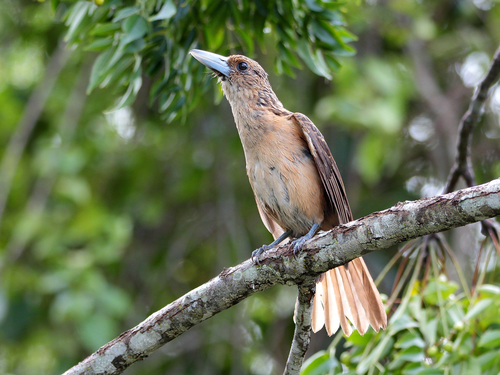
The closest relatives of the Australian Pipit that you can see in Daintree National Park (order Passeriformes, Perching Birds) are Black Butcherbird (about 70%), Green Oriole (about 60%) and Shining Flycatcher (about 60%), with each one's daily chance of a sighting.

Where does the Australian Pipit sighting chance come from?

GBIF citizen-science records

It is estimated from how often the Australian Pipit is recorded against all the birds logged in Daintree National Park (19 verified sightings from 2019 to 2026), calibrated against known sighting rates. Figures are rounded to the nearest 10% because citizen-science data supports honest approximations, not decimals, and months with records from fewer than five people show "—". How it works.

← Back to Daintree National Park