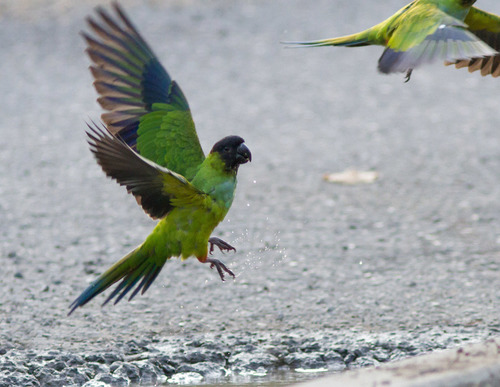
Blue-and-yellow Macaw

Blue-and-yellow Macaw

Ara ararauna

Silhouette: Edwin Price · PhyloPic

LCLeast ConcernNTVUENCR
Daily sighting probability <5% · Rare
at Parque Estadual Encontro das Águas

In 3 days <5% in a week ~10%

20 Verified sightings at Parque Estadual Encontro das Águas From 2019 to 2026
5,511 In all 13 parks
May Best month
☀️ Diurnal When it's spotted

About the Blue-and-yellow Macaw

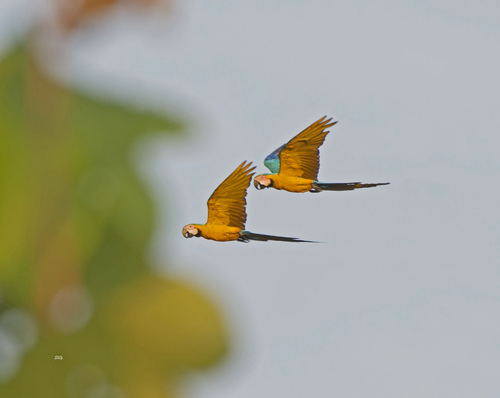
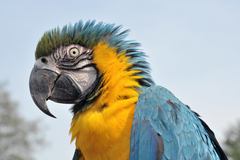
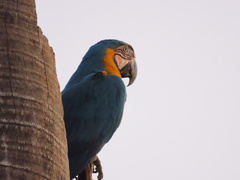
The blue-and-yellow macaw (Ara ararauna), also known as the blue-and-gold macaw, is a large Neotropical parrot with a mostly blue dorsum, light yellow/orange venter, and gradient hues of green on top of its head. It is a member of the large group of neotropical parrots known as macaws. It inhabits forest (especially varzea, but also in open sections of terra firme or unflooded forest), woodland, and savannah of tropical Central and South America, as well as the island of Trinidad in the Caribbean. They are popular in aviculture because of their striking color, ability to talk, ready availability in the marketplace, and close bonding to humans. It is the most commonly kept macaw species in captivity worldwide as a pet or companion parrot and is also the cheapest among the large macaws. As of 2025, there are 1 million blue and gold macaws living in captivity worldwide, one of the highest populations of any large parrot in captivity.

The blue-and-yellow macaw was formally described by the Swedish naturalist Carl Linnaeus in 1758 in the tenth edition of his Systema Naturae. He placed it with all the other parrots in the genus Psittacus and coined the binomial name Psittacus... Wikipedia →

Sounds

Call0:06

Brazil · 2026

© JAYRSON ARAUJO DE OLIVEIRA · XC1163760 · CC BY-NC-SA 4.0

Flight call0:22

Ecuador · 2026

© Manuel Sánchez-Nivicela · XC1157392 · CC BY-NC-ND 4.0

Alarm call0:42

Brazil · 1998

© Dante Buzzetti · XC777319 · CC BY-NC-SA 4.0

Global Distribution

Parks Where Found

# Park Country Daily sighting probability
1 Emas National Park 🇧🇷 Brazil
~80%
2 Cuyabeno Wildlife Reserve 🇪🇨 Ecuador
~70%
3 Tambopata National Reserve 🇵🇪 Peru
~40%
4 Yasuní National Park 🇪🇨 Ecuador
~30%
5 Anavilhanas National Park 🇧🇷 Brazil
~30%
6 Manu National Park 🇵🇪 Peru
~30%
7 Amacayacu National Natural Park 🇨🇴 Colombia
~10%
8 Darién National Park 🇵🇦 Panama
<5%
9 Tayrona National Natural Park 🇨🇴 Colombia
<5%
10 Henri Pittier National Park 🇻🇪 Venezuela
<5%
11 Chapada dos Guimarães National Park 🇧🇷 Brazil
<5%
12 Parque Estadual Encontro das Águas 🇧🇷 Brazil
<5%
13 Sierra de la Macarena National Park 🇨🇴 Colombia
<5%

Cities Where Found

# City Country Daily sighting probability
1 Caracas 🇻🇪 Venezuela
~80%
2 Campo Grande 🇧🇷 Brazil
~80%
3 Goiânia 🇧🇷 Brazil
~50%
4 Brasilia 🇧🇷 Brazil
~10%
5 Miami 🇺🇸 United States
<5%
6 Belém 🇧🇷 Brazil
<5%
7 Manaus 🇧🇷 Brazil
<5%
8 Asuncion 🇵🇾 Paraguay
<5%
9 Medellín 🇨🇴 Colombia
<5%

Zoos & Centres Where Found

# Zoo / Centre Country
1 Disney's Animal Kingdom 🇺🇸 United States In captivity
2 SeaWorld Orlando 🇺🇸 United States In captivity
3 Busch Gardens Tampa 🇺🇸 United States In captivity
4 SeaWorld San Diego 🇺🇸 United States In captivity
5 San Diego Zoo 🇺🇸 United States In captivity
6 Moscow Zoo 🇷🇺 Russia In captivity
7 ZooParc de Beauval 🇫🇷 France In captivity
8 Denver Zoo 🇺🇸 United States In captivity
9 Natura Artis Magistra 🇳🇱 Netherlands In captivity
10 Cincinnati Zoo and Botanical Garden 🇺🇸 United States In captivity
11 California Academy of Sciences 🇺🇸 United States In captivity
12 Parque das Aves 🇧🇷 Brazil In captivity
13 Barcelona Zoo 🇪🇸 Spain In captivity
14 Australia Zoo 🇦🇺 Australia In captivity
15 Kolmården Wildlife Park 🇸🇪 Sweden In captivity
16 Parc Phœnix 🇫🇷 France In captivity
17 Taman Safari Bali (Bali Safari) 🇮🇩 Indonesia In captivity
18 Melaka Zoo and Bird Park 🇲🇾 Malaysia In captivity
19 Bali Zoo 🇮🇩 Indonesia In captivity
20 Réserve africaine de Sigean 🇫🇷 France In captivity
21 Parc des oiseaux 🇫🇷 France In captivity
22 Abilene Zoological Gardens 🇺🇸 United States In captivity
23 Zoo de Maubeuge 🇫🇷 France In captivity
24 La Tanière 🇫🇷 France In captivity
25 Heinola bird sanctuary 🇫🇮 Finland In captivity
26 Zoo d'Amiens 🇫🇷 France In captivity
27 Karagandy Zoo 🇰🇿 Kazakhstan In captivity
28 Le rocher des aigles 🇫🇷 France In captivity
29 Zoobotanic Park of Brusque 🇧🇷 Brazil In captivity
30 Silver Springs 🇺🇸 United States In captivity
31 Gazipur Safari Park 🇧🇩 Bangladesh In captivity
32 Parque Temático Hacienda Nápoles 🇨🇴 Colombia In captivity
33 Harewood House 🇬🇧 United Kingdom In captivity
34 Vinpearl Safari 🇻🇳 Vietnam In captivity
35 Arignar Anna Zoological Park 🇮🇳 India In captivity
36 Jardín Botánico y Zoológico de Asunción 🇵🇾 Paraguay In captivity
37 Lion Country Safari 🇺🇸 United States In captivity
38 Beijing Wildlife Park 🇨🇳 China In captivity
39 Al Ain Zoo 🇦🇪 United Arab Emirates In captivity
40 Toronto Zoo 🇨🇦 Canada In captivity
41 Taipei Zoo 🇹🇼 Taiwan In captivity
42 La Reserva del Castillo de las Guardas 🇪🇸 Spain In captivity
43 Bondla Zoo 🇮🇳 India In captivity
44 Nehru Zoological Park 🇮🇳 India In captivity
45 Shanghai Wild Animal Park 🇨🇳 China In captivity
46 Woburn Safari Park 🇬🇧 United Kingdom In captivity
47 Columbus Zoo and Aquarium 🇺🇸 United States In captivity
48 Bronx Zoo 🇺🇸 United States In captivity
49 Khao Kheow Open Zoo 🇹🇭 Thailand In captivity
50 Yumka' 🇲🇽 Mexico In captivity

Before you go

What are the chances of seeing a Blue-and-yellow Macaw in Parque Estadual Encontro das Águas?

Rare

Under 5% of wildlife watchers report a Blue-and-yellow Macaw sighting in Parque Estadual Encontro das Águas on a given day, based on 20 verified sightings from GBIF citizen-science data from 2019 to 2026. It is the 239th most-seen of the 308 birds we can rate there. Over three days the chance rises to under 5%, and over a week to about 10%, if each day is a fresh chance.

When is the best time to see a Blue-and-yellow Macaw in Parque Estadual Encontro das Águas?

May and June

In those months about 10% of wildlife watchers report a Blue-and-yellow Macaw in Parque Estadual Encontro das Águas on a given day, against under 5% in July to December, the lowest months. Those are among Parque Estadual Encontro das Águas's driest months, with about 25 mm of rain a month against 190 mm in January. January to April have too few records to rate.

What time of day is best to see a Blue-and-yellow Macaw?

Between 4 and 7 pm

Across all the parks we cover, that three-hour window holds the most Blue-and-yellow Macaw sightings with a recorded time, and about 8 in 10 of them come between 6 am and 6 pm: it is a daytime animal.

Which relatives of the Blue-and-yellow Macaw live in Parque Estadual Encontro das Águas?

Same family: Psittacidae

The closest relatives of the Blue-and-yellow Macaw that you can see in Parque Estadual Encontro das Águas (family Psittacidae, New World and African Parrots) are Monk Parakeet (about 60%), Yellow-chevroned Parakeet (about 60%) and Blue-fronted Parrot (about 50%), with each one's daily chance of a sighting.

Where does the Blue-and-yellow Macaw sighting chance come from?

GBIF citizen-science records

It is estimated from how often the Blue-and-yellow Macaw is recorded against all the birds logged in Parque Estadual Encontro das Águas (20 verified sightings from 2019 to 2026), calibrated against known sighting rates. Figures are rounded to the nearest 10% because citizen-science data supports honest approximations, not decimals, and months with records from fewer than five people show "—". How it works.

← Back to Parque Estadual Encontro das Águas