Goldcrest

Goldcrest

Regulus regulus

Silhouette: Ferran Sayol · PhyloPic

LCLeast ConcernNTVUENCR
Daily sighting probability <5% · Rare
at Fertő-Hanság National Park

In 3 days <5% in a week ~10%

17 Verified sightings at Fertő-Hanság National Park From 2019 to 2026
6,152 In all 28 parks
October Best month
🌅 Crepuscular When it's spotted

About the Goldcrest

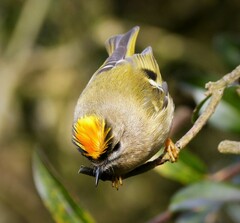
The goldcrest (Regulus regulus) is a very small passerine bird in the kinglet family. Its colourful golden crest feathers, as well as being called the "king of the birds" in European folklore, gives rise to its English and scientific names. The scientific name, R. regulus, means 'petty king' or prince. Several subspecies are recognised across the very large distribution range that includes much of the Palearctic and the islands of Macaronesia and Iceland. Birds from the north and east of its breeding range migrate to winter further south.

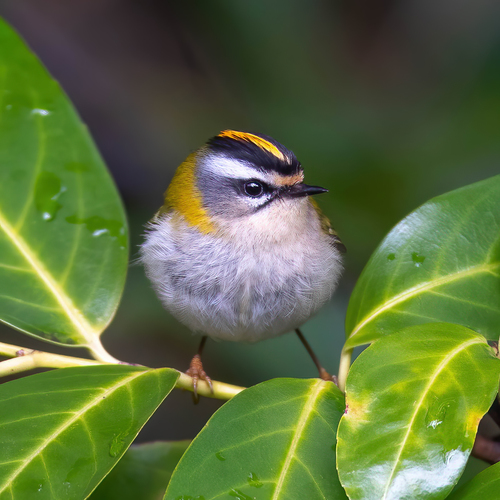
This kinglet has greenish upper-parts, whitish under-parts, and has two white wingbars. It has a plain face contrasting black irises and a bright head crest, orange and yellow in the male and yellow in the female, which is displayed during breeding. It superficially resembles the common firecrest (Regulus ignicapilla), which largely shares its European range, but the latter's bronze shoulders and strong face pattern are distinctive. The song is a repetition of high thin notes, slightly higher-pitched than those of its relative. Birds on the Canary Islands are now separated into two subspecies of the goldcrest, but were formerly considered to be a subspecies of the firecrest or a separate species, Regulus teneriffae.

The goldcrest breeds in coniferous woodland and gardens, building its compact, three-layered nest on a tree branch. Ten to twelve eggs are incubated by the female alone, and the chicks are fed by both parents; second broods are common. This kinglet is constantly on the move as it searches for insects to eat, and in winter it is often found with flocks of tits. It may be killed by birds of prey or carry parasites, but its large range and population mean that it is not considered to present any significant conservation concerns. Wikipedia →

Sounds

Call0:50

Sweden · 2026

© Lars Edenius · XC1163300 · CC BY-NC-SA 4.0

Song0:17

Estonia · 2025

© Joost van Bruggen · XC1002355 · CC BY-NC-ND 4.0

Alarm call0:30

Germany · 2022

© Bastian Forkel · XC712109 · CC BY-NC-SA 4.0

Global Distribution

Parks Where Found

# Park Country Daily sighting probability
1 Tatra National Park 🇸🇰 Slovakia
~50%
2 Cairngorms National Park 🇬🇧 United Kingdom
~40%
3 Białowieża National Park 🇵🇱 Poland
~40%
4 Aigüestortes National Park 🇪🇸 Spain
~40%
5 Jiuzhaigou National Park 🇨🇳 China
~40%
6 Triglav National Park 🇸🇮 Slovenia
~30%
7 Bavarian Forest National Park 🇩🇪 Germany
~30%
8 Snowdonia National Park 🇬🇧 United Kingdom
~30%
9 Pyrénées National Park 🇫🇷 France
~20%
10 Ordesa y Monte Perdido National Park 🇪🇸 Spain
~20%
11 Vanoise National Park 🇫🇷 France
~20%
12 Hohe Tauern National Park 🇦🇹 Austria
~20%
13 Biebrza National Park 🇵🇱 Poland
~20%
14 Plitvice Lakes National Park 🇭🇷 Croatia
~10%
15 Wadden Sea National Park 🇩🇪 Germany
~10%
16 Cévennes National Park 🇫🇷 France
~10%
17 Nikko National Park 🇯🇵 Japan
~10%
18 Picos de Europa National Park 🇪🇸 Spain
~10%
19 Ecrins National Park 🇫🇷 France
~10%
20 Gauja National Park 🇱🇻 Latvia
~10%
21 Vatnajokull National Park 🇮🇸 Iceland
~10%
22 Mercantour National Park 🇫🇷 France
~10%
23 Hortobágy National Park 🇭🇺 Hungary
~10%
24 Kiskunság National Park 🇭🇺 Hungary
~10%
25 Sierra de Guadarrama National Park 🇪🇸 Spain
~10%
26 Langtang National Park 🇳🇵 Nepal
~10%
27 Camargue 🇫🇷 France
<5%
28 Fertő-Hanság National Park 🇭🇺 Hungary
<5%

Cities Where Found

# City Country Daily sighting probability
1 Birmingham 🇬🇧 United Kingdom
~30%
2 Dublin 🇮🇪 Ireland
~30%
3 Manchester 🇬🇧 United Kingdom
~30%
4 Liverpool 🇬🇧 United Kingdom
~20%
5 Novosibirsk 🇷🇺 Russia
~20%
6 London 🇬🇧 United Kingdom
~20%
7 Kharkiv 🇺🇦 Ukraine
~20%
8 Turin 🇮🇹 Italy
~20%
9 Seoul 🇰🇷 South Korea
~20%
10 Paris 🇫🇷 France
~20%

Zoos & Centres Where Found

# Zoo / Centre Country
1 Dublin Zoo 🇮🇪 Ireland In captivity
2 Alpenzoo Innsbruck 🇦🇹 Austria In captivity
3 LBV-Vogel- und Umweltstation Regenstauf Station für Greifvögel und Eulen 🇩🇪 Germany In captivity

Before you go

What are the chances of seeing a Goldcrest in Fertő-Hanság National Park?

Rare

Under 5% of wildlife watchers report a Goldcrest sighting in Fertő-Hanság National Park on a given day, based on 17 verified sightings from GBIF citizen-science data from 2019 to 2026. It is the 176th most-seen of the 207 birds we can rate there. Over three days the chance rises to under 5%, and over a week to about 10%, if each day is a fresh chance.

When is the best time to see a Goldcrest in Fertő-Hanság National Park?

October

In that month about 20% of wildlife watchers report a Goldcrest in Fertő-Hanság National Park on a given day, against under 5% in January, March–September and November, the lowest months.

What time of day is best to see a Goldcrest?

Between 6 and 9 pm

Across all the parks we cover, that three-hour window holds the most Goldcrest sightings with a recorded time, and about 7 in 10 of them come between 6 pm and 6 am: it is most active around dawn and dusk.

Where does the Goldcrest sighting chance come from?

GBIF citizen-science records

It is estimated from how often the Goldcrest is recorded against all the birds logged in Fertő-Hanság National Park (17 verified sightings from 2019 to 2026), calibrated against known sighting rates. Figures are rounded to the nearest 10% because citizen-science data supports honest approximations, not decimals, and months with records from fewer than five people show "—". How it works.

← Back to Fertő-Hanság National Park