





Completed


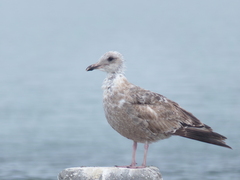


American Herring Gull
Larus smithsonianus
Silhouette: Andy Wilson · PhyloPic
- KingdomAnimalia (Animals)
- PhylumChordata (Chordates)
- ClassAves (Birds)
- OrderCharadriiformes (Shorebirds and Allies)
- FamilyLaridae (Gulls, Terns, and Skimmers)
- GenusLarus (Large White-headed Gulls)
- SpeciesLarus smithsonianus (American Herring Gull)
In 3 days ~30% in a week ~60%
830 Verified sightings at Great Bear Rainforest From 2019 to 2026
35,152 In all 33 parks
October Best month
☀️ Diurnal When it's spotted
About the American Herring Gull
The American herring gull (Larus smithsonianus or Larus argentatus smithsonianus), also known as the Arctic herring gull or Smithsonian gull, is a large gull that breeds in North America, where it is treated by the American Ornithological Society as distinct from the European herring gull (Larus argentatus).
Adults are white with gray back and wings, black wingtips with white spots, and pink legs. Immature birds are gray-brown and are darker and more uniform than European herring gulls, with a darker tail. As is common with other gulls, they are colloquially referred to simply as seagulls.
It occurs in a variety of habitats including coasts, lakes, rivers, parking lots and garbage dumps. Its broad diet includes invertebrates, fish, and many other items. It usually nests near water, laying around three eggs in a scrape on the ground.
This gull was first described as a new species in 1862 by Elliott Coues based on a series of specimens from the Smithsonian Institution. It was later reclassified as a subspecies of the herring gull (Larus argentatus). The genus name is from Latin Larus, which refers to a gull or other large seabird. The species name smithsonianus commemorates... Wikipedia →
Recent sightings of American Herring Gull in Great Bear Rainforest
LIVEiNaturalistGlobal Distribution
Parks Where Found
Cities Where Found
| # | City | Country | Daily sighting probability |
|---|---|---|---|
| 1 | Boston | 🇺🇸 United States | |
| 2 | New York City | 🇺🇸 United States | |
| 3 | Chicago | 🇺🇸 United States | |
| 4 | Toronto | 🇨🇦 Canada | |
| 5 | Montreal | 🇨🇦 Canada | |
| 6 | Baltimore | 🇺🇸 United States | |
| 7 | Anchorage | 🇺🇸 United States | |
| 8 | Calgary | 🇨🇦 Canada | |
| 9 | Sacramento | 🇺🇸 United States | |
| 10 | Philadelphia | 🇺🇸 United States |
Zoos & Centres Where Found
| # | Zoo / Centre | Country | |
|---|---|---|---|
| 1 | Cameron Park Zoo | 🇺🇸 United States | |
| 2 | Mote Marine Laboratory | 🇺🇸 United States | |
| 3 | Seaside Seabird Sanctuary | 🇺🇸 United States |
Closest Relatives at Great Bear Rainforest


Before you go
What are the chances of seeing an American Herring Gull in Great Bear Rainforest?
With luck
About 10% of wildlife watchers report an American Herring Gull sighting in Great Bear Rainforest on a given day, based on 830 verified sightings from GBIF citizen-science data from 2019 to 2026. It is the 66th most-seen of the 239 birds we can rate there. Over three days the chance rises to about 30%, and over a week to about 60%, if each day is a fresh chance.
When is the best time to see an American Herring Gull in Great Bear Rainforest?
October
In that month about 30% of wildlife watchers report an American Herring Gull in Great Bear Rainforest on a given day, against under 5% in February and May–July, the lowest months.
What time of day is best to see an American Herring Gull?
Between 1 and 4 pm
Across all the parks we cover, that three-hour window holds the most American Herring Gull sightings with a recorded time, and nearly all of them come between 6 am and 6 pm: it is a daytime animal.
Is Great Bear Rainforest the best place to see an American Herring Gull?
14th of 33
Of the 33 parks where we can rate American Herring Gull sightings, Great Bear Rainforest ranks 14th at about 10%. The best odds are in Acadia National Park (United States, about 80%), Cape Breton Highlands National Park (Canada, about 70%) and Isle Royale National Park (United States, about 70%). All parks ranked.
Which relatives of the American Herring Gull live in Great Bear Rainforest?
Same genus: Larus
The closest relatives of the American Herring Gull that you can see in Great Bear Rainforest (genus Larus, Large White-headed Gulls) are Glaucous-winged Gull (about 60%), Short-billed Gull (about 50%) and California Gull (about 30%), with each one's daily chance of a sighting.
Where does the American Herring Gull sighting chance come from?
GBIF citizen-science records
It is estimated from how often the American Herring Gull is recorded against all the birds logged in Great Bear Rainforest (830 verified sightings from 2019 to 2026), calibrated against known sighting rates. Figures are rounded to the nearest 10% because citizen-science data supports honest approximations, not decimals, and months with records from fewer than five people show "—". How it works.
