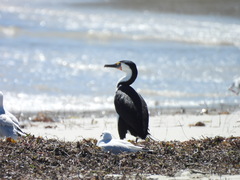
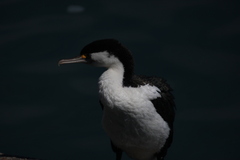
Australian Pied Cormorant

Australian Pied Cormorant

Phalacrocorax varius

Silhouette: L. Shyamal · PhyloPic

LCLeast ConcernNTVUENCR
Daily sighting probability ~10% · With luck
at Great Otway National Park

In 3 days ~20% in a week ~40%

183 Verified sightings at Great Otway National Park From 2019 to 2026
2,743 In all 16 parks
July Best month
☀️ Diurnal When it's spotted

About the Australian Pied Cormorant

The Australian pied cormorant (Phalacrocorax varius), also known as the pied cormorant, pied shag, or great pied cormorant, is a medium-sized member of the cormorant family. It is found around the coasts of Australasia. In New Zealand, it is usually known either as the pied shag or by its Māori name of kāruhiruhi. Older sources may refer to it as the "yellow-faced cormorant".

The Australian pied cormorant was formally described in 1789 by the German naturalist Johann Friedrich Gmelin in his revised and expanded edition of Carl Linnaeus's Systema Naturae. He placed it in the genus Pelecanus and coined the binomial name Pelecanus varius. Gmelin based his description on the "pied shag" from Queen Charlotte Sound, New Zealand, that had been described in 1785 by English ornithologist John Latham in his book A General Synopsis of Birds. Latham had based his own description on a specimen in the Leverian Museum and on a watercolour by Georg Forster that belonged to Joseph Banks. Forster had accompanied James Cook on his second voyage to the Pacific Ocean. The Australian pied cormorant is now one of 12 species placed in the genus Phalacrocorax that was introduced in 1760 by... Wikipedia →

Sounds

Uncertain0:14

Australia · 2024

© Nick Talbot · XC900484 · CC BY-NC-SA 4.0

Call0:44

Australia · 2024

© nick talbot · XC900462 · CC BY-NC-SA 4.0

Begging call0:16

New Zealand · 2015

© Johannes Fischer · XC215247 · CC BY-NC-SA 4.0

Global Distribution

Parks Where Found

# Park Country Daily sighting probability
1 Rottnest Island 🇦🇺 Australia
~70%
2 Noosa National Park 🇦🇺 Australia
~40%
3 Rakiura National Park 🇳🇿 New Zealand
~40%
4 Abel Tasman National Park 🇳🇿 New Zealand
~30%
5 Ningaloo Marine Park 🇦🇺 Australia
~20%
6 Cape Range 🇦🇺 Australia
~20%
7 Booderee National Park 🇦🇺 Australia
~20%
8 Fiordland National Park 🇳🇿 New Zealand
~10%
9 Wilsons Promontory National Park 🇦🇺 Australia
~10%
10 Hattah-Kulkyne National Park 🇦🇺 Australia
~10%
11 Royal National Park 🇦🇺 Australia
~10%
12 Great Otway National Park 🇦🇺 Australia
~10%
13 Kakadu National Park 🇦🇺 Australia
<5%
14 Kosciuszko National Park 🇦🇺 Australia
<5%
15 Daintree National Park 🇦🇺 Australia
<5%
16 Blue Mountains National Park 🇦🇺 Australia
<5%

Cities Where Found

# City Country Daily sighting probability
1 Auckland 🇳🇿 New Zealand
~30%
2 Sydney 🇦🇺 Australia
~20%
3 Perth 🇦🇺 Australia
~10%
4 Melbourne 🇦🇺 Australia
~10%
5 Brisbane 🇦🇺 Australia
<5%

Zoos & Centres Where Found

# Zoo / Centre Country
1 Cleland Wildlife Park 🇦🇺 Australia In captivity
2 Currumbin Wildlife Sanctuary 🇦🇺 Australia In captivity
3 Sea Life Sydney Aquarium 🇦🇺 Australia In captivity
4 Wild Life Sydney 🇦🇺 Australia In captivity

Before you go

What are the chances of seeing an Australian Pied Cormorant in Great Otway National Park?

With luck

About 10% of wildlife watchers report an Australian Pied Cormorant sighting in Great Otway National Park on a given day, based on 183 verified sightings from GBIF citizen-science data from 2019 to 2026. It is the 89th most-seen of the 175 birds we can rate there. Over three days the chance rises to about 20%, and over a week to about 40%, if each day is a fresh chance.

When is the best time to see an Australian Pied Cormorant in Great Otway National Park?

March and July–December

In those months about 10% of wildlife watchers report an Australian Pied Cormorant in Great Otway National Park on a given day, against under 5% in January–February and April–June, the lowest months.

What time of day is best to see an Australian Pied Cormorant?

Between 11 am and 2 pm

Across all the parks we cover, that three-hour window holds the most Australian Pied Cormorant sightings with a recorded time, and about 9 in 10 of them come between 6 am and 6 pm: it is a daytime animal.

Is Great Otway National Park the best place to see an Australian Pied Cormorant?

12th of 16

Of the 16 parks where we can rate Australian Pied Cormorant sightings, Great Otway National Park ranks 12th at about 10%. The best odds are in Rottnest Island (Australia, about 70%), Noosa National Park (Australia, about 40%) and Rakiura National Park (New Zealand, about 40%). All parks ranked.

Which relatives of the Australian Pied Cormorant live in Great Otway National Park?

Same genus: Phalacrocorax

The closest relatives of the Australian Pied Cormorant that you can see in Great Otway National Park (genus Phalacrocorax, Typical Old World Cormorants) are Great Cormorant (about 20%), Little Black Cormorant (about 10%) and Black-faced Cormorant (about 10%), with each one's daily chance of a sighting.

Where does the Australian Pied Cormorant sighting chance come from?

GBIF citizen-science records

It is estimated from how often the Australian Pied Cormorant is recorded against all the birds logged in Great Otway National Park (183 verified sightings from 2019 to 2026), calibrated against known sighting rates. Figures are rounded to the nearest 10% because citizen-science data supports honest approximations, not decimals, and months with records from fewer than five people show "—". How it works.

← Back to Great Otway National Park