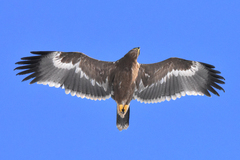
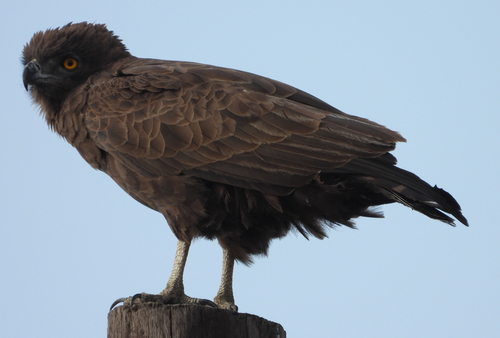
Steppe Eagle

Steppe Eagle

Aquila nipalensis

Silhouette: Andy Wilson · PhyloPic

LCNTVUENEndangeredCR
Daily sighting probability <5% · Rare
at Hwange National Park

In 3 days ~10% in a week ~30%

22 Verified sightings at Hwange National Park From 2019 to 2026
2,473 In all 30 parks
December Best month
☀️ Diurnal When it's spotted

About the Steppe Eagle

The steppe eagle (Aquila nipalensis) is a large bird of prey. Like all eagles, it belongs to the family Accipitridae. The steppe eagle's well-feathered legs illustrate it to be a member of the subfamily Aquilinae, also known as the "Booted eagles". This species was once considered to be closely related to the sedentary tawny eagle (Aquila rapax) and the two forms have previously been treated as conspecific. They were split based on pronounced differences in morphology and anatomy; two molecular studies, each based on a very small number of genes, indicate that the species are distinct but disagree over how closely related they are.

The Steppe eagle is in many ways a peculiar species of eagle. It is a specialized predator of ground squirrels on the breeding ground, also taking other rather small mammals and other prey, doing so more often when ground squirrels are less consistently found. In rather treeless areas of the steppe habitats, these eagles tend to nest on a slight rise, often on or near an outcrop, but may even be found on flat, wide-open ground, in a rather flat nest. They are the only eagle to nest primarily on the ground. Usually, one to three eggs are laid and, in successful nests, one to two young eagles fledge. The steppe eagle undertakes a massive migration from essentially its entire breeding range, moving en masse past major migration flyways, especially those of the Middle East, Red Sea and the Himalayas. In winter, though less closely studied than during breeding, the steppe eagle is remarkable for its sluggish and almost passive feeding ecology, focusing on insect swarms, landfills, carrion and the semi-altricial young of assorted animals, lacking the bold and predatory demeanor of their cousin species. Although still seen by the thousands at migration sites in larger numbers than other migrating eagles of these areas, the steppe eagle's entire population has declined precipitously. The threats to this species consist of increasing steppe fires and pests around the nests (both probably increased by the warming climate) which can cause a large volume of nest failures. Rivaling these factors, declines are being exacerbated by disturbance and persecution by humans, as well as trampling of nests by livestock. Free-flying steppe eagles are also being killed in alarmingly large numbers, especially in the stronghold nation for breeding of Kazakhstan, by electrocutions on dangerous electricial wires and pylons. Due to these and other reasons, the decline of the species is thought to be considerably more than 50%. Wikipedia →

Sounds

Call1:09

China · 2026

© Bo Shunqi 薄顺奇 · XC1174915 · CC BY-NC-SA 4.0

Begging call0:11

Uzbekistan · 2014

© Albert Lastukhin · XC184828 · CC BY-NC-SA 4.0

Flight call0:10

Oman · 2002

© Antero Lindholm · XC106053 · CC BY-NC-ND 2.5

Global Distribution

Parks Where Found

# Park Country Daily sighting probability
1 Bale Mountains National Park 🇪🇹 Ethiopia
~30%
2 Keoladeo National Park 🇮🇳 India
~20%
3 Tsavo West National Park 🇰🇪 Kenya
~10%
4 Samburu National Reserve 🇰🇪 Kenya
~10%
5 Tarangire National Park 🇹🇿 Tanzania
~10%
6 Kaziranga National Park 🇮🇳 India
~10%
7 Ngorongoro Conservation Area 🇹🇿 Tanzania
~10%
8 Tsavo East National Park 🇰🇪 Kenya
~10%
9 Serengeti National Park 🇹🇿 Tanzania
~10%
10 Mudumalai National Park 🇮🇳 India
~10%
11 Chitwan National Park 🇳🇵 Nepal
~10%
12 Jim Corbett National Park 🇮🇳 India
~10%
13 Meru National Park 🇰🇪 Kenya
~10%
14 Lake Nakuru National Park 🇰🇪 Kenya
<5%
15 Mkomazi National Park 🇹🇿 Tanzania
<5%
16 Hwange National Park 🇿🇼 Zimbabwe
<5%
17 Gobi Gurvansaikhan National Park 🇲🇳 Mongolia
<5%
18 Masai Mara National Reserve 🇰🇪 Kenya
<5%
19 Kidepo Valley National Park 🇺🇬 Uganda
<5%
20 Manas National Park 🇮🇳 India
<5%
21 Langtang National Park 🇳🇵 Nepal
<5%
22 Murchison Falls National Park 🇺🇬 Uganda
<5%
23 Royal Manas National Park 🇧🇹 Bhutan
<5%
24 Amboseli National Park 🇰🇪 Kenya
<5%
25 Nairobi National Park 🇰🇪 Kenya
<5%
26 Aberdare National Park 🇰🇪 Kenya
<5%
27 Kruger National Park 🇿🇦 South Africa
<5%
28 Lake Mburo National Park 🇺🇬 Uganda
<5%
29 Bandipur National Park 🇮🇳 India
<5%
30 Chobe National Park 🇧🇼 Botswana
<5%

Cities Where Found

# City Country Daily sighting probability
1 Riyadh 🇸🇦 Saudi Arabia
~10%
2 Kathmandu 🇳🇵 Nepal
~10%
3 Jodhpur 🇮🇳 India
~10%
4 Mashhad 🇮🇷 Iran
<5%
5 Dehradun 🇮🇳 India
<5%
6 Jammu 🇮🇳 India
<5%
7 Vasai-Virar 🇮🇳 India
<5%
8 Lucknow 🇮🇳 India
<5%
9 Srinagar 🇮🇳 India
<5%
10 Ramallah 🇵🇸 Palestine
<5%

Zoos & Centres Where Found

# Zoo / Centre Country
1 Moscow Zoo 🇷🇺 Russia In captivity
2 ZooParc de Beauval 🇫🇷 France In captivity
3 Tierpark Berlin 🇩🇪 Germany In captivity
4 Walsrode World Bird Park 🇩🇪 Germany In captivity
5 Kaliningrad Zoo 🇷🇺 Russia In captivity
6 Espace zoologique de La Boissière-du-Doré 🇫🇷 France In captivity
7 Al Hefaiyah Reserve 🇦🇪 United Arab Emirates In captivity
8 Wildpark Schloss Tambach 🇩🇪 Germany In captivity
9 Espace Rambouillet 🇫🇷 France In captivity
10 African Lion Safari 🇨🇦 Canada In captivity
11 Kadoorie Farm and Botanic Garden 🇭🇰 Hong Kong SAR China In captivity
12 Badoca Safari Park 🇵🇹 Portugal In captivity
13 Safari Madrid 🇪🇸 Spain In captivity
14 Shanghai Zoo 🇨🇳 China In captivity
15 Silesian Zoological Garden 🇵🇱 Poland In captivity
16 Wildgehege Hellenthal 🇩🇪 Germany In captivity
17 Yerevan Zoo 🇦🇲 Armenia In captivity
18 Kyiv Zoo 🇺🇦 Ukraine In captivity
19 Oasis Park 🇪🇸 Spain In captivity
20 Дельфинарий в Сочи-парке 🇷🇺 Russia In captivity
21 Łódź Zoo 🇵🇱 Poland In captivity
22 Център за защита на природата и животните 🇧🇬 Bulgaria In captivity
23 Leśny Park Niespodzianek 🇵🇱 Poland In captivity
24 Krasnodar Safari Park 🇷🇺 Russia In captivity
25 Tbilisi Zoo 🇬🇪 Georgia In captivity
26 Hawk Conservancy Trust 🇬🇧 United Kingdom In captivity
27 Leningrad Zoo 🇷🇺 Russia In captivity
28 Odesa Zoo 🇺🇦 Ukraine In captivity
29 Bird Park Steinen 🇩🇪 Germany In captivity
30 Cherkasy Zoo 🇺🇦 Ukraine In captivity
31 Pt. G.B. Pant High Altitude Zoo, Nainital 🇮🇳 India In captivity
32 Cim d'Àligues 🇪🇸 Spain In captivity
33 Greifvogelpark Saarburg 🇩🇪 Germany In captivity
34 Avifauna 🇪🇸 Spain In captivity
35 Дельфинарий "Сочи Парк" 🇷🇺 Russia In captivity
36 Cotswold Falconry Center 🇬🇧 United Kingdom In captivity
37 Dobrich Zoo 🇧🇬 Bulgaria In captivity
38 Falkecenter Samsø ApS 🇩🇰 Denmark In captivity
39 Greifvogelwarte Riegersburg 🇦🇹 Austria In captivity
40 Le centre de soins des rapaces Espace Rambouillet 🇫🇷 France In captivity
41 Margitszigeti Kisállatkert 🇭🇺 Hungary In captivity
42 The Falconry Experience 🇬🇧 United Kingdom In captivity
43 مركز كلباء للطيور الجارحة 🇦🇪 United Arab Emirates In captivity

Before you go

What are the chances of seeing a Steppe Eagle in Hwange National Park?

Rare

Under 5% of wildlife watchers report a Steppe Eagle sighting in Hwange National Park on a given day, based on 22 verified sightings from GBIF citizen-science data from 2019 to 2026. It is the 199th most-seen of the 308 birds we can rate there. Over three days the chance rises to about 10%, and over a week to about 30%, if each day is a fresh chance.

When is the best time to see a Steppe Eagle in Hwange National Park?

December

In that month about 30% of wildlife watchers report a Steppe Eagle in Hwange National Park on a given day, against under 5% in February to October, the lowest months. That is one of Hwange National Park's wettest months, with about 120 mm of rain against almost none in July.

What time of day is best to see a Steppe Eagle?

Between 8 and 11 am

Across all the parks we cover, that three-hour window holds the most Steppe Eagle sightings with a recorded time, and about 9 in 10 of them come between 6 am and 6 pm: it is a daytime animal.

Which relatives of the Steppe Eagle live in Hwange National Park?

Same genus: Aquila

The closest relatives of the Steppe Eagle that you can see in Hwange National Park (genus Aquila, True Eagles) are Tawny Eagle (about 40%), African Hawk-Eagle (about 20%) and Lesser Spotted Eagle (about 10%), with each one's daily chance of a sighting.

Where does the Steppe Eagle sighting chance come from?

GBIF citizen-science records

It is estimated from how often the Steppe Eagle is recorded against all the birds logged in Hwange National Park (22 verified sightings from 2019 to 2026), calibrated against known sighting rates. Figures are rounded to the nearest 10% because citizen-science data supports honest approximations, not decimals, and months with records from fewer than five people show "—". How it works.

← Back to Hwange National Park