


Completed

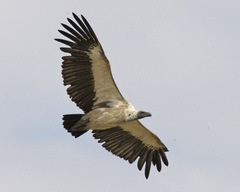
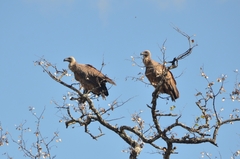


White-backed Vulture
Gyps africanus
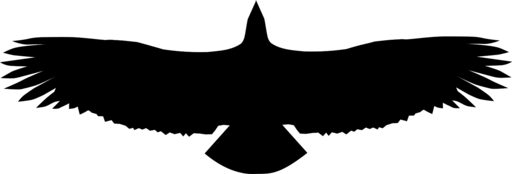
Silhouette: Shyamal · PhyloPic
- KingdomAnimalia (Animals)
- PhylumChordata (Chordates)
- ClassAves (Birds)
- OrderAccipitriformes (Hawks, Eagles, Kites, and Allies)
- FamilyAccipitridae (Hawks, Eagles, and Kites)
- GenusGyps (Griffon Vultures)
- SpeciesGyps africanus (White-backed Vulture)
In 3 days ~80% in a week >90%
231 Verified sightings at Hwange National Park From 2019 to 2026
20,542 In all 42 parks
October Best month
☀️ Diurnal When it's spotted
About the White-backed Vulture
The white-backed vulture (Gyps africanus) is an Old World vulture in the family Accipitridae, which also includes eagles, kites, buzzards and hawks. It is the most common vulture species in the continent of Africa. The white-backed vulture is a typical vulture, with only down feathers on the head and neck, very broad wings and short tail feathers. It has a white neck ruff. The adult's whitish back contrasts with the otherwise dark plumage. Juveniles are largely dark. This is a medium-sized vulture; its body mass is 4.2 to 7.2 kg (9.3–15.9 lb), it is 78 to 98 cm (31 to 39 in) long and has a 1.96 to 2.25 m (6 ft 5 in to 7 ft 5 in) wingspan.
The white-backed vulture occurs from Senegal, Gambia and Mali in the west, throughout the Sahel region to Ethiopia and Somalia in the east, through East Africa into Mozambique, Zimbabwe, Botswana, Namibia and South Africa in the south. It is the most widespread and common vulture in Africa with an estimated range of 24,300,000 km2 (9,400,000 sq mi), but has undergone rapid population declines in recent years.
White-backed vultures are obligate scavengers... Wikipedia →
Recent sightings of White-backed Vulture in Hwange National Park
LIVEiNaturalistGlobal Distribution
Parks Where Found
Cities Where Found
| # | City | Country | Daily sighting probability |
|---|---|---|---|
| 1 | Addis Ababa | 🇪🇹 Ethiopia | |
| 2 | Nairobi | 🇰🇪 Kenya | |
| 3 | Kampala | 🇺🇬 Uganda |
Zoos & Centres Where Found
Closest Relatives at Hwange National Park




Before you go
What are the chances of seeing a White-backed Vulture in Hwange National Park?
Likely
About 40% of wildlife watchers report a White-backed Vulture sighting in Hwange National Park on a given day, based on 231 verified sightings from GBIF citizen-science data from 2019 to 2026. It is the 16th most-seen of the 308 birds we can rate there. Over three days the chance rises to about 80%, and over a week to over 90%, if each day is a fresh chance.
When is the best time to see a White-backed Vulture in Hwange National Park?
October
In that month about 60% of wildlife watchers report a White-backed Vulture in Hwange National Park on a given day, against about 20% in March, the lowest month. That is one of Hwange National Park's driest months, with about 5 mm of rain against 150 mm in January.
What time of day is best to see a White-backed Vulture?
Between 10 am and 1 pm
Across all the parks we cover, that three-hour window holds the most White-backed Vulture sightings with a recorded time, and about 8 in 10 of them come between 6 am and 6 pm: it is a daytime animal.
Is Hwange National Park the best place to see a White-backed Vulture?
12th of 42
Of the 42 parks where we can rate White-backed Vulture sightings, Hwange National Park ranks 12th at about 40%. The best odds are in Hluhluwe-Imfolozi Park (South Africa, about 70%), Nairobi National Park (Kenya, about 60%) and Tarangire National Park (Tanzania, about 60%). All parks ranked.
Which relatives of the White-backed Vulture live in Hwange National Park?
Same family: Accipitridae
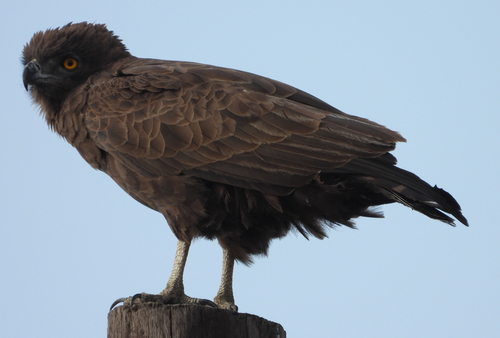
The closest relatives of the White-backed Vulture that you can see in Hwange National Park (family Accipitridae, Hawks, Eagles, and Kites) are Bateleur (about 40%), Tawny Eagle (about 40%) and Hooded Vulture (about 40%), with each one's daily chance of a sighting.
Where does the White-backed Vulture sighting chance come from?
GBIF citizen-science records
It is estimated from how often the White-backed Vulture is recorded against all the birds logged in Hwange National Park (231 verified sightings from 2019 to 2026), calibrated against known sighting rates. Figures are rounded to the nearest 10% because citizen-science data supports honest approximations, not decimals, and months with records from fewer than five people show "—". How it works.
