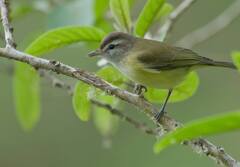

Brown-capped Vireo

Brown-capped Vireo

Vireo leucophrys

Silhouette: Caleb Gordon · PhyloPic

LCLeast ConcernNTVUENCR
Daily sighting probability <5% · Rare
at Irazú Volcano National Park

In 3 days ~10% in a week ~20%

16 Verified sightings at Irazú Volcano National Park From 2019 to 2026
5,821 In all 19 parks
May Best month
☀️ Diurnal When it's spotted

About the Brown-capped Vireo

The brown-capped vireo (Vireo leucophrys) is a small passerine bird in the family Vireonidae, the vireos, greenlets, and shrike-babblers. It is found in Mexico, much of Central America, and in South America from Venezuela to Bolivia.

The brown-capped vireo was originally described in 1844 as Hylophilus leucophrys. For much of the twentieth century it was treated as conspecific with the warbling vireo (Vireo gilvus). The brown-capped vireo's further taxonomy is unsettled. The IOC, AviList, and BirdLife International's Handbook of the Birds of the World assign it these 14 subspecies:

This article follows the 14-subspecies model. The brown-capped vireo is 11.5 to 12.5 cm (4.5 to 4.9 in) long and weighs... Wikipedia →

Sounds

Call0:27

Ecuador · 2025

© Marc Anderson · XC1078652 · CC BY-NC-ND 4.0

Song0:27

Ecuador · 2025

© Scott Olmstead · XC1018376 · CC BY-NC-SA 4.0

Recording0:58

Colombia · 2001

© Daniel Cadena (Colección de Sonidos Ambientales - Instituto Humboldt) · XC525766 · CC BY-NC-SA 4.0

Global Distribution

Parks Where Found

# Park Country Daily sighting probability
1 Volcán Barú National Park 🇵🇦 Panama
~40%
2 Henri Pittier National Park 🇻🇪 Venezuela
~30%
3 Los Quetzales National Park 🇨🇷 Costa Rica
~20%
4 La Amistad International Park (Panama) 🇵🇦 Panama
~20%
5 El Triunfo 🇲🇽 Mexico
~10%
6 Chirripó National Park 🇨🇷 Costa Rica
~10%
7 Cusuco National Park 🇭🇳 Honduras
~10%
8 Celaque National Park 🇭🇳 Honduras
~10%
9 Farallones de Cali National Natural Park 🇨🇴 Colombia
~10%
10 Podocarpus National Park 🇪🇨 Ecuador
<5%
11 Los Nevados National Natural Park 🇨🇴 Colombia
<5%
12 Tapantí-Macizo de la Muerte National Park 🇨🇷 Costa Rica
<5%
13 La Tigra National Park 🇭🇳 Honduras
<5%
14 Monteverde Cloud Forest Reserve 🇨🇷 Costa Rica
<5%
15 Braulio Carrillo National Park 🇨🇷 Costa Rica
<5%
16 Irazú Volcano National Park 🇨🇷 Costa Rica
<5%
17 Poás Volcano National Park 🇨🇷 Costa Rica
<5%
18 Cumbres de Monterrey National Park 🇲🇽 Mexico
<5%
19 Chingaza National Natural Park 🇨🇴 Colombia
<5%

Cities Where Found

# City Country Daily sighting probability
1 Quito 🇪🇨 Ecuador
<5%
2 Bogota 🇨🇴 Colombia
<5%
3 Medellín 🇨🇴 Colombia
<5%
4 Caracas 🇻🇪 Venezuela
<5%
5 Cali 🇨🇴 Colombia
<5%
6 San José 🇨🇷 Costa Rica
<5%

Before you go

What are the chances of seeing a Brown-capped Vireo in Irazú Volcano National Park?

Rare

Under 5% of wildlife watchers report a Brown-capped Vireo sighting in Irazú Volcano National Park on a given day, based on 16 verified sightings from GBIF citizen-science data from 2019 to 2026. It is the 94th most-seen of the 121 birds we can rate there. Over three days the chance rises to about 10%, and over a week to about 20%, if each day is a fresh chance.

When is the best time to see a Brown-capped Vireo in Irazú Volcano National Park?

April and May

In those months about 10% of wildlife watchers report a Brown-capped Vireo in Irazú Volcano National Park on a given day, against under 5% in June to March, the lowest months.

What time of day is best to see a Brown-capped Vireo?

Between 7 and 10 am

Across all the parks we cover, that three-hour window holds the most Brown-capped Vireo sightings with a recorded time, and about 9 in 10 of them come between 6 am and 6 pm: it is a daytime animal.

Where does the Brown-capped Vireo sighting chance come from?

GBIF citizen-science records

It is estimated from how often the Brown-capped Vireo is recorded against all the birds logged in Irazú Volcano National Park (16 verified sightings from 2019 to 2026), calibrated against known sighting rates. Figures are rounded to the nearest 10% because citizen-science data supports honest approximations, not decimals, and months with records from fewer than five people show "—". How it works.

← Back to Irazú Volcano National Park