Tickell's Blue Flycatcher

Tickell's Blue Flycatcher

Cyornis tickelliae

Silhouette: L. Shyamal · PhyloPic

LCLeast ConcernNTVUENCR
Daily sighting probability ~30% · Possible
at Kaeng Krachan National Park

In 3 days ~70% in a week ~90%

1,259 Verified sightings at Kaeng Krachan National Park From 2019 to 2026
12,155 In all 27 parks
March Best month
🌅 Crepuscular When it's spotted

About the Tickell's Blue Flycatcher

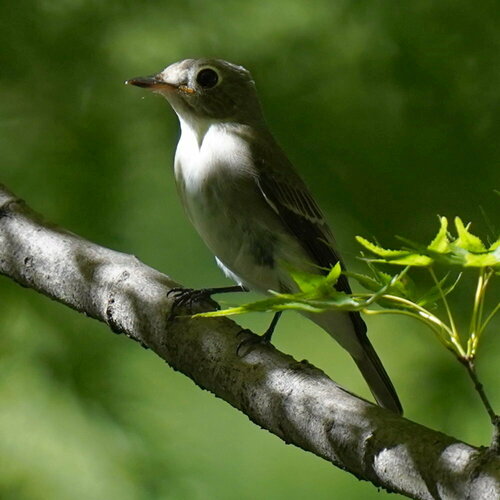
Tickell's blue flycatcher (Cyornis tickelliae) is a small passerine bird in the flycatcher family. This is an insectivorous species which breeds in tropical Asia, from the Indian subcontinent eastwards to Bangladesh and western Myanmar. The Indochinese blue flycatcher was formerly considered conspecific. They are blue on the upperparts and the throat and breast are rufous. They are found in dense scrub to forest habitats. The name commemorates the wife of the British ornithologist Samuel Tickell who collected in India and Burma.

Tickell's blue flycatcher is about 11–12 cm long. It sits upright and forages mainly in the overgrowth. The male's upper parts are bright blue, its throat and breast are red, and the rest of the underparts are white. The female is duller blue with a brighter blue brow, shoulder, rump, and tail. It hybridizes with the pale-chinned blue flycatcher (Cyornis poliogenys) in the Eastern Ghats of India and these hybrids have sometimes been treated as a subspecies vernayi. The juvenile is streaked and has a spotted mantle, scaly brown upperparts, head and breast, with just the wings and tail being blue.

They have sometimes been known to feed even... Wikipedia →

Sounds

Song1:01

India · 2025

© Jairam Vijayan · XC1043297 · CC BY-SA 4.0

Call0:39

India · 2022

© Sathyan Meppayur · XC741607 · CC BY-NC-SA 4.0

Song0:27

India · 2021

© [email protected] · XC825028 · CC BY-NC-ND 4.0

Global Distribution

Parks Where Found

# Park Country Daily sighting probability
1 Gir National Park 🇮🇳 India
~50%
2 Bandhavgarh National Park 🇮🇳 India
~50%
3 Mudumalai National Park 🇮🇳 India
~50%
4 Kanha National Park 🇮🇳 India
~40%
5 Cat Tien National Park 🇻🇳 Vietnam
~40%
6 Kaeng Krachan National Park 🇹🇭 Thailand
~30%
7 Nagarhole National Park 🇮🇳 India
~30%
8 Satpura National Park 🇮🇳 India
~30%
9 Minneriya National Park 🇱🇰 Sri Lanka
~30%
10 Bandipur National Park 🇮🇳 India
~30%
11 Ranthambore National Park 🇮🇳 India
~20%
12 Wilpattu National Park 🇱🇰 Sri Lanka
~20%
13 Periyar National Park 🇮🇳 India
~10%
14 Sinharaja Forest Reserve 🇱🇰 Sri Lanka
~10%
15 Khao Luang National Park 🇹🇭 Thailand
~10%
16 Royal Bardia National Park 🇳🇵 Nepal
~10%
17 Taman Negara National Park 🇲🇾 Malaysia
~10%
18 Jim Corbett National Park 🇮🇳 India
<5%
19 Udawalawe National Park 🇱🇰 Sri Lanka
<5%
20 Doi Inthanon National Park 🇹🇭 Thailand
<5%
21 Horton Plains National Park 🇱🇰 Sri Lanka
<5%
22 Yala National Park 🇱🇰 Sri Lanka
<5%
23 Eravikulam National Park 🇮🇳 India
<5%
24 Chitwan National Park 🇳🇵 Nepal
<5%
25 Khao Sok National Park 🇹🇭 Thailand
<5%
26 Khao Yai National Park 🇹🇭 Thailand
<5%
27 Keoladeo National Park 🇮🇳 India
<5%

Cities Where Found

# City Country Daily sighting probability
1 Hyderabad 🇮🇳 India
~50%
2 Jabalpur 🇮🇳 India
~50%
3 Mysuru 🇮🇳 India
~30%
4 Raipur 🇮🇳 India
~20%
5 Pune 🇮🇳 India
~20%
6 Chhatrapati Sambhajinagar 🇮🇳 India
~20%
7 Mumbai 🇮🇳 India
~10%
8 Nagpur 🇮🇳 India
~10%
9 Rajkot 🇮🇳 India
~10%
10 Durg 🇮🇳 India
~10%

Before you go

What are the chances of seeing a Tickell's Blue Flycatcher in Kaeng Krachan National Park?

Possible

About 30% of wildlife watchers report a Tickell's Blue Flycatcher sighting in Kaeng Krachan National Park on a given day, based on 1,259 verified sightings from GBIF citizen-science data from 2019 to 2026. It is the 46th most-seen of the 360 birds we can rate there. Over three days the chance rises to about 70%, and over a week to about 90%, if each day is a fresh chance.

When is the best time to see a Tickell's Blue Flycatcher in Kaeng Krachan National Park?

February and March

In those months about 40% of wildlife watchers report a Tickell's Blue Flycatcher in Kaeng Krachan National Park on a given day, against about 10% in September, the lowest month. Those are among Kaeng Krachan National Park's driest months, with about 55 mm of rain a month against 260 mm in September.

What time of day is best to see a Tickell's Blue Flycatcher?

Between 4 and 7 am

Across all the parks we cover, that three-hour window holds the most Tickell's Blue Flycatcher sightings with a recorded time, and about 6 in 10 of them come between 6 am and 6 pm: it is most active around dawn and dusk.

Which relatives of the Tickell's Blue Flycatcher live in Kaeng Krachan National Park?

Same genus: Cyornis

The closest relatives of the Tickell's Blue Flycatcher that you can see in Kaeng Krachan National Park (genus Cyornis, Blue Flycatchers and Jungle Flycatchers) are Hainan Blue-Flycatcher (about 20%), Chinese Blue Flycatcher (about 10%) and Hill Blue Flycatcher (about 10%), with each one's daily chance of a sighting.

Where does the Tickell's Blue Flycatcher sighting chance come from?

GBIF citizen-science records

It is estimated from how often the Tickell's Blue Flycatcher is recorded against all the birds logged in Kaeng Krachan National Park (1,259 verified sightings from 2019 to 2026), calibrated against known sighting rates. Figures are rounded to the nearest 10% because citizen-science data supports honest approximations, not decimals, and months with records from fewer than five people show "—". How it works.

← Back to Kaeng Krachan National Park