Leaden Flycatcher

Leaden Flycatcher

Myiagra rubecula

Silhouette: Sheatherius · PhyloPic

LCLeast ConcernNTVUENCR
Daily sighting probability ~30% · Possible
at Kakadu National Park

In 3 days ~70% in a week ~90%

500 Verified sightings at Kakadu National Park From 2019 to 2026
1,809 In all 11 parks
August Best month
☀️ Diurnal When it's spotted

About the Leaden Flycatcher

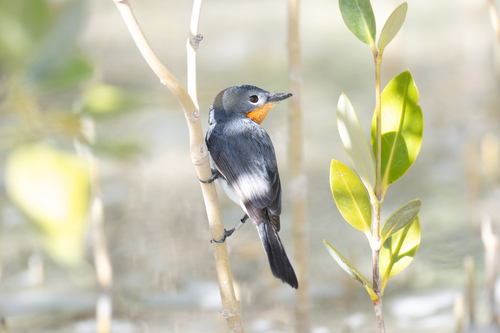
The leaden flycatcher (Myiagra rubecula) is a species of passerine bird in the family Monarchidae. Around 15 cm (6 in) in length, the male is lustrous azure with white underparts, while the female possesses leaden head, mantle and back and rufous throat and breast. It is found in eastern and northern Australia, Indonesia, and Papua New Guinea. Its natural habitat is subtropical or tropical mangrove forests in the northern parts of its range, in the south and inland it is eucalypt woodland.

The leaden flycatcher was first described by the English ornithologist John Latham in 1801, from an illustration of a female bird in the Watling drawings. He coined the English name "red-breasted tody" and classified it in the genus Todus. Its specific name, rubecula, comes from the Latin for robin. A local name around Sydney is frogbird, derived from its guttural call. Other variants of its common name include blue- or leaden-coloured flycatcher, leaden Myiagra and leaden Myiagra flycatcher.

The leaden flycatcher is a member of a group of birds termed monarch flycatchers. This group is considered either as a subfamily Monarchinae, together with the fantails as part... Wikipedia →

Sounds

Call1:00

Australia · 2024

© Romuald Mikusek · XC1173889 · CC BY-NC-SA 4.0

Song and call1:17

Australia · 2025

© Peter Boesman · XC1066731 · CC BY-NC-ND 4.0

Song0:22

Australia · 2023

© nick talbot · XC818283 · CC BY-NC-SA 4.0

Global Distribution

Parks Where Found

# Park Country Daily sighting probability
1 Nitmiluk National Park 🇦🇺 Australia
~40%
2 Kakadu National Park 🇦🇺 Australia
~30%
3 Daintree National Park 🇦🇺 Australia
~20%
4 Litchfield National Park 🇦🇺 Australia
~20%
5 Noosa National Park 🇦🇺 Australia
~10%
6 Kosciuszko National Park 🇦🇺 Australia
~10%
7 Springbrook National Park 🇦🇺 Australia
~10%
8 Royal National Park 🇦🇺 Australia
~10%
9 Booderee National Park 🇦🇺 Australia
~10%
10 Blue Mountains National Park 🇦🇺 Australia
~10%
11 Lamington National Park 🇦🇺 Australia
<5%

Cities Where Found

# City Country Daily sighting probability
1 Brisbane 🇦🇺 Australia
~10%
2 Sydney 🇦🇺 Australia
<5%
3 Melbourne 🇦🇺 Australia
<5%

Before you go

What are the chances of seeing a Leaden Flycatcher in Kakadu National Park?

Possible

About 30% of wildlife watchers report a Leaden Flycatcher sighting in Kakadu National Park on a given day, based on 500 verified sightings from GBIF citizen-science data from 2019 to 2026. It is the 51st most-seen of the 186 birds we can rate there. Over three days the chance rises to about 70%, and over a week to about 90%, if each day is a fresh chance.

When is the best time to see a Leaden Flycatcher in Kakadu National Park?

June to October

In those months about 30% of wildlife watchers report a Leaden Flycatcher in Kakadu National Park on a given day, against about 20% in March–May and November–January, the lowest months. Those are among Kakadu National Park's driest months, with about 10 mm of rain a month against 350 mm in January. February has too few records to rate.

What time of day is best to see a Leaden Flycatcher?

Between 2 and 5 pm

Across all the parks we cover, that three-hour window holds the most Leaden Flycatcher sightings with a recorded time, and about 9 in 10 of them come between 6 am and 6 pm: it is a daytime animal.

Is Kakadu National Park the best place to see a Leaden Flycatcher?

2nd of 11

Of the 11 parks where we can rate Leaden Flycatcher sightings, Kakadu National Park ranks 2nd at about 30%. The best odds are in Nitmiluk National Park (Australia, about 40%).

Which relatives of the Leaden Flycatcher live in Kakadu National Park?

Same genus: Myiagra

The closest relatives of the Leaden Flycatcher that you can see in Kakadu National Park (genus Myiagra, Myiagra Flycatchers) are Paperbark Flycatcher (about 50%), Shining Flycatcher (about 30%) and Broad-billed Flycatcher (about 10%), with each one's daily chance of a sighting.

Where does the Leaden Flycatcher sighting chance come from?

GBIF citizen-science records

It is estimated from how often the Leaden Flycatcher is recorded against all the birds logged in Kakadu National Park (500 verified sightings from 2019 to 2026), calibrated against known sighting rates. Figures are rounded to the nearest 10% because citizen-science data supports honest approximations, not decimals, and months with records from fewer than five people show "—". How it works.

← Back to Kakadu National Park