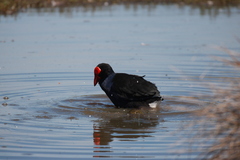
South-west Pacific Swamphen

South-west Pacific Swamphen

Porphyrio melanotus

Silhouette: Sheatherius · PhyloPic

Daily sighting probability ~20% · Possible
at Kakadu National Park

In 3 days ~50% in a week ~80%

356 Verified sightings at Kakadu National Park From 2019 to 2026
2,952 In all 15 parks
October Best month
☀️ Diurnal When it's spotted

About the South-west Pacific Swamphen

The Australasian swamphen (Porphyrio melanotus), commonly known as the pūkeko in New Zealand, is a striking and socially complex bird found in Oceania, including eastern Indonesia (the Moluccas, Aru and Kai Islands), Papua New Guinea, New Zealand and Australia. A member of the rail family, it is part of the diverse order Gruiformes, which includes species with similar characteristics such as cranes and other rail species. Within the Australasian swamphen species, five recognised subspecies exist, with P. m. melanotus being the most common and widely distributed in New Zealand. They display phenotypic characteristics typical of rails: relatively short wings and strong, elongated bills, adapted to its semi-aquatic lifestyle in wetlands.

The swamphen is renowned for its distinctive blue-purple plumage, striking red frontal shield, and strong red legs. It is often found in swamps, marshes, and other wet lowland areas, though its habitat has expanded to include pastures, roadside verges, and farmland, due to significant landscape changes in New Zealand over the last 150 years. Unlike many other wetland birds, it is highly opportunistic and adaptable, thriving in both natural and human-modified environments. Its diet reflects this adaptability, consisting primarily of plant material such as grass stems, shoots, and leaves, but also including animal matter like invertebrates and, occasionally, the young of other bird species.

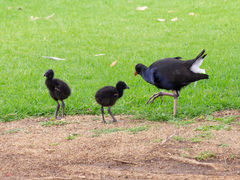
Classified as a communal gallinule, the birds often breed in social groups rather than pairs. These groups typically consist of three to nine individuals, including both males and females, which all contribute to territory defence, nesting, and chick rearing. They exhibit a linear dominance hierarchy within these groups that is reinforced by physical traits, such as the size of the bird's frontal shield, which serves as a signal of social dominance. Wikipedia →

Sounds

Begging call1:04

Australia · 2024

© Romuald Mikusek · XC1172802 · CC BY-NC-SA 4.0

Call0:08

Australia · 2024

© Tom Cooney · XC1104850 · CC BY-NC-SA 4.0

Song0:27

Australia · 2020

© Marc Anderson · XC1044985 · CC BY-NC-ND 4.0

Global Distribution

Parks Where Found

# Park Country Daily sighting probability
1 Abel Tasman National Park 🇳🇿 New Zealand
~50%
2 Egmont National Park 🇳🇿 New Zealand
~40%
3 Royal National Park 🇦🇺 Australia
~30%
4 Kakadu National Park 🇦🇺 Australia
~20%
5 Great Otway National Park 🇦🇺 Australia
~20%
6 Blue Mountains National Park 🇦🇺 Australia
~10%
7 Grampians National Park 🇦🇺 Australia
~10%
8 Noosa National Park 🇦🇺 Australia
<5%
9 Kosciuszko National Park 🇦🇺 Australia
<5%
10 Springbrook National Park 🇦🇺 Australia
<5%
11 Booderee National Park 🇦🇺 Australia
<5%
12 Daintree National Park 🇦🇺 Australia
<5%
13 Fiordland National Park 🇳🇿 New Zealand
<5%
14 Hattah-Kulkyne National Park 🇦🇺 Australia
<5%
15 Lamington National Park 🇦🇺 Australia
<5%

Cities Where Found

# City Country Daily sighting probability
1 Auckland 🇳🇿 New Zealand
~50%
2 Perth 🇦🇺 Australia
~50%
3 Melbourne 🇦🇺 Australia
~50%
4 Brisbane 🇦🇺 Australia
~50%
5 Sydney 🇦🇺 Australia
~30%

Zoos & Centres Where Found

# Zoo / Centre Country
1 Moonlit Sanctuary Wildlife Conservation Park 🇦🇺 Australia In captivity
2 Staglands Wildlife Reserve 🇳🇿 New Zealand In captivity
3 Willowbank Wildlife Reserve 🇳🇿 New Zealand In captivity
4 Kiwi Park 🇳🇿 New Zealand In captivity
5 Ōtorohanga Kiwi House 🇳🇿 New Zealand In captivity
6 Te Anau Bird Sanctuary 🇳🇿 New Zealand In captivity
7 Birdworld Kuranda 🇦🇺 Australia In captivity
8 Kuranda Koala Gardens 🇦🇺 Australia In captivity
9 Wildlife Habitat Port Douglas 🇦🇺 Australia In captivity

Before you go

What are the chances of seeing a South-west Pacific Swamphen in Kakadu National Park?

Possible

About 20% of wildlife watchers report a South-west Pacific Swamphen sighting in Kakadu National Park on a given day, based on 356 verified sightings from GBIF citizen-science data from 2019 to 2026. It is the 63rd most-seen of the 186 birds we can rate there. Over three days the chance rises to about 50%, and over a week to about 80%, if each day is a fresh chance.

When is the best time to see a South-west Pacific Swamphen in Kakadu National Park?

October

In that month about 50% of wildlife watchers report a South-west Pacific Swamphen in Kakadu National Park on a given day, against under 5% in April, the lowest month. That is one of Kakadu National Park's driest months, with about 25 mm of rain against 350 mm in January. February has too few records to rate.

What time of day is best to see a South-west Pacific Swamphen?

Between noon and 3 pm

Across all the parks we cover, that three-hour window holds the most South-west Pacific Swamphen sightings with a recorded time, and nearly all of them come between 6 am and 6 pm: it is a daytime animal.

Where does the South-west Pacific Swamphen sighting chance come from?

GBIF citizen-science records

It is estimated from how often the South-west Pacific Swamphen is recorded against all the birds logged in Kakadu National Park (356 verified sightings from 2019 to 2026), calibrated against known sighting rates. Figures are rounded to the nearest 10% because citizen-science data supports honest approximations, not decimals, and months with records from fewer than five people show "—". How it works.

← Back to Kakadu National Park