
Canivet's Emerald

Canivet's Emerald

Cynanthus canivetii

Silhouette: Ferran Sayol · PhyloPic

LCLeast ConcernNTVUENCR
Daily sighting probability <5% · Rare
at Lago de Yojoa

In 3 days ~10% in a week ~20%

39 Verified sightings at Lago de Yojoa From 2019 to 2026
3,794 In all 21 parks
January Best month
☀️ Diurnal When it's spotted

About the Canivet's Emerald

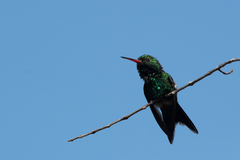
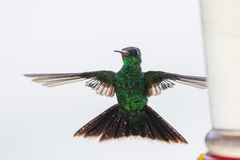
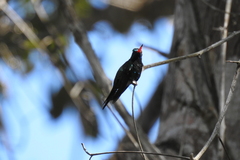
Canivet's emerald (Cynanthus canivetii) is a species of hummingbird in the "emeralds", tribe Trochilini of subfamily Trochilinae. It is found in Belize, Costa Rica, El Salvador, Guatemala, Honduras, Mexico, and Nicaragua.

The taxonomic history of Canivet's emerald is complicated. The North American Classification Committee of the American Ornithological Society, the International Ornithological Committee (IOC), and the Clements taxonomy assign it the binomial Cynanthus canivetii. However, as of 2020 BirdLife International's Handbook of the Birds of the World (HBW) retains it in its earlier genus Chlorostilbon.

However, some authors treat the last two as a single subspecies or species, Salvin's emerald. Others expand C. canivetii to include all of the species now in genus Chlorostilbon under the binomial Chlorostilbon canivetii and the English name fork-tailed emerald, and still others call this combined entity the blue-tailed emerald (Chlorostilbon mellisugus)... Wikipedia →

Sounds

Flight call0:09

Costa Rica · 2017

© Albert Lastukhin · XC894124 · CC BY-NC-ND 4.0

Call0:05

Costa Rica · 2013

© Paul Driver · XC137688 · CC BY-NC-SA 3.0

Global Distribution

Parks Where Found

# Park Country Daily sighting probability
1 Cañón del Sumidero National Park 🇲🇽 Mexico
~40%
2 Rincón de la Vieja National Park 🇨🇷 Costa Rica
~20%
3 Ostional Wildlife Refuge 🇨🇷 Costa Rica
~10%
4 Las Baulas Marine National Park 🇨🇷 Costa Rica
~10%
5 Sian Ka'an Biosphere Reserve 🇲🇽 Mexico
~10%
6 Monteverde Cloud Forest Reserve 🇨🇷 Costa Rica
~10%
7 Santa Rosa National Park 🇨🇷 Costa Rica
~10%
8 Masaya Volcano National Park 🇳🇮 Nicaragua
~10%
9 Palo Verde National Park 🇨🇷 Costa Rica
~10%
10 Tenorio Volcano National Park 🇨🇷 Costa Rica
~10%
11 Calakmul Biosphere Reserve 🇲🇽 Mexico
<5%
12 Celestún Biosphere Reserve 🇲🇽 Mexico
<5%
13 Cabo Blanco Absolute Nature Reserve 🇨🇷 Costa Rica
<5%
14 Biotopo Cerro Cahuí 🇬🇹 Guatemala
<5%
15 Lago de Yojoa 🇭🇳 Honduras
<5%
16 Tikal National Park 🇬🇹 Guatemala
<5%
17 Cerro Azul Meámbar National Park 🇭🇳 Honduras
<5%
18 Ría Lagartos Biosphere Reserve 🇲🇽 Mexico
<5%
19 Carara National Park 🇨🇷 Costa Rica
<5%
20 Arenal Volcano National Park 🇨🇷 Costa Rica
<5%
21 Poás Volcano National Park 🇨🇷 Costa Rica
<5%

Cities Where Found

# City Country Daily sighting probability
1 Guatemala City 🇬🇹 Guatemala
<5%
2 Managua 🇳🇮 Nicaragua
<5%
3 San José 🇨🇷 Costa Rica
<5%
4 Tegucigalpa 🇭🇳 Honduras
<5%
5 San Salvador 🇸🇻 El Salvador
<5%

Before you go

What are the chances of seeing a Canivet's Emerald in Lago de Yojoa?

Rare

Under 5% of wildlife watchers report a Canivet's Emerald sighting in Lago de Yojoa on a given day, based on 39 verified sightings from GBIF citizen-science data from 2019 to 2026. It is the 183rd most-seen of the 263 birds we can rate there. Over three days the chance rises to about 10%, and over a week to about 20%, if each day is a fresh chance.

When is the best time to see a Canivet's Emerald in Lago de Yojoa?

January and April

In those months about 10% of wildlife watchers report a Canivet's Emerald in Lago de Yojoa on a given day, against under 5% in February–March and May–December, the lowest months. Those are among Lago de Yojoa's driest months, with about 95 mm of rain a month against 320 mm in September.

What time of day is best to see a Canivet's Emerald?

Between 8 and 11 am

Across all the parks we cover, that three-hour window holds the most Canivet's Emerald sightings with a recorded time, and about 9 in 10 of them come between 6 am and 6 pm: it is a daytime animal.

Where does the Canivet's Emerald sighting chance come from?

GBIF citizen-science records

It is estimated from how often the Canivet's Emerald is recorded against all the birds logged in Lago de Yojoa (39 verified sightings from 2019 to 2026), calibrated against known sighting rates. Figures are rounded to the nearest 10% because citizen-science data supports honest approximations, not decimals, and months with records from fewer than five people show "—". How it works.

← Back to Lago de Yojoa