
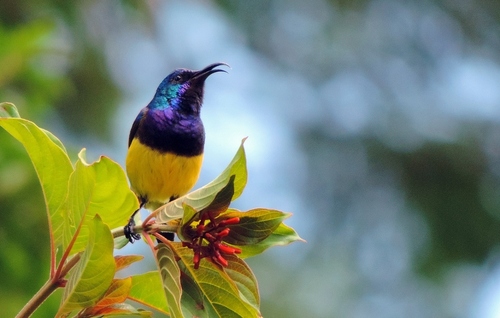
Collared Sunbird

Collared Sunbird

Hedydipna collaris

Silhouette: Sheatherius · PhyloPic

LCLeast ConcernNTVUENCR
Daily sighting probability <5% · Rare
at Lake Nakuru National Park

In 3 days ~10% in a week ~20%

32 Verified sightings at Lake Nakuru National Park From 2019 to 2026
7,022 In all 43 parks
September Best month
☀️ Diurnal When it's spotted

About the Collared Sunbird

The collared sunbird (Hedydipna collaris) is a bird species of the family Nectariniidae. The sunbirds are a group of very small Old World passerine birds which feed largely on nectar, although they will also take insects, especially when feeding young. The collared sunbird is in fact mainly insectivorous.

Sunbird flight is fast and direct on their short wings. Most species can take nectar by hovering like a hummingbird, but usually perch to feed most of the time. The collared sunbird is a common breeder across most of sub-Saharan Africa. Two or three eggs are laid in a suspended nest in a tree. It is a seasonal bird migrant within its range.

Collared sunbirds are tiny, only 9–10 cm (3.5–3.9 in) long. They have short thin down-curved bills and brush-tipped tubular tongues, both adaptations to nectar feeding. The adult male has glossy green upperparts and head with a yellow belly and narrow purple breast band. The female is a duller green above and entirely yellow below.

This species inhabits forests near water. Birds of The Gambia by Barlow, Wacher and Disley, ISBN 1-873403-32-1 Collared sunbird - Species text in The Atlas of Southern African Birds. Wikipedia →

Sounds

Song0:18

Botswana · 2026

© Ehren Eksteen · XC1187089 · CC BY-NC-SA 4.0

Dawn song1:08

Ivory Coast · 2026

© Étienne Leroy · XC1186478 · CC BY-NC-SA 4.0

Call0:28

Uganda · 2025

© Bernard BOUSQUET · XC1060328 · CC BY-NC-SA 4.0

Global Distribution

Parks Where Found

# Park Country Daily sighting probability
1 iSimangaliso Wetland Park 🇿🇦 South Africa
~40%
2 Bwindi Impenetrable National Park 🇺🇬 Uganda
~40%
3 Arusha National Park 🇹🇿 Tanzania
~40%
4 Nyungwe National Park 🇷🇼 Rwanda
~30%
5 Gorongosa National Park 🇲🇿 Mozambique
~30%
6 Kibale National Park 🇺🇬 Uganda
~30%
7 Nairobi National Park 🇰🇪 Kenya
~30%
8 Garden Route National Park 🇿🇦 South Africa
~20%
9 Kafue National Park 🇿🇲 Zambia
~20%
10 Meru National Park 🇰🇪 Kenya
~20%
11 Taï National Park 🇨🇮 Ivory Coast
~20%
12 Semuliki National Park 🇺🇬 Uganda
~20%
13 Mikumi National Park 🇹🇿 Tanzania
~20%
14 uMkhuze Game Reserve 🇿🇦 South Africa
~20%
15 Lower Zambezi National Park 🇿🇲 Zambia
~20%
16 Kruger National Park 🇿🇦 South Africa
~20%
17 Mkomazi National Park 🇹🇿 Tanzania
~20%
18 Mana Pools National Park 🇿🇼 Zimbabwe
~10%
19 South Luangwa National Park 🇿🇲 Zambia
~10%
20 Liwonde National Park 🇲🇼 Malawi
~10%
21 Gonarezhou National Park 🇿🇼 Zimbabwe
~10%
22 Ngorongoro Conservation Area 🇹🇿 Tanzania
~10%
23 Masai Mara National Reserve 🇰🇪 Kenya
~10%
24 Akagera National Park 🇷🇼 Rwanda
~10%
25 Aberdare National Park 🇰🇪 Kenya
~10%
26 Hluhluwe-Imfolozi Park 🇿🇦 South Africa
~10%
27 Tsavo West National Park 🇰🇪 Kenya
~10%
28 Lake Mburo National Park 🇺🇬 Uganda
~10%
29 Virunga National Park 🇨🇩 Democratic Republic of the Congo
~10%
30 Murchison Falls National Park 🇺🇬 Uganda
<5%
31 Lake Manyara National Park 🇹🇿 Tanzania
<5%
32 Addo Elephant National Park 🇿🇦 South Africa
<5%
33 Chobe National Park 🇧🇼 Botswana
<5%
34 Moremi Game Reserve 🇧🇼 Botswana
<5%
35 Volcanoes National Park 🇷🇼 Rwanda
<5%
36 Bale Mountains National Park 🇪🇹 Ethiopia
<5%
37 Tsavo East National Park 🇰🇪 Kenya
<5%
38 Lake Nakuru National Park 🇰🇪 Kenya
<5%
39 Queen Elizabeth National Park 🇺🇬 Uganda
<5%
40 Hwange National Park 🇿🇼 Zimbabwe
<5%
41 Tarangire National Park 🇹🇿 Tanzania
<5%
42 Serengeti National Park 🇹🇿 Tanzania
<5%
43 Amboseli National Park 🇰🇪 Kenya
<5%

Cities Where Found

# City Country Daily sighting probability
1 Dar es-Salaam 🇹🇿 Tanzania
~30%
2 Nairobi 🇰🇪 Kenya
~30%
3 Lusaka 🇿🇲 Zambia
~30%
4 Kampala 🇺🇬 Uganda
~20%
5 Durban 🇿🇦 South Africa
~10%
6 Mombasa 🇰🇪 Kenya
~10%
7 Abidjan 🇨🇮 Côte d'Ivoire
~10%
8 Zanzibar City 🇹🇿 Tanzania
~10%
9 Abuja 🇳🇬 Nigeria
<5%
10 Kigali 🇷🇼 Rwanda
<5%

Before you go

What are the chances of seeing a Collared Sunbird in Lake Nakuru National Park?

Rare

Under 5% of wildlife watchers report a Collared Sunbird sighting in Lake Nakuru National Park on a given day, based on 32 verified sightings from GBIF citizen-science data from 2019 to 2026. It is the 249th most-seen of the 369 birds we can rate there. Over three days the chance rises to about 10%, and over a week to about 20%, if each day is a fresh chance.

When is the best time to see a Collared Sunbird in Lake Nakuru National Park?

September and December

In those months about 10% of wildlife watchers report a Collared Sunbird in Lake Nakuru National Park on a given day, against under 5% in January–August and October–November, the lowest months.

What time of day is best to see a Collared Sunbird?

Between 9 am and noon

Across all the parks we cover, that three-hour window holds the most Collared Sunbird sightings with a recorded time, and about 9 in 10 of them come between 6 am and 6 pm: it is a daytime animal.

Which relatives of the Collared Sunbird live in Lake Nakuru National Park?

Same family: Nectariniidae

The closest relatives of the Collared Sunbird that you can see in Lake Nakuru National Park (family Nectariniidae, Sunbirds and Spiderhunters) are Scarlet-chested Sunbird (about 30%), Bronze Sunbird (about 10%) and Variable Sunbird (about 10%), with each one's daily chance of a sighting.

Where does the Collared Sunbird sighting chance come from?

GBIF citizen-science records

It is estimated from how often the Collared Sunbird is recorded against all the birds logged in Lake Nakuru National Park (32 verified sightings from 2019 to 2026), calibrated against known sighting rates. Figures are rounded to the nearest 10% because citizen-science data supports honest approximations, not decimals, and months with records from fewer than five people show "—". How it works.

← Back to Lake Nakuru National Park