American Golden-Plover

American Golden-Plover

Pluvialis dominica

Silhouette: Emily Willoughby · PhyloPic

LCLeast ConcernNTVUENCR
Daily sighting probability <5% · Rare
at Lauca National Park

In 3 days ~10% in a week ~20%

21 Verified sightings at Lauca National Park From 2019 to 2026
506 In all 20 parks
March Best month
☀️ Diurnal When it's spotted

About the American Golden-Plover

The American golden plover (Pluvialis dominica) is a medium-sized plover. The genus name is Latin and means relating to rain, from pluvia, "rain". It was believed that golden plovers flocked when rain was imminent. The species name dominica refers to Santo Domingo, now Hispaniola, in the West Indies.

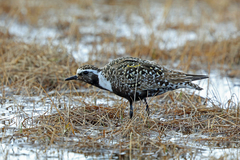
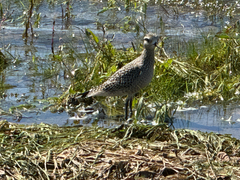
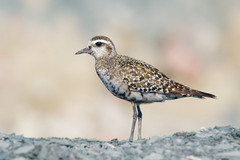
Measurements: Length: 24–28 cm (9+1⁄2–11 in) Weight: 122–194 g (4+5⁄16–6+13⁄16 oz) Wingspan: 65–67 cm (25+1⁄2–26+1⁄2 in) The breeding adult American golden plover has a black face, neck, breast, and belly, with a white crown and nape that extends to the side of the breast. The back is mottled black and white with pale, gold spots. The breeding female is similar, but with less black. When in winter plumage, both sexes have grey-brown upperparts, pale grey-brown underparts, and a whitish eyebrow. The head is small, along with the bill.

It is similar to two other golden plovers, European and Pacific. The American golden plover is smaller, slimmer and relatively longer-legged than European golden plover (Pluvialis apricaria) which also has white axillary (armpit) feathers. It is more similar to Pacific golden plover (Pluvialis fulva) with which it shares grey axillary feathers... Wikipedia →

Sounds

Song0:22

United States · 2022

© AUDEVARD Aurélien · XC1046370 · CC BY-NC-SA 4.0

Flight call0:24

United States · 2024

© Valerie Heemstra · XC883099 · CC BY-NC-SA 4.0

Alarm call0:31

United States · 2017

© Patrik Åberg · XC406168 · CC BY-NC-SA 4.0

Global Distribution

Parks Where Found

# Park Country Daily sighting probability
1 Caroni Swamp 🇹🇹 Trinidad and Tobago
~10%
2 Padre Island National Seashore 🇺🇸 United States
<5%
3 Lauca National Park 🇨🇱 Chile
<5%
4 Celestún Biosphere Reserve 🇲🇽 Mexico
<5%
5 Denali National Park 🇺🇸 United States
<5%
6 Point Pelee National Park 🇨🇦 Canada
<5%
7 Camargue 🇫🇷 France
<5%
8 Jasper National Park 🇨🇦 Canada
<5%
9 Table Mountain National Park 🇿🇦 South Africa
<5%
10 Palo Verde National Park 🇨🇷 Costa Rica
<5%
11 Parque Estadual Encontro das Águas 🇧🇷 Brazil
<5%
12 La Amistad International Park (Panama) 🇵🇦 Panama
<5%
13 Wadden Sea National Park 🇩🇪 Germany
<5%
14 Acadia National Park 🇺🇸 United States
<5%
15 Olympic National Park 🇺🇸 United States
<5%
16 Bastimentos Island National Marine Park 🇵🇦 Panama
<5%
17 Everglades National Park 🇺🇸 United States
<5%
18 Galápagos Islands 🇪🇨 Ecuador
<5%
19 Carara National Park 🇨🇷 Costa Rica
<5%
20 Merritt Island National Wildlife Refuge 🇺🇸 United States
<5%

Cities Where Found

# City Country Daily sighting probability
1 Vancouver 🇨🇦 Canada
<5%
2 Seattle 🇺🇸 United States
<5%
3 Santos 🇧🇷 Brazil
<5%
4 Caracas 🇻🇪 Venezuela
<5%
5 Rio de Janeiro 🇧🇷 Brazil
<5%
6 Montevideo 🇺🇾 Uruguay
<5%
7 Lima 🇵🇪 Peru
<5%
8 São Paulo 🇧🇷 Brazil
<5%
9 Panama City 🇵🇦 Panama
<5%
10 Anchorage 🇺🇸 United States
<5%

Zoos & Centres Where Found

# Zoo / Centre Country
1 National Zoological Park 🇺🇸 United States In captivity
2 Columbus Zoo and Aquarium 🇺🇸 United States In captivity
3 National Aviary 🇺🇸 United States In captivity

Before you go

What are the chances of seeing an American Golden-Plover in Lauca National Park?

Rare

Under 5% of wildlife watchers report an American Golden-Plover sighting in Lauca National Park on a given day, based on 21 verified sightings from GBIF citizen-science data from 2019 to 2026. It is the 102nd most-seen of the 112 birds we can rate there. Over three days the chance rises to about 10%, and over a week to about 20%, if each day is a fresh chance.

When is the best time to see an American Golden-Plover in Lauca National Park?

February–March and May

In those months about 10% of wildlife watchers report an American Golden-Plover in Lauca National Park on a given day, against under 5% in April and June–January, the lowest months.

What time of day is best to see an American Golden-Plover?

Between 8 and 11 am

Across all the parks we cover, that three-hour window holds the most American Golden-Plover sightings with a recorded time, and about 9 in 10 of them come between 6 am and 6 pm: it is a daytime animal.

Is Lauca National Park the best place to see an American Golden-Plover?

3rd of 20

Of the 20 parks where we can rate American Golden-Plover sightings, Lauca National Park ranks 3rd at under 5%. The best odds are in Caroni Swamp (Trinidad and Tobago, about 10%) and Padre Island National Seashore (United States, under 5%).

Which relatives of the American Golden-Plover live in Lauca National Park?

Same family: Charadriidae

The closest relatives of the American Golden-Plover that you can see in Lauca National Park (family Charadriidae, Plovers and Lapwings) are Andean Lapwing (about 40%) and Diademed Sandpiper-Plover (about 10%), with each one's daily chance of a sighting.

Where does the American Golden-Plover sighting chance come from?

GBIF citizen-science records

It is estimated from how often the American Golden-Plover is recorded against all the birds logged in Lauca National Park (21 verified sightings from 2019 to 2026), calibrated against known sighting rates. Figures are rounded to the nearest 10% because citizen-science data supports honest approximations, not decimals, and months with records from fewer than five people show "—". How it works.

← Back to Lauca National Park