About the Leaden Flycatcher
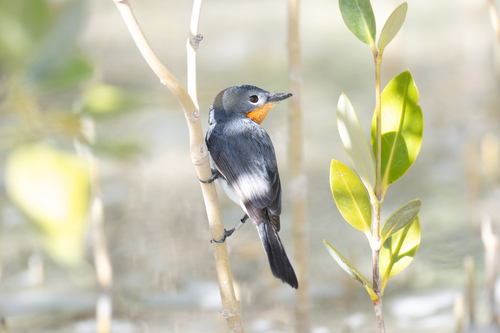
The leaden flycatcher (Myiagra rubecula) is a species of passerine bird in the family Monarchidae. Around 15 cm (6 in) in length, the male is lustrous azure with white underparts, while the female possesses leaden head, mantle and back and rufous throat and breast. It is found in eastern and northern Australia, Indonesia, and Papua New Guinea. Its natural habitat is subtropical or tropical mangrove forests in the northern parts of its range, in the south and inland it is eucalypt woodland.
The leaden flycatcher was first described by the English ornithologist John Latham in 1801, from an illustration of a female bird in the Watling drawings. He coined the English name "red-breasted tody" and classified it in the genus Todus. Its specific name, rubecula, comes from the Latin for robin. A local name around Sydney is frogbird, derived from its guttural call. Other variants of its common name include blue- or leaden-coloured flycatcher, leaden Myiagra and leaden Myiagra flycatcher.
The leaden flycatcher is a member of a group of birds termed monarch flycatchers. This group is considered either as a subfamily Monarchinae, together with the fantails as part... Wikipedia →