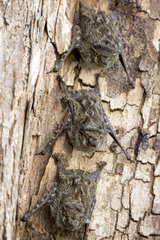
Proboscis Bat

Proboscis Bat

Rhynchonycteris naso

Silhouette: Roberto Díaz Sibaja · PhyloPic

LCLeast ConcernNTVUENCR
Daily sighting probability ~20% · Possible
at Manuel Antonio National Park

In 3 days ~50% in a week ~80%

37 Verified sightings at Manuel Antonio National Park From 2019 to 2026
865 In all 22 parks
May Best month
☀️ Diurnal When it's spotted

About the Proboscis Bat

The proboscis bat (Rhynchonycteris naso) is a species of bat found in South America and Central America. Other common names include long-nosed proboscis bat, sharp-nosed bat, Brazilian long-nosed bat, and river bat. It is the only species in the genus Rhynchonycteris.

This species is in the family Emballonuridae, the sac-winged or sheath-tailed bats. Like most bats, it is nocturnal. It is found from southern Mexico to Belize, Peru, Venezuela, Bolivia and Brazil, as well as in Trinidad.

This is a small bat, with a head-and-body length of 37–43 mm (1.5–1.7 in), a tail length of around 12 mm (0.47 in), and a forearm length of 35–41 mm (1.4–1.6 in). A sample of males and females from Trinidad found weights ranging between 2.1–4.3 g (0.074–0.152 oz). Males in northern South America were found to average 56 millimetres (2.2 in) long, females 59 millimetres (2.3 in). The tail is about 16 millimetres (0.63 in) long. Pregnant females can weigh up to 6 grams (0.21 oz).

This species is found in the lowlands of the northern half of South America, throughout Central America, and into southeastern Mexico. From Ecuador south, it is limited to east of the Andes... Wikipedia →

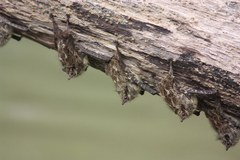
Global Distribution

Parks Where Found

# Park Country Daily sighting probability
1 Parque Estadual Encontro das Águas 🇧🇷 Brazil
~60%
2 Palo Verde National Park 🇨🇷 Costa Rica
~60%
3 Cuyabeno Wildlife Reserve 🇪🇨 Ecuador
~50%
4 Caroni Swamp 🇹🇹 Trinidad and Tobago
~40%
5 Tortuguero National Park 🇨🇷 Costa Rica
~40%
6 Yasuní National Park 🇪🇨 Ecuador
~40%
7 Montes Azules Biosphere Reserve 🇲🇽 Mexico
~40%
8 Braulio Carrillo National Park 🇨🇷 Costa Rica
~30%
9 Soberanía National Park 🇵🇦 Panama
~30%
10 Tambopata National Reserve 🇵🇪 Peru
~30%
11 Cahuita National Park 🇨🇷 Costa Rica
~30%
12 Manu National Park 🇵🇪 Peru
~20%
13 Manuel Antonio National Park 🇨🇷 Costa Rica
~20%
14 Biotopo Cerro Cahuí 🇬🇹 Guatemala
~20%
15 Lago de Yojoa 🇭🇳 Honduras
~20%
16 Gandoca-Manzanillo Wildlife Refuge 🇨🇷 Costa Rica
~10%
17 Las Baulas Marine National Park 🇨🇷 Costa Rica
~10%
18 Piedras Blancas National Park 🇨🇷 Costa Rica
~10%
19 Corcovado National Park 🇨🇷 Costa Rica
~10%
20 Carara National Park 🇨🇷 Costa Rica
~10%
21 Arenal Volcano National Park 🇨🇷 Costa Rica
~10%
22 La Amistad International Park (Panama) 🇵🇦 Panama
<5%

Cities Where Found

# City Country Daily sighting probability
1 Belém 🇧🇷 Brazil
~30%
2 João Pessoa 🇧🇷 Brazil
~20%
3 Recife 🇧🇷 Brazil
~20%

Before you go

What are the chances of seeing a Proboscis Bat in Manuel Antonio National Park?

Possible

About 20% of wildlife watchers report a Proboscis Bat sighting in Manuel Antonio National Park on a given day, based on 37 verified sightings from GBIF citizen-science data from 2019 to 2026. It is the 12th most-seen of the 18 mammals we can rate there. Over three days the chance rises to about 50%, and over a week to about 80%, if each day is a fresh chance.

When is the best time to see a Proboscis Bat in Manuel Antonio National Park?

May

In that month about 40% of wildlife watchers report a Proboscis Bat in Manuel Antonio National Park on a given day, against under 5% in August to December, the lowest months.

What time of day is best to see a Proboscis Bat?

Between 9 am and noon

Across all the parks we cover, that three-hour window holds the most Proboscis Bat sightings with a recorded time, and about 8 in 10 of them come between 6 am and 6 pm: it is a daytime animal.

Where does the Proboscis Bat sighting chance come from?

GBIF citizen-science records

It is estimated from how often the Proboscis Bat is recorded against all the mammals logged in Manuel Antonio National Park (37 verified sightings from 2019 to 2026), calibrated against known sighting rates. Figures are rounded to the nearest 10% because citizen-science data supports honest approximations, not decimals, and months with records from fewer than five people show "—". How it works.

← Back to Manuel Antonio National Park