Song Thrush

Song Thrush

Turdus philomelos

Silhouette: Zeynel Cebeci · PhyloPic

LCLeast ConcernNTVUENCR
Daily sighting probability ~10% · With luck
at Oosterschelde National Park

In 3 days ~30% in a week ~50%

64 Verified sightings at Oosterschelde National Park From 2019 to 2026
11,014 In all 36 parks
February Best month
☀️ Diurnal When it's spotted

About the Song Thrush

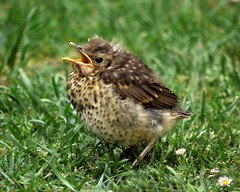
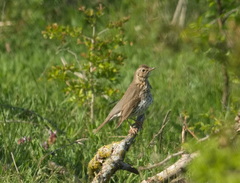
The song thrush (Turdus philomelos) is a thrush that breeds across the West Palearctic. It has brown upperparts and black-spotted cream or buff underparts and has four recognised subspecies. Its distinctive song, which features repeated musical phrases, has frequently been referenced in poetry.

The song thrush breeds in forests, gardens and parks. It is partially migratory, with many birds wintering in southern Europe, North Africa and the Middle East. The species has also been introduced into New Zealand and Australia. While it is not globally threatened, serious population declines have been observed in some European regions, potentially due to changes in farming practices.

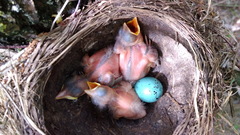
The song thrush builds a neat, mud-lined cup nest in a bush or tree and lays four to five dark-spotted blue eggs. It is omnivorous and has the habit of using a favourite stone as an "anvil" on which to break open the shells of snails. Like other perching birds (passerines), it is susceptible to external and internal parasites and is vulnerable to predation by cats and birds of prey.

The song thrush was described by German ornithologist Christian Ludwig Brehm in 1831, and...

Wikipedia →

Sounds

Flight call0:07

Italy · 2026

© Paolo Zucca · XC1186029 · CC BY-NC-SA 4.0

Alarm call0:10

France · 2026

© Thierry THOMAS · XC1185466 · CC BY-NC-SA 4.0

Call0:05

United Kingdom · 2026

© Mark James Pearson · XC1184873 · CC BY-NC-SA 4.0

Global Distribution

Parks Where Found

# Park Country Daily sighting probability
1 Białowieża National Park 🇵🇱 Poland
~60%
2 Arthur's Pass National Park 🇳🇿 New Zealand
~60%
3 Plitvice Lakes National Park 🇭🇷 Croatia
~60%
4 Aoraki Mount Cook National Park 🇳🇿 New Zealand
~50%
5 Abel Tasman National Park 🇳🇿 New Zealand
~40%
6 Triglav National Park 🇸🇮 Slovenia
~40%
7 Cairngorms National Park 🇬🇧 United Kingdom
~30%
8 Fiordland National Park 🇳🇿 New Zealand
~30%
9 Biebrza National Park 🇵🇱 Poland
~30%
10 Tatra National Park 🇸🇰 Slovakia
~30%
11 Snowdonia National Park 🇬🇧 United Kingdom
~30%
12 Bavarian Forest National Park 🇩🇪 Germany
~30%
13 Picos de Europa National Park 🇪🇸 Spain
~30%
14 Ordesa y Monte Perdido National Park 🇪🇸 Spain
~30%
15 Egmont National Park 🇳🇿 New Zealand
~30%
16 Hohe Tauern National Park 🇦🇹 Austria
~20%
17 Rakiura National Park 🇳🇿 New Zealand
~20%
18 Pyrénées National Park 🇫🇷 France
~20%
19 Monfragüe National Park 🇪🇸 Spain
~20%
20 Fertő-Hanság National Park 🇭🇺 Hungary
~20%
21 Wadden Sea National Park 🇩🇪 Germany
~20%
22 Vanoise National Park 🇫🇷 France
~20%
23 Cévennes National Park 🇫🇷 France
~20%
24 Mercantour National Park 🇫🇷 France
~10%
25 Aigüestortes National Park 🇪🇸 Spain
~10%
26 Kiskunság National Park 🇭🇺 Hungary
~10%
27 Ecrins National Park 🇫🇷 France
~10%
28 Gauja National Park 🇱🇻 Latvia
~10%
29 Sierra Nevada National Park 🇪🇸 Spain
~10%
30 Oosterschelde National Park 🇳🇱 Netherlands
~10%
31 Sierra de Guadarrama National Park 🇪🇸 Spain
~10%
32 Hortobágy National Park 🇭🇺 Hungary
~10%
33 Doñana National Park 🇪🇸 Spain
~10%
34 Corsica Regional Natural Park (Parc naturel régional de Corse) 🇫🇷 France
<5%
35 Camargue 🇫🇷 France
<5%
36 Great Otway National Park 🇦🇺 Australia
<5%

Cities Where Found

# City Country Daily sighting probability
1 Auckland 🇳🇿 New Zealand
~60%
2 Manchester 🇬🇧 United Kingdom
~40%
3 Moscow 🇷🇺 Russia
~40%
4 London 🇬🇧 United Kingdom
~30%
5 Birmingham 🇬🇧 United Kingdom
~30%
6 Liverpool 🇬🇧 United Kingdom
~30%
7 Jerusalem 🇮🇱 Israel
~30%
8 Tehran 🇮🇷 Iran
~30%
9 Nizhny Novgorod 🇷🇺 Russia
~30%
10 Essen 🇩🇪 Germany
~20%

Zoos & Centres Where Found

# Zoo / Centre Country
1 Prague Zoo 🇨🇿 Czechia In captivity
2 Zoo Pilsen 🇨🇿 Czechia In captivity
3 Bronx Zoo 🇺🇸 United States In captivity
4 Schönbrunn Zoo 🇦🇹 Austria In captivity
5 Tierpark Hexentanzplatz 🇩🇪 Germany In captivity
6 Rákosův pavilon 🇨🇿 Czechia In captivity
7 Velemlokárium 🇨🇿 Czechia In captivity

Before you go

What are the chances of seeing a Song Thrush in Oosterschelde National Park?

With luck

About 10% of wildlife watchers report a Song Thrush sighting in Oosterschelde National Park on a given day, based on 64 verified sightings from GBIF citizen-science data from 2019 to 2026. It is the 82nd most-seen of the 157 birds we can rate there. Over three days the chance rises to about 30%, and over a week to about 50%, if each day is a fresh chance.

When is the best time to see a Song Thrush in Oosterschelde National Park?

February

In that month about 20% of wildlife watchers report a Song Thrush in Oosterschelde National Park on a given day, against under 5% in January, August–September and November, the lowest months.

What time of day is best to see a Song Thrush?

Between 8 and 11 am

Across all the parks we cover, that three-hour window holds the most Song Thrush sightings with a recorded time, and about 9 in 10 of them come between 6 am and 6 pm: it is a daytime animal.

Where does the Song Thrush sighting chance come from?

GBIF citizen-science records

It is estimated from how often the Song Thrush is recorded against all the birds logged in Oosterschelde National Park (64 verified sightings from 2019 to 2026), calibrated against known sighting rates. Figures are rounded to the nearest 10% because citizen-science data supports honest approximations, not decimals, and months with records from fewer than five people show "—". How it works.

← Back to Oosterschelde National Park