Royal Spoonbill

Royal Spoonbill

Platalea regia

Silhouette: Andy Wilson · PhyloPic

LCLeast ConcernNTVUENCR
Daily sighting probability ~30% · Possible
at Phillip Island Nature Park

In 3 days ~60% in a week ~90%

509 Verified sightings at Phillip Island Nature Park From 2019 to 2026
1,551 In all 14 parks
April Best month
☀️ Diurnal When it's spotted

About the Royal Spoonbill

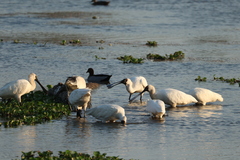
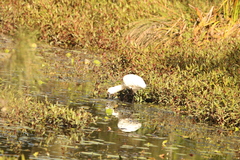
The royal spoonbill (Platalea regia), also known as the black-billed spoonbill lives in intertidal flats and shallows of fresh and saltwater wetlands in Australia, New Zealand, Indonesia, Papua New Guinea, and the Solomon Islands. (In New Zealand, it is also known by the Māori name kōtuku ngutupapa.) It has also been recorded as a vagrant in New Caledonia. It is one of 6 spoonbill species world wide. The royal spoonbill lives in wetlands and feeds on crustaceans, fish and small insects by sweeping its bill from side to side. It always flies with its head extended. Widespread throughout its large range, the royal spoonbill is evaluated as Least Concern on the IUCN Red List of Threatened Species.

The renowned ornithologist John Gould first described the royal spoonbill in 1838, naming it Platalea regia and noting its similarity to the Eurasian spoonbill (P. leucorodia). A 2010 study of mitochondrial DNA of the spoonbills by Chesser and colleagues found that the royal and black-faced spoonbills were each other's closest relatives.

The royal spoonbill is a large, white bird with a black, spoon-shaped bill. It is approximately 80 cm (31 in) tall, 74–81 cm...

Wikipedia →

Sounds

Begging call0:31

Australia · 2016

© nick talbot · XC349855 · CC BY-NC-SA 4.0

Recording0:19

New Zealand · 2024

© M Rutherford · iNaturalist · CC BY-NC 4.0

Global Distribution

Parks Where Found

# Park Country Daily sighting probability
1 Kakadu National Park 🇦🇺 Australia
~30%
2 Phillip Island Nature Park 🇦🇺 Australia
~30%
3 Daintree National Park 🇦🇺 Australia
~10%
4 Abel Tasman National Park 🇳🇿 New Zealand
~10%
5 Royal National Park 🇦🇺 Australia
~10%
6 Wilsons Promontory National Park 🇦🇺 Australia
<5%
7 Hattah-Kulkyne National Park 🇦🇺 Australia
<5%
8 Litchfield National Park 🇦🇺 Australia
<5%
9 Booderee National Park 🇦🇺 Australia
<5%
10 Great Otway National Park 🇦🇺 Australia
<5%
11 Rakiura National Park 🇳🇿 New Zealand
<5%
12 Blue Mountains National Park 🇦🇺 Australia
<5%
13 Fiordland National Park 🇳🇿 New Zealand
<5%
14 Lamington National Park 🇦🇺 Australia
<5%

Cities Where Found

# City Country Daily sighting probability
1 Auckland 🇳🇿 New Zealand
~20%
2 Brisbane 🇦🇺 Australia
~20%
3 Sydney 🇦🇺 Australia
~10%
4 Melbourne 🇦🇺 Australia
~10%

Zoos & Centres Where Found

# Zoo / Centre Country
1 Healesville Sanctuary 🇦🇺 Australia In captivity
2 Taronga Zoo 🇦🇺 Australia In captivity
3 Singapore Zoo 🇸🇬 Singapore In captivity
4 Cleland Wildlife Park 🇦🇺 Australia In captivity
5 Melbourne Zoo 🇦🇺 Australia In captivity
6 Perth Zoo 🇦🇺 Australia In captivity
7 Espace zoologique de Saint-Martin-la-Plaine 🇫🇷 France In captivity
8 Adelaide Zoo 🇦🇺 Australia In captivity
9 Gorge Wildlife Park 🇦🇺 Australia In captivity
10 Featherdale Sydney Wildlife Park 🇦🇺 Australia In captivity
11 Ipswich Nature Centre 🇦🇺 Australia In captivity
12 Caversham Wildlife Park 🇦🇺 Australia In captivity
13 Ranger Red’s Zoo & Conservation Park 🇦🇺 Australia In captivity

Before you go

What are the chances of seeing a Royal Spoonbill in Phillip Island Nature Park?

Possible

About 30% of wildlife watchers report a Royal Spoonbill sighting in Phillip Island Nature Park on a given day, based on 509 verified sightings from GBIF citizen-science data from 2019 to 2026. It is the 42nd most-seen of the 149 birds we can rate there. Over three days the chance rises to about 60%, and over a week to about 90%, if each day is a fresh chance.

When is the best time to see a Royal Spoonbill in Phillip Island Nature Park?

April

In that month about 40% of wildlife watchers report a Royal Spoonbill in Phillip Island Nature Park on a given day, against about 20% in July–September and December–January, the lowest months.

What time of day is best to see a Royal Spoonbill?

Between noon and 3 pm

Across all the parks we cover, that three-hour window holds the most Royal Spoonbill sightings with a recorded time, and nearly all of them come between 6 am and 6 pm: it is a daytime animal.

Is Phillip Island Nature Park the best place to see a Royal Spoonbill?

Among the best

Of the 14 parks where we can rate Royal Spoonbill sightings, Phillip Island Nature Park ranks 2nd at about 30%, level with the leaders once rounded. The best odds are in Kakadu National Park (Australia, about 30%).

Where does the Royal Spoonbill sighting chance come from?

GBIF citizen-science records

It is estimated from how often the Royal Spoonbill is recorded against all the birds logged in Phillip Island Nature Park (509 verified sightings from 2019 to 2026), calibrated against known sighting rates. Figures are rounded to the nearest 10% because citizen-science data supports honest approximations, not decimals, and months with records from fewer than five people show "—". How it works.

← Back to Phillip Island Nature Park