Swamp Harrier

Swamp Harrier

Circus approximans

Silhouette: Shyamal · PhyloPic

LCLeast ConcernNTVUENCR
Daily sighting probability <5% · Rare
at Rottnest Island

In 3 days <5% in a week ~10%

7 Verified sightings at Rottnest Island From 2019 to 2026
1,531 In all 16 parks
April Best month
☀️ Diurnal When it's spotted

About the Swamp Harrier

The swamp harrier (Circus approximans), also known as the Australasian marsh harrier or Australasian harrier, is a large, slim bird of prey widely distributed across Australasia. In New Zealand, it is also known by the Māori name kāhu. It arrived in New Zealand within the last 700 years, replacing the larger species, the extinct New Zealand endemic Eyles's harrier.

The swamp harrier belongs to the subfamily Circinae and genus Circus, which are represented worldwide, except Antarctica. The subfamily and genus are derived from the characteristic behaviour of circling flight during courtship and hawking.

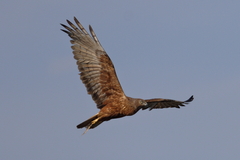
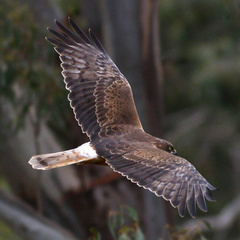
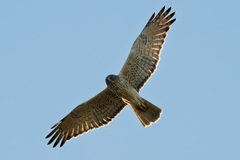
The swamp harrier is largely dark brown, becoming lighter with age, and has a distinct white rump. It hunts by flying slowly, low to the ground, on upswept wings. The body length is 48 to 62 cm (19 to 24.5 in), and the wingspan is 118 to 145 cm (3 ft 10 in to 4 ft 9 in). The recorded weights of adults range from 580 to 1,100 g (1.28 to 2.43 lb). Females are significantly larger than the males. In New Zealand, 54 males averaged 640 g (1.41 lb) and 66 females averaged 870 g (1.92 lb). Going on mean weights and linear measurements, the swamp harrier may be by a slight margin... Wikipedia →
Sounds

Flight call0:45

New Zealand · 2021

© David Boyle · XC926285 · CC BY-NC-SA 4.0

Call0:19

Australia · 2019

© Ramit Singal · XC503668 · CC BY-NC-SA 4.0

Uncertain0:12

Australia · 2024

© Nick Talbot · XC911820 · CC BY-NC-SA 4.0

Global Distribution

Parks Where Found

# Park Country Daily sighting probability
1 Egmont National Park 🇳🇿 New Zealand
~50%
2 Fiordland National Park 🇳🇿 New Zealand
~30%
3 Abel Tasman National Park 🇳🇿 New Zealand
~30%
4 Arthur's Pass National Park 🇳🇿 New Zealand
~20%
5 Aoraki Mount Cook National Park 🇳🇿 New Zealand
~20%
6 Wilsons Promontory National Park 🇦🇺 Australia
~10%
7 Maria Island National Park 🇦🇺 Australia
~10%
8 Rakiura National Park 🇳🇿 New Zealand
~10%
9 Great Otway National Park 🇦🇺 Australia
<5%
10 Booderee National Park 🇦🇺 Australia
<5%
11 Rottnest Island 🇦🇺 Australia
<5%
12 Royal National Park 🇦🇺 Australia
<5%
13 Kakadu National Park 🇦🇺 Australia
<5%
14 Grampians National Park 🇦🇺 Australia
<5%
15 Hattah-Kulkyne National Park 🇦🇺 Australia
<5%
16 Blue Mountains National Park 🇦🇺 Australia
<5%

Cities Where Found

# City Country Daily sighting probability
1 Auckland 🇳🇿 New Zealand
~20%
2 Perth 🇦🇺 Australia
~10%
3 Melbourne 🇦🇺 Australia
<5%
4 Brisbane 🇦🇺 Australia
<5%
5 Sydney 🇦🇺 Australia
<5%

Zoos & Centres Where Found

# Zoo / Centre Country
1 Auckland Zoo 🇳🇿 New Zealand In captivity
2 Wingspan National Bird of Prey Centre 🇳🇿 New Zealand In captivity

Before you go

What are the chances of seeing a Swamp Harrier in Rottnest Island?

Rare

Under 5% of wildlife watchers report a Swamp Harrier sighting in Rottnest Island on a given day, based on 7 verified sightings from GBIF citizen-science data from 2019 to 2026. It is the 75th most-seen of the 81 birds we can rate there. Over three days the chance rises to under 5%, and over a week to about 10%, if each day is a fresh chance.

When is the best time to see a Swamp Harrier in Rottnest Island?

Any time of year

In every month with enough records, under 5% of wildlife watchers report a Swamp Harrier in Rottnest Island on a given day, so our monthly data shows no clear season.

What time of day is best to see a Swamp Harrier?

Between 1 and 4 pm

Across all the parks we cover, that three-hour window holds the most Swamp Harrier sightings with a recorded time, and about 9 in 10 of them come between 6 am and 6 pm: it is a daytime animal.

Which relatives of the Swamp Harrier live in Rottnest Island?

Same family: Accipitridae

The closest relatives of the Swamp Harrier that you can see in Rottnest Island (family Accipitridae, Hawks, Eagles, and Kites) are White-Bellied Sea-Eagle (about 10%) and Black-shouldered Kite (about 10%), with each one's daily chance of a sighting.

Where does the Swamp Harrier sighting chance come from?

GBIF citizen-science records

It is estimated from how often the Swamp Harrier is recorded against all the birds logged in Rottnest Island (7 verified sightings from 2019 to 2026), calibrated against known sighting rates. Figures are rounded to the nearest 10% because citizen-science data supports honest approximations, not decimals, and months with records from fewer than five people show "—". How it works.

← Back to Rottnest Island