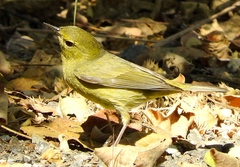
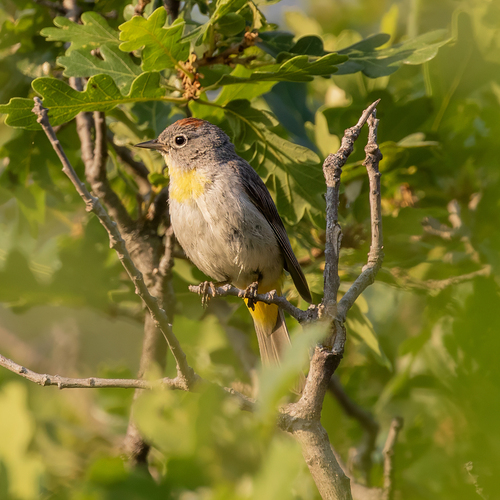
Orange-crowned Warbler

Orange-crowned Warbler

Leiothlypis celata

Silhouette: Andy Wilson · PhyloPic

LCLeast ConcernNTVUENCR
Daily sighting probability ~10% · With luck
at Saguaro National Park

In 3 days ~30% in a week ~50%

1,008 Verified sightings at Saguaro National Park From 2019 to 2026
15,648 In all 44 parks
October Best month
☀️ Diurnal When it's spotted

About the Orange-crowned Warbler

The orange-crowned warbler (Leiothlypis celata) is a small songbird of the New World warbler family. The orange-crowned warbler was formally described in 1822 by the American zoologist Thomas Say under the binomial name Sylvia celatus from a specimen collected on an expedition from Pittsburgh to the Rocky Mountains led by Stephen Harriman Long. The specific epithet celatus is Latin and means "secret" or "hidden". The type locality is Omaha, Nebraska. The orange-crowned warbler is now placed in the genus Leiothlypis that was introduced by the Dutch ornithologist George Sangster in 2008. The genus name is derived from the Ancient Greek λειος/leios meaning "plain" and θλυπις/thlupis, an unknown small bird mentioned by Aristotle.

Four subspecies are recognised: The orange... Wikipedia →

Sounds

Song1:20

United States · 2014

© Ed Pandolfino · XC1134051 · CC BY-NC-SA 4.0

Call0:58

United States · 2026

© Greg Irving · XC1105211 · CC BY-NC-SA 4.0

Chip note0:24

United States · 2020

© Russ Wigh · XC561187 · CC BY-NC-SA 4.0

Global Distribution

Parks Where Found

# Park Country Daily sighting probability
1 Reserva de la Biosfera Mariposa Monarca 🇲🇽 Mexico
~50%
2 Cabo Pulmo National Park 🇲🇽 Mexico
~50%
3 Channel Islands National Park 🇺🇸 United States
~50%
4 Denali National Park 🇺🇸 United States
~40%
5 Bahía de Loreto National Park 🇲🇽 Mexico
~40%
6 Pacific Rim National Park Reserve 🇨🇦 Canada
~30%
7 Kenai Fjords National Park 🇺🇸 United States
~30%
8 Katmai National Park 🇺🇸 United States
~30%
9 El Vizcaíno Biosphere Reserve 🇲🇽 Mexico
~30%
10 Kluane National Park 🇨🇦 Canada
~30%
11 Death Valley National Park 🇺🇸 United States
~20%
12 Wrangell-St. Elias National Park 🇺🇸 United States
~20%
13 Cumbres de Monterrey National Park 🇲🇽 Mexico
~20%
14 Great Bear Rainforest 🇨🇦 Canada
~20%
15 Redwood National Park 🇺🇸 United States
~20%
16 Olympic National Park 🇺🇸 United States
~20%
17 Jasper National Park 🇨🇦 Canada
~20%
18 Sequoia and Kings Canyon National Parks 🇺🇸 United States
~10%
19 Yosemite National Park 🇺🇸 United States
~10%
20 Glacier National Park 🇺🇸 United States
~10%
21 Banff National Park 🇨🇦 Canada
~10%
22 Riding Mountain National Park 🇨🇦 Canada
~10%
23 Big Bend National Park 🇺🇸 United States
~10%
24 Saguaro National Park 🇺🇸 United States
~10%
25 Joshua Tree National Park 🇺🇸 United States
~10%
26 Grand Teton National Park 🇺🇸 United States
~10%
27 Merritt Island National Wildlife Refuge 🇺🇸 United States
~10%
28 Zion National Park 🇺🇸 United States
~10%
29 Everglades National Park 🇺🇸 United States
~10%
30 Congaree National Park 🇺🇸 United States
~10%
31 Grand Canyon National Park 🇺🇸 United States
<5%
32 Rocky Mountain National Park 🇺🇸 United States
<5%
33 Elk Island National Park 🇨🇦 Canada
<5%
34 Point Pelee National Park 🇨🇦 Canada
<5%
35 Guadalupe Mountains National Park 🇺🇸 United States
<5%
36 Big Cypress National Preserve 🇺🇸 United States
<5%
37 Voyageurs National Park 🇺🇸 United States
<5%
38 Badlands National Park 🇺🇸 United States
<5%
39 Yellowstone National Park 🇺🇸 United States
<5%
40 Cañón del Sumidero National Park 🇲🇽 Mexico
<5%
41 Padre Island National Seashore 🇺🇸 United States
<5%
42 Acadia National Park 🇺🇸 United States
<5%
43 Arrecifes de Cozumel National Park 🇲🇽 Mexico
<5%
44 Great Smoky Mountains National Park 🇺🇸 United States
<5%

Cities Where Found

# City Country Daily sighting probability
1 Tijuana 🇲🇽 México
~50%
2 San Diego 🇺🇸 United States
~40%
3 Monterrey 🇲🇽 México
~40%
4 Los Angeles 🇺🇸 United States
~40%
5 Mesa 🇺🇸 United States
~40%
6 Anchorage 🇺🇸 United States
~30%
7 San Antonio 🇺🇸 United States
~30%
8 Puebla 🇲🇽 México
~30%
9 Mexico City 🇲🇽 México
~20%
10 Torreón 🇲🇽 México
~20%

Before you go

What are the chances of seeing an Orange-crowned Warbler in Saguaro National Park?

With luck

About 10% of wildlife watchers report an Orange-crowned Warbler sighting in Saguaro National Park on a given day, based on 1,008 verified sightings from GBIF citizen-science data from 2019 to 2026. It is the 49th most-seen of the 220 birds we can rate there. Over three days the chance rises to about 30%, and over a week to about 50%, if each day is a fresh chance.

When is the best time to see an Orange-crowned Warbler in Saguaro National Park?

October

In that month about 30% of wildlife watchers report an Orange-crowned Warbler in Saguaro National Park on a given day, against under 5% in May to August, the lowest months. That is one of Saguaro National Park's driest months, with about 15 mm of rain against 55 mm in July.

What time of day is best to see an Orange-crowned Warbler?

Between 8 and 11 am

Across all the parks we cover, that three-hour window holds the most Orange-crowned Warbler sightings with a recorded time, and about 9 in 10 of them come between 6 am and 6 pm: it is a daytime animal.

Where does the Orange-crowned Warbler sighting chance come from?

GBIF citizen-science records

It is estimated from how often the Orange-crowned Warbler is recorded against all the birds logged in Saguaro National Park (1,008 verified sightings from 2019 to 2026), calibrated against known sighting rates. Figures are rounded to the nearest 10% because citizen-science data supports honest approximations, not decimals, and months with records from fewer than five people show "—". How it works.

← Back to Saguaro National Park