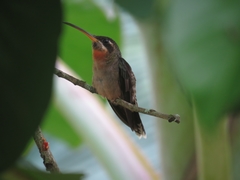

Band-tailed Barbthroat

Band-tailed Barbthroat

Threnetes ruckeri

Silhouette: Ferran Sayol · PhyloPic

LCLeast ConcernNTVUENCR
Daily sighting probability <5% · Rare
at San Lorenzo Protected Forest

In 3 days ~10% in a week ~20%

5 Verified sightings at San Lorenzo Protected Forest From 2019 to 2026
3,037 In all 21 parks
May Best month
☀️ Diurnal When it's spotted

About the Band-tailed Barbthroat

The band-tailed barbthroat (Threnetes ruckeri) is a medium-sized hummingbird that is found from southeastern Guatemala and Belize to western Ecuador and western Venezuela. The band-tailed barbthroat has the three subspecies listed. A fourth proposed subspecies, T. r. darienensis of the Panama-Colombia border area, shares the characteristics of all three recognized subspecies. The band-tailed barbthroat and the other two members of its genus pale-tailed barbthroat (T. lecurus) and sooty barbthroat (T. niger) form a superspecies.

The band-tailed barbthroat is 10 to 11 cm (3.9 to 4.3 in) long. Males weigh 5.5 to 7 g (0.19 to 0.25 oz) and females 5 to 7 g (0.18 to 0.25 oz).The adult male of the nominate subspecies has bronze-green upperparts, a dark ear patch and chin, and a dusky malar stripe. The tail is dark with white bases and tips to the feathers that create a black band near the end. The throat is ochraceous and the underparts are otherwise gray with some green feathers. It has a nearly straight bill. As with other hermit hummingbirds, the sexes are similar; the female's bill is somewhat more decurved than the male's and the plumage... Wikipedia →

Sounds

Song0:48

Costa Rica · 2024

© Paul Driver · XC954849 · CC BY-NC-SA 4.0

Flight call0:18

Ecuador · 1995

© Patricio Mena Valenzuela · XC275251 · CC BY-NC-SA 4.0

?0:47

Colombia · 2008

© Herman van Oosten · XC18160 · CC BY-NC-ND 2.5

Global Distribution

Parks Where Found

# Park Country Daily sighting probability
1 Piedras Blancas National Park 🇨🇷 Costa Rica
~30%
2 Corcovado National Park 🇨🇷 Costa Rica
~10%
3 Bastimentos Island National Marine Park 🇵🇦 Panama
~10%
4 Gandoca-Manzanillo Wildlife Refuge 🇨🇷 Costa Rica
~10%
5 Darién National Park 🇵🇦 Panama
<5%
6 Carara National Park 🇨🇷 Costa Rica
<5%
7 La Amistad International Park (Panama) 🇵🇦 Panama
<5%
8 Cusuco National Park 🇭🇳 Honduras
<5%
9 Manuel Antonio National Park 🇨🇷 Costa Rica
<5%
10 Tenorio Volcano National Park 🇨🇷 Costa Rica
<5%
11 San Lorenzo Protected Forest 🇵🇦 Panama
<5%
12 Braulio Carrillo National Park 🇨🇷 Costa Rica
<5%
13 Tortuguero National Park 🇨🇷 Costa Rica
<5%
14 Cahuita National Park 🇨🇷 Costa Rica
<5%
15 Soberanía National Park 🇵🇦 Panama
<5%
16 Marino Ballena National Park 🇨🇷 Costa Rica
<5%
17 Cockscomb Basin Wildlife Sanctuary 🇧🇿 Belize
<5%
18 Pico Bonito National Park 🇭🇳 Honduras
<5%
19 Arenal Volcano National Park 🇨🇷 Costa Rica
<5%
20 Farallones de Cali National Natural Park 🇨🇴 Colombia
<5%
21 Tapantí-Macizo de la Muerte National Park 🇨🇷 Costa Rica
<5%

Before you go

What are the chances of seeing a Band-tailed Barbthroat in San Lorenzo Protected Forest?

Rare

Under 5% of wildlife watchers report a Band-tailed Barbthroat sighting in San Lorenzo Protected Forest on a given day, based on 5 verified sightings from GBIF citizen-science data from 2019 to 2026. It is the 244th most-seen of the 249 birds we can rate there. Over three days the chance rises to about 10%, and over a week to about 20%, if each day is a fresh chance.

When is the best time to see a Band-tailed Barbthroat in San Lorenzo Protected Forest?

May and October

In those months about 10% of wildlife watchers report a Band-tailed Barbthroat in San Lorenzo Protected Forest on a given day, against under 5% in June–September and November–April, the lowest months.

What time of day is best to see a Band-tailed Barbthroat?

Between 7 and 10 am

Across all the parks we cover, that three-hour window holds the most Band-tailed Barbthroat sightings with a recorded time, and about 8 in 10 of them come between 6 am and 6 pm: it is a daytime animal.

Where does the Band-tailed Barbthroat sighting chance come from?

GBIF citizen-science records

It is estimated from how often the Band-tailed Barbthroat is recorded against all the birds logged in San Lorenzo Protected Forest (5 verified sightings from 2019 to 2026), calibrated against known sighting rates. Figures are rounded to the nearest 10% because citizen-science data supports honest approximations, not decimals, and months with records from fewer than five people show "—". How it works.

← Back to San Lorenzo Protected Forest