
Inca Dove

Inca Dove

Columbina inca

Silhouette: Sheatherius · PhyloPic

LCLeast ConcernNTVUENCR
Daily sighting probability ~50% · Likely
at Santa Rosa National Park

In 3 days ~80% in a week >90%

364 Verified sightings at Santa Rosa National Park From 2019 to 2026
10,046 In all 28 parks
April Best month
☀️ Diurnal When it's spotted

About the Inca Dove

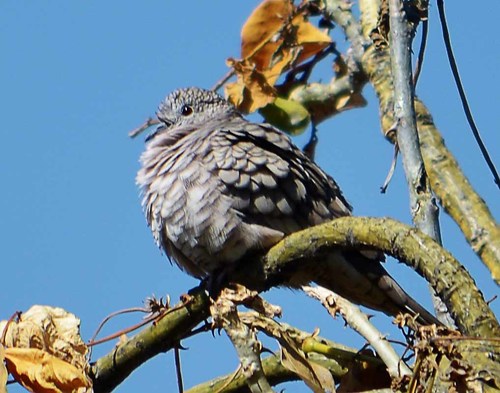
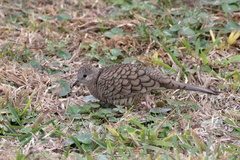
The Inca dove or Mexican dove (Columbina inca) is a small New World dove. The species was first described by French surgeon and naturalist René Lesson in 1847. It reaches a length of 16.5–23 cm (6.5–9.1 in) and weighs 30–58 g (1.1–2.0 oz). The Inca dove has an average wingspan of 28.5 cm and a max wingspan of 32 cm. It is a slender species, with a gray-brown body covered in feathers that resemble a scaled pattern. The tail is long and square and edged with white feathers that may flare out in flight. The underwings are reddish, like other ground doves, and upon takeoff, the wings produce a distinctive, quiet rattling noise.

The Inca dove ranges from Costa Rica in the south to the American Southwest in the north and is often common to abundant in suitable habitat. Its range has been expanding northward and southward the past few decades. Despite being named after the Inca Empire, this species does not occur in any of the lands that once constituted that empire. Inca doves are expanding their range in the north and south. This terrestrial species forms flocks in deserts, scrublands and cultivated areas and may also be found in urban settings where they... Wikipedia →

Sounds

Song0:24

United States · 2025

© David Tattersley · XC1000179 · CC BY-NC-SA 4.0

Call0:42

United States · 2023

© Richard E. Webster · XC940509 · CC BY-NC-SA 4.0

Song0:14

Mexico · 2021

© Manuel Grosselet · XC623956 · CC BY-NC-SA 4.0

Global Distribution

Parks Where Found

# Park Country Daily sighting probability
1 Palo Verde National Park 🇨🇷 Costa Rica
~60%
2 Santa Rosa National Park 🇨🇷 Costa Rica
~50%
3 Masaya Volcano National Park 🇳🇮 Nicaragua
~40%
4 El Triunfo 🇲🇽 Mexico
~40%
5 Las Baulas Marine National Park 🇨🇷 Costa Rica
~40%
6 Cañón del Sumidero National Park 🇲🇽 Mexico
~40%
7 Rincón de la Vieja National Park 🇨🇷 Costa Rica
~40%
8 Celaque National Park 🇭🇳 Honduras
~30%
9 Manuel Antonio National Park 🇨🇷 Costa Rica
~30%
10 Carara National Park 🇨🇷 Costa Rica
~30%
11 Cabo Blanco Absolute Nature Reserve 🇨🇷 Costa Rica
~30%
12 Pico Bonito National Park 🇭🇳 Honduras
~30%
13 Ostional Wildlife Refuge 🇨🇷 Costa Rica
~20%
14 Cumbres de Monterrey National Park 🇲🇽 Mexico
~20%
15 Cusuco National Park 🇭🇳 Honduras
~20%
16 Marino Ballena National Park 🇨🇷 Costa Rica
~20%
17 Lago de Yojoa 🇭🇳 Honduras
~10%
18 Cerro Azul Meámbar National Park 🇭🇳 Honduras
~10%
19 La Tigra National Park 🇭🇳 Honduras
~10%
20 Big Bend National Park 🇺🇸 United States
~10%
21 Saguaro National Park 🇺🇸 United States
~10%
22 Reserva de la Biosfera Mariposa Monarca 🇲🇽 Mexico
~10%
23 Monteverde Cloud Forest Reserve 🇨🇷 Costa Rica
<5%
24 Tenorio Volcano National Park 🇨🇷 Costa Rica
<5%
25 Piedras Blancas National Park 🇨🇷 Costa Rica
<5%
26 Tapantí-Macizo de la Muerte National Park 🇨🇷 Costa Rica
<5%
27 Braulio Carrillo National Park 🇨🇷 Costa Rica
<5%
28 Poás Volcano National Park 🇨🇷 Costa Rica
<5%

Cities Where Found

# City Country Daily sighting probability
1 León 🇲🇽 México
~90%
2 Guadalajara 🇲🇽 México
~90%
3 Torreón 🇲🇽 México
~80%
4 Mexico City 🇲🇽 México
~70%
5 Ciudad Juárez 🇲🇽 México
~70%
6 Monterrey 🇲🇽 México
~60%
7 Puebla 🇲🇽 México
~50%
8 San José 🇨🇷 Costa Rica
~40%
9 San Pedro Sula 🇭🇳 Honduras
~40%
10 Toluca 🇲🇽 México
~40%

Zoos & Centres Where Found

# Zoo / Centre Country
1 Arizona-Sonora Desert Museum 🇺🇸 United States In captivity
2 National Aviary 🇺🇸 United States In captivity

Before you go

What are the chances of seeing an Inca Dove in Santa Rosa National Park?

Likely

About 50% of wildlife watchers report an Inca Dove sighting in Santa Rosa National Park on a given day, based on 364 verified sightings from GBIF citizen-science data from 2019 to 2026. It is the 14th most-seen of the 233 birds we can rate there. Over three days the chance rises to about 80%, and over a week to over 90%, if each day is a fresh chance.

When is the best time to see an Inca Dove in Santa Rosa National Park?

April, October and December

In those months about 60% of wildlife watchers report an Inca Dove in Santa Rosa National Park on a given day, against about 20% in June, the lowest month.

What time of day is best to see an Inca Dove?

Between 8 and 11 am

Across all the parks we cover, that three-hour window holds the most Inca Dove sightings with a recorded time, and about 9 in 10 of them come between 6 am and 6 pm: it is a daytime animal.

Is Santa Rosa National Park the best place to see an Inca Dove?

2nd of 28

Of the 28 parks where we can rate Inca Dove sightings, Santa Rosa National Park ranks 2nd at about 50%. The best odds are in Palo Verde National Park (Costa Rica, about 60%). All parks ranked.

Where does the Inca Dove sighting chance come from?

GBIF citizen-science records

It is estimated from how often the Inca Dove is recorded against all the birds logged in Santa Rosa National Park (364 verified sightings from 2019 to 2026), calibrated against known sighting rates. Figures are rounded to the nearest 10% because citizen-science data supports honest approximations, not decimals, and months with records from fewer than five people show "—". How it works.

← Back to Santa Rosa National Park