


Completed

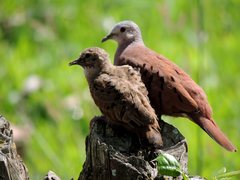



Ruddy Ground-Dove
Columbina talpacoti
Silhouette: Sheatherius · PhyloPic
- KingdomAnimalia (Animals)
- PhylumChordata (Chordates)
- ClassAves (Birds)
- OrderColumbiformes (Pigeons and Doves)
- FamilyColumbidae (Pigeons and Doves)
- GenusColumbina (Small Ground Doves)
- SpeciesColumbina talpacoti (Ruddy Ground-Dove)
In 3 days ~10% in a week ~20%
25 Verified sightings at Santa Rosa National Park From 2019 to 2026
32,672 In all 74 parks
August Best month
☀️ Diurnal When it's spotted
About the Ruddy Ground-Dove
The ruddy ground dove (Columbina talpacoti) is a small New World tropical dove. It is a resident breeder from Mexico south to Brazil, Peru and Paraguay, and northern Argentina, and on Trinidad and Tobago. Individual birds can sometimes be seen in the southwestern USA, from southern Texas to southernmost California, primarily during winter.
The ruddy ground dove is very common in scrub and other open country, including cultivated land and urban centers, where it can be seen feeding on grain alongside feral pigeons. It builds a solid but sparsely lined cup-shaped stick nest in a tree and lays two white eggs. Incubation is 12–13 days with another 12–14 days to fledging. There may be a second or third brood. Chick mortality through predation and falls from the nest is high.
Its flight is fast and direct, with the regular beats and occasional sharp flick of the wings which are characteristic of pigeons in general. Ruddy ground doves are small short-tailed pigeons, 17 cm (6.7 in) long with a weight normally about 47 g (1.7 oz). Adult males have a pale grey head and neck, and rich rufous upperparts, black-spotted on the wing coverts. The underparts are paler brown, the tail is edged black, and the underwings are cinnamon and black. The female is grey-brown rather than rufous, and has less contrast between head and body than the male.
Ruddy ground doves feed mainly on seeds, but also sometimes on snails and small insects. Their call is a soft cooing cur-WOO.This species can be quite approachable. Males frequently threaten each other by jumping and raising a wing, and brief confrontations may ensue. Wikipedia →
Recent sightings of Ruddy Ground-Dove in Santa Rosa National Park
LIVEiNaturalistGlobal Distribution
Parks Where Found
Cities Where Found
| # | City | Country | Daily sighting probability |
|---|---|---|---|
| 1 | Salvador | 🇧🇷 Brazil | |
| 2 | Cali | 🇨🇴 Colombia | |
| 3 | João Pessoa | 🇧🇷 Brazil | |
| 4 | Medellín | 🇨🇴 Colombia | |
| 5 | Rio de Janeiro | 🇧🇷 Brazil | |
| 6 | Fortaleza | 🇧🇷 Brazil | |
| 7 | Belo Horizonte | 🇧🇷 Brazil | |
| 8 | Goiânia | 🇧🇷 Brazil | |
| 9 | Vitória | 🇧🇷 Brazil | |
| 10 | San Salvador | 🇸🇻 El Salvador |
Zoos & Centres Where Found
| # | Zoo / Centre | Country | |
|---|---|---|---|
| 1 | Parque das Aves | 🇧🇷 Brazil | |
| 2 | Bronx Zoo | 🇺🇸 United States | |
| 3 | World of Birds Wildlife Sanctuary and Monkey Park | 🇿🇦 South Africa | |
| 4 | Castellar Zoo | 🇪🇸 Spain |
Closest Relatives at Santa Rosa National Park





Before you go
What are the chances of seeing a Ruddy Ground-Dove in Santa Rosa National Park?
Rare
Under 5% of wildlife watchers report a Ruddy Ground-Dove sighting in Santa Rosa National Park on a given day, based on 25 verified sightings from GBIF citizen-science data from 2019 to 2026. It is the 148th most-seen of the 233 birds we can rate there. Over three days the chance rises to about 10%, and over a week to about 20%, if each day is a fresh chance.
When is the best time to see a Ruddy Ground-Dove in Santa Rosa National Park?
August
In that month about 20% of wildlife watchers report a Ruddy Ground-Dove in Santa Rosa National Park on a given day, against under 5% in February–June and September–November, the lowest months. That is one of Santa Rosa National Park's wettest months, with about 270 mm of rain against almost none in February.
What time of day is best to see a Ruddy Ground-Dove?
Between 1 and 4 pm
Across all the parks we cover, that three-hour window holds the most Ruddy Ground-Dove sightings with a recorded time, and about 9 in 10 of them come between 6 am and 6 pm: it is a daytime animal.
Is Santa Rosa National Park the best place to see a Ruddy Ground-Dove?
60th of 74
Of the 74 parks where we can rate Ruddy Ground-Dove sightings, Santa Rosa National Park ranks 60th at under 5%. The best odds are in Tijuca National Park (Brazil, about 70%), Masaya Volcano National Park (Nicaragua, about 70%) and Chapada dos Guimarães National Park (Brazil, about 60%). All parks ranked.
Which relatives of the Ruddy Ground-Dove live in Santa Rosa National Park?
Same genus: Columbina
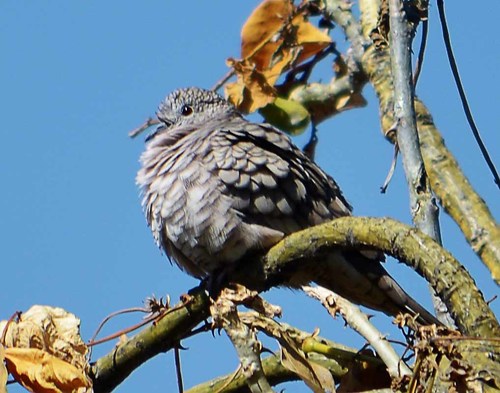
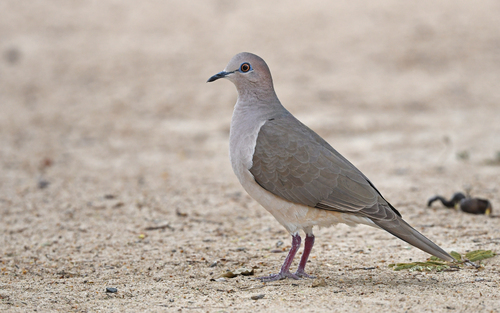
The closest relatives of the Ruddy Ground-Dove that you can see in Santa Rosa National Park (genus Columbina, Small Ground Doves) are Inca Dove (about 50%) and Common Ground-Dove (about 20%), with each one's daily chance of a sighting.
Where does the Ruddy Ground-Dove sighting chance come from?
GBIF citizen-science records
It is estimated from how often the Ruddy Ground-Dove is recorded against all the birds logged in Santa Rosa National Park (25 verified sightings from 2019 to 2026), calibrated against known sighting rates. Figures are rounded to the nearest 10% because citizen-science data supports honest approximations, not decimals, and months with records from fewer than five people show "—". How it works.
