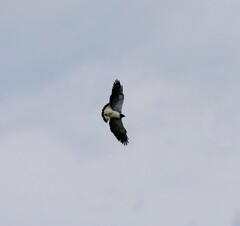
White-tailed Hawk

White-tailed Hawk

Buteo albicaudatus

Silhouette: Lauren Anderson · PhyloPic

LCLeast ConcernNTVUENCR
Daily sighting probability <5% · Rare
at Santa Rosa National Park

In 3 days <5% in a week ~10%

8 Verified sightings at Santa Rosa National Park From 2019 to 2026
1,673 In all 22 parks
January Best month
☀️ Diurnal When it's spotted

About the White-tailed Hawk

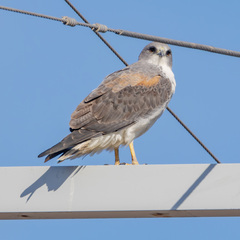
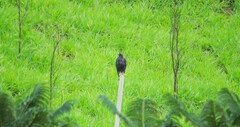
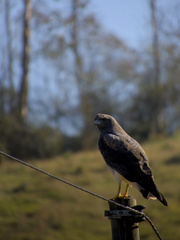
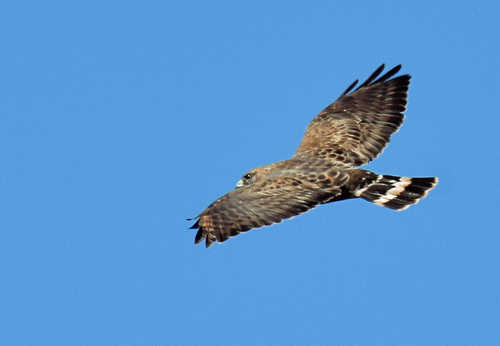
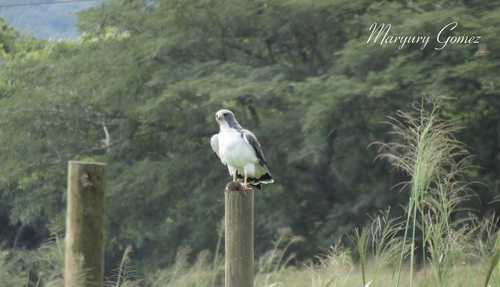
The white-tailed hawk (Geranoaetus albicaudatus) is a large bird of prey species found in tropical and subtropical environments of the Americas. The white-tailed hawk is found from the coastal of Texas and the Rio Grande Valley south to central Argentina. Its range also includes many Caribbean islands in the Lesser Antilles and Trinidad and Tobago. It prefers open or semi-open regions up to 2,000 ft (c. 600 m) ASL, with few trees to obstruct flight. It is not a migratory bird, though some populations may make regional movements when food is scarce. It commonly perches on bushes, trees, or telephone poles, stands on the ground, or engages in soar. Generally, it prefers arid habitats and rarely occurs in areas with heavy rainfall.

Though it may disappear from unsuitable locations following habitat fragmentation, it has a wide range and is not considered to be a globally threatened species by the IUCN. The white-tailed hawk is a large, stocky hawk. It is similar in size to Swainson's (Buteo swainsoni) and red-tailed hawks (Buteo jamaicensis), with mean measurements slightly larger than the former and slightly smaller than the latter. It... Wikipedia →

Sounds

Alarm call0:21

Brazil · 2025

© Robson Silva e Silva · XC1059975 · CC BY-NC-SA 4.0

Recording0:34

Argentina · 2024

© Sabrina Andrea Rendon Anaya · XC928320 · CC BY-NC-SA 4.0

Call0:38

Mexico · 2022

© Manuel Grosselet · XC696178 · CC BY-NC-SA 4.0

Global Distribution

Parks Where Found

# Park Country Daily sighting probability
1 Emas National Park 🇧🇷 Brazil
~60%
2 Serra da Canastra National Park 🇧🇷 Brazil
~30%
3 Padre Island National Seashore 🇺🇸 United States
~30%
4 Parque Estadual Encontro das Águas 🇧🇷 Brazil
~10%
5 Itatiaia National Park 🇧🇷 Brazil
~10%
6 Serra dos Órgãos National Park 🇧🇷 Brazil
~10%
7 Chapada Diamantina National Park 🇧🇷 Brazil
~10%
8 Iberá National Park 🇦🇷 Argentina
<5%
9 Chapada dos Guimarães National Park 🇧🇷 Brazil
<5%
10 El Impenetrable National Park 🇦🇷 Argentina
<5%
11 Sierra de la Macarena National Park 🇨🇴 Colombia
<5%
12 Los Nevados National Natural Park 🇨🇴 Colombia
<5%
13 Henri Pittier National Park 🇻🇪 Venezuela
<5%
14 Santa Rosa National Park 🇨🇷 Costa Rica
<5%
15 Palo Verde National Park 🇨🇷 Costa Rica
<5%
16 Sian Ka'an Biosphere Reserve 🇲🇽 Mexico
<5%
17 Ría Lagartos Biosphere Reserve 🇲🇽 Mexico
<5%
18 Tijuca National Park 🇧🇷 Brazil
<5%
19 Volcán Barú National Park 🇵🇦 Panama
<5%
20 Farallones de Cali National Natural Park 🇨🇴 Colombia
<5%
21 Iguaçu National Park 🇧🇷 Brazil
<5%
22 La Amistad International Park (Panama) 🇵🇦 Panama
<5%

Cities Where Found

# City Country Daily sighting probability
1 Vitória 🇧🇷 Brazil
~10%
2 San Pedro Sula 🇭🇳 Honduras
<5%
3 Belo Horizonte 🇧🇷 Brazil
<5%
4 São Paulo 🇧🇷 Brazil
<5%
5 Niterói 🇧🇷 Brazil
<5%
6 Monterrey 🇲🇽 México
<5%
7 Caracas 🇻🇪 Venezuela
<5%
8 Rio de Janeiro 🇧🇷 Brazil
<5%
9 Guadalajara 🇲🇽 México
<5%
10 Bogota 🇨🇴 Colombia
<5%

Zoos & Centres Where Found

# Zoo / Centre Country
1 Jardín Botánico y Zoológico de Asunción 🇵🇾 Paraguay In captivity
2 Zoológico de Brasília 🇧🇷 Brazil In captivity
3 São Paulo Zoo 🇧🇷 Brazil In captivity
4 Joya Grande 🇭🇳 Honduras In captivity
5 Parque Zoobotânico Arruda Câmara (BICA) 🇧🇷 Brazil In captivity
6 Bioparque Municipal Vesty Pakos 🇧🇴 Bolivia In captivity
7 Simba Safari 🇧🇷 Brazil In captivity
8 Rio de Janeiro Zoological Garden 🇧🇷 Brazil In captivity
9 Zoobotânico de São José do Rio Preto 🇧🇷 Brazil In captivity
10 Aviario Nacional de Colombia 🇨🇴 Colombia In captivity
11 Bioparque Los Ocarros 🇨🇴 Colombia In captivity
12 Mangal das Garças 🇧🇷 Brazil In captivity
13 Ecozoológico San Martín 🇪🇨 Ecuador In captivity
14 Agroflori Parque de las Aves 🇧🇴 Bolivia In captivity
15 Parque dos Falcões 🇧🇷 Brazil In captivity
16 Texas State Aquarium 🇺🇸 United States In captivity
17 Zoológico Miguél Álvarez del Toro 🇲🇽 Mexico In captivity

Before you go

What are the chances of seeing a White-tailed Hawk in Santa Rosa National Park?

Rare

Under 5% of wildlife watchers report a White-tailed Hawk sighting in Santa Rosa National Park on a given day, based on 8 verified sightings from GBIF citizen-science data from 2019 to 2026. It is the 198th most-seen of the 233 birds we can rate there. Over three days the chance rises to under 5%, and over a week to about 10%, if each day is a fresh chance.

When is the best time to see a White-tailed Hawk in Santa Rosa National Park?

January

In that month about 10% of wildlife watchers report a White-tailed Hawk in Santa Rosa National Park on a given day, against under 5% in February to December, the lowest months. That is one of Santa Rosa National Park's driest months, with about 5 mm of rain against 450 mm in October.

What time of day is best to see a White-tailed Hawk?

Between 8 and 11 am

Across all the parks we cover, that three-hour window holds the most White-tailed Hawk sightings with a recorded time, and about 9 in 10 of them come between 6 am and 6 pm: it is a daytime animal.

Which relatives of the White-tailed Hawk live in Santa Rosa National Park?

Same genus: Buteo

The closest relatives of the White-tailed Hawk that you can see in Santa Rosa National Park (genus Buteo, Buteos) are Gray-lined Hawk (about 10%) and Broad-winged Hawk (about 10%), with each one's daily chance of a sighting.

Where does the White-tailed Hawk sighting chance come from?

GBIF citizen-science records

It is estimated from how often the White-tailed Hawk is recorded against all the birds logged in Santa Rosa National Park (8 verified sightings from 2019 to 2026), calibrated against known sighting rates. Figures are rounded to the nearest 10% because citizen-science data supports honest approximations, not decimals, and months with records from fewer than five people show "—". How it works.
← Back to Santa Rosa National Park