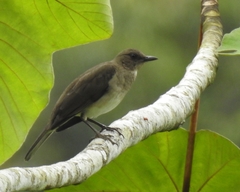

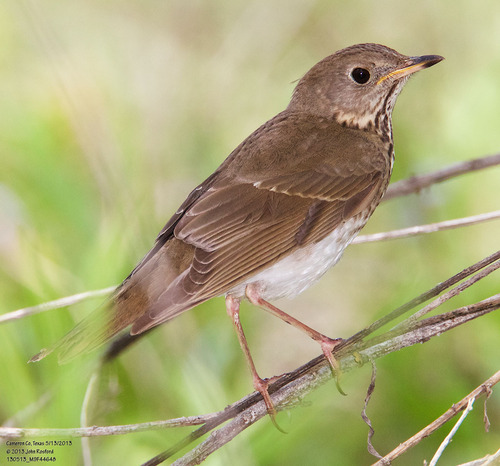
Black-billed Thrush

Black-billed Thrush

Turdus ignobilis

Silhouette: Sharon Wegner-Larsen · PhyloPic

LCLeast ConcernNTVUENCR
Daily sighting probability ~20% · Possible
at Sierra de la Macarena National Park

In 3 days ~40% in a week ~70%

169 Verified sightings at Sierra de la Macarena National Park From 2019 to 2026
5,655 In all 13 parks
August Best month
☀️ Diurnal When it's spotted

About the Black-billed Thrush

The black-billed thrush (Turdus ignobilis) is a species of bird in the family Turdidae. It is found in Bolivia, Brazil, Colombia, Ecuador, Peru, and Venezuela. The black-billed thrush was originally described in 1858 with its current binomial Turdus ignobilis. Its further taxonomy is unsettled.

Molecular phylogenetics studies published in the 2010s determined that arthuri and murinus should again be established as full species. Following those studies, the South American Classification Committee, the IOC, AviList, and the Clements taxonomy recognized them as the campina thrush and pantepui thrush respectively. With these moves the systems returned the black-billed thrush to its early twentieth century status with three subspecies.

As of late 2025 BirdLife International's Handbook of the Birds of the World (HBW) recognizes the campina thrush (arthuri) as a species. However... Wikipedia →

Sounds

Song1:08

Brazil · 2026

© JAYRSON ARAUJO DE OLIVEIRA · XC1186317 · CC BY-NC-SA 4.0

Call0:50

Colombia · 2022

© Joost van Bruggen · XC742378 · CC BY-NC-ND 4.0

Dawn song0:39

Bolivia · 2022

© Jacob Wijpkema · XC701496 · CC BY-NC-SA 4.0

Global Distribution

Parks Where Found

# Park Country Daily sighting probability
1 Farallones de Cali National Natural Park 🇨🇴 Colombia
~70%
2 Manu National Park 🇵🇪 Peru
~30%
3 Sierra de la Macarena National Park 🇨🇴 Colombia
~20%
4 Amacayacu National Natural Park 🇨🇴 Colombia
~20%
5 Yasuní National Park 🇪🇨 Ecuador
~10%
6 Podocarpus National Park 🇪🇨 Ecuador
~10%
7 Los Nevados National Natural Park 🇨🇴 Colombia
~10%
8 Tambopata National Reserve 🇵🇪 Peru
~10%
9 Anavilhanas National Park 🇧🇷 Brazil
~10%
10 Cuyabeno Wildlife Reserve 🇪🇨 Ecuador
<5%
11 Amboró National Park 🇧🇴 Bolivia
<5%
12 Chingaza National Natural Park 🇨🇴 Colombia
<5%
13 Chapada dos Guimarães National Park 🇧🇷 Brazil
<5%

Cities Where Found

# City Country Daily sighting probability
1 Medellín 🇨🇴 Colombia
~70%
2 Cali 🇨🇴 Colombia
~60%
3 Manaus 🇧🇷 Brazil
~30%
4 Santa Cruz de la Sierra 🇧🇴 Bolivia
~20%

Before you go

What are the chances of seeing a Black-billed Thrush in Sierra de la Macarena National Park?

Possible

About 20% of wildlife watchers report a Black-billed Thrush sighting in Sierra de la Macarena National Park on a given day, based on 169 verified sightings from GBIF citizen-science data from 2019 to 2026. It is the 61st most-seen of the 418 birds we can rate there. Over three days the chance rises to about 40%, and over a week to about 70%, if each day is a fresh chance.

When is the best time to see a Black-billed Thrush in Sierra de la Macarena National Park?

May and August

In those months about 30% of wildlife watchers report a Black-billed Thrush in Sierra de la Macarena National Park on a given day, against about 10% in January, April, July and September–November, the lowest months.

What time of day is best to see a Black-billed Thrush?

Between 7 and 10 am

Across all the parks we cover, that three-hour window holds the most Black-billed Thrush sightings with a recorded time, and about 9 in 10 of them come between 6 am and 6 pm: it is a daytime animal.

Where does the Black-billed Thrush sighting chance come from?

GBIF citizen-science records

It is estimated from how often the Black-billed Thrush is recorded against all the birds logged in Sierra de la Macarena National Park (169 verified sightings from 2019 to 2026), calibrated against known sighting rates. Figures are rounded to the nearest 10% because citizen-science data supports honest approximations, not decimals, and months with records from fewer than five people show "—". How it works.

← Back to Sierra de la Macarena National Park